Why Is The Mars Helicopter So Important For Future Space Exploration? — Reading Comprehension
Rate this
Premium Resource
Present
Present in classroom. No work saved
Assign
Classroom with student accounts, Track progress
Quick Play
No student accounts, assign with a link
Grades
6
PRINT+DIGITAL RESOURCE
This learning resource is available in interactive and printable formats. The interactive worksheet can be played online and assigned to students. The Printable PDF version can be downloaded and printed for completion by hand.
This engaging passage explores the groundbreaking role of the Ingenuity Mars Helicopter in future space exploration. Students will learn about the challenges of flying on Mars, how Ingenuity solved these problems, and its impact on planning future missions to the Red Planet. The passage highlights problem-solving and innovation, aligning with NGSS standard 3-5-ETS1-2, which encourages generating and comparing multiple solutions to a problem. Audio integration enhances the learning experience, making complex scientific concepts accessible and enjoyable for students.
CONTENT PREVIEW
Expand content preview
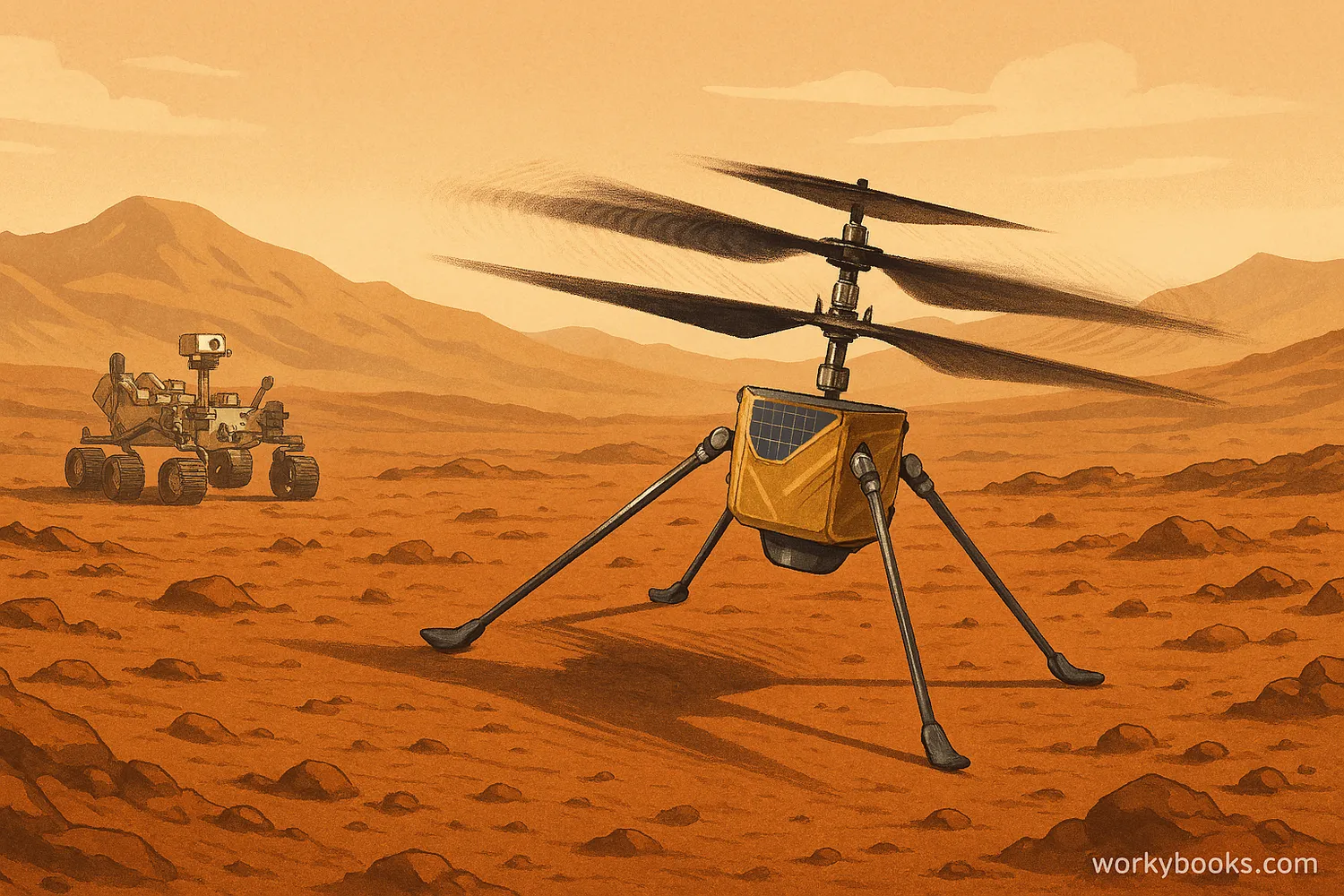
Ingenuity flies above Mars, scouting terrain for Perseverance in thin atmosphere.
Meet Ingenuity: The First Mars Helicopter
In 2021, NASA made history by flying the Ingenuity helicopter on Mars. Ingenuity is the first helicopter ever to fly on another planet. This small, lightweight drone joined the Perseverance rover on Mars to test if powered flight could work far from Earth.
Why Is Flying on Mars So Hard?
Flying a helicopter on Mars is much harder than flying one on Earth. The air on Mars is about 100 times thinner than Earth's air. This means there is much less air for the blades to push against. To fly, Ingenuity’s rotor blades had to spin much faster than a helicopter’s blades on Earth—about 2,400 times a minute!
What Did Ingenuity Prove?
Ingenuity showed that powered flight is possible on another planet. That’s a huge achievement! It’s like the Wright Brothers’ first airplane flight on Earth—a small flight that changed history. Now, scientists know they can build flying machines for other planets too.
How Will Mars Helicopters Help the Future?
Mars helicopters can do things that rovers can’t. They can fly over dangerous ground, explore cliffs and canyons, and take pictures from the air. Ingenuity helped the Perseverance rover by scouting ahead and taking photos of places the rover might travel. Helicopters can reach places with rocks or steep drops that wheels can’t cross. They can also travel faster and cover more ground in a short time.
Engineering and Innovation
Ingenuity is full of smart technology. It uses solar panels to charge its batteries. It survived freezing Mars nights, where temperatures drop lower than -70°C! It flies by itself using computer programs, because signals from Earth take too long to reach Mars. Ingenuity’s success comes from problem-solving and creative engineering.
Small Steps Lead to Big Discoveries
Ingenuity’s flight shows that even tiny inventions can open the door to amazing discoveries. Who knows what new things we’ll find when we explore with flying robots?
Interesting Fact: NASA named the helicopter 'Ingenuity' because it shows creative thinking and problem-solving—just like all great scientists and inventors!
What is Ingenuity?
A Mars helicopterA Mars roverA space rocketA computer program
Why must Ingenuity's blades spin fast?
Mars air is thinTo make loud noiseBecause it is heavyTo charge its battery
What powers Ingenuity?
Solar panelsGasolineWindNuclear power
How did Ingenuity help Perseverance?
By scouting aheadBy digging soilBy landing on the roverBy sending rocks
What challenge did Mars helicopters overcome?
Thin atmosphereHeavy rainCrowded skiesNo sunlight
Why is Ingenuity like the Wright Brothers’ plane?
Both were first flightsBoth flew on MarsBoth are roversBoth used solar power
Ingenuity can fly by itself. (True or False)
TrueFalse
What does 'innovation' mean?
A new ideaA weather reportA space rockA planet
Perfect For:
👩🏫 Teachers
• Reading comprehension practice
• Auto-graded assessments
• Literacy skill development
👨👩👧👦 Parents
• Reading practice at home
• Comprehension improvement
• Educational reading time
🏠 Homeschoolers
• Reading curriculum support
• Independent reading practice
• Progress monitoring
Reading Features:
📖
Reading Passage
Engaging fiction or nonfiction text
❓
Comprehension Quiz
Auto-graded questions
📊
Instant Feedback
Immediate results and scoring
📄
Printable Version
Download for offline reading
🔊
Read Aloud
Voice-over with word highlighting
Reviews & Ratings
No reviews yet. Be the first to share your experience!
Related Content
Earth: Our Home in Space
This engaging Grade 4-5 science passage, aligned to NGSS, introduces students to Earth's special place in the solar syst...
Tools and Technology in Earth Science
This middle school science reading passage explores the wide range of tools and technologies used in Earth science, from...
MS-ESS2-2MS-ESS3-2MS-ETS1-1MS-PS4-3
Earth's Place in the Universe
This reading passage explains Earth's place in the universe, supporting NGSS 1-ESS1-1. It describes how Earth is one of ...
1-ESS1-1
Scientific Inquiry in Earth Science
This passage explores scientific inquiry in Earth science for grades 6-8, aligned with NGSS standards MS-ESS1-4, MS-ESS2...
MS-ESS1-4MS-ESS2-1MS-ESS3-5SEP
What Is Space Weather and How Does It Affect the Earth?
This NGSS-aligned science passage for middle school explains what space weather is and how it affects Earth. Students le...
MS-ESS2-2
Escape Velocity and Space Travel
This middle school science passage introduces students to the concept of escape velocity—the minimum speed required to b...
MS-ESS1-2MS-PS2-4
Space Stations
This informational science reading passage for grades 6-8 explores the complex systems and technology behind space stati...
MS-ESS1-3MS-ETS1-1
What Is Earth Science?
This engaging middle school science passage introduces students to the field of Earth science, aligning with NGSS standa...
MS-ESS1MS-ESS2MS-ESS3SEP
The Space Garden
This innovative passage combines plant science with space exploration, aligning with NGSS standards for life sciences an...
RL.3.1RL.2.1RL.4.9
Measuring Distances in Space
This middle school science passage explores how astronomers measure the vast distances in space, aligning with NGSS stan...
MS-ESS1-3
Earth: Our Home Planet
This comprehensive science passage for grades 6-8 explores Earth’s unique characteristics and the interconnected systems...
MS-ESS1-2
Meteorite Impacts on Earth
This engaging science reading passage for Grades 4-5 explores meteorite impacts on Earth, aligning with NGSS standards. ...
Exploring Space: Rockets and Spacecraft
Space exploration has been one of humanity's greatest achievements, made possible by rockets and spacecraft. Rockets act...
RI.4.4RI.4.2
Earth's Rotation
This middle school science passage, aligned with NGSS standard MS-ESS1-1, focuses on Earth's rotation—how Earth spins on...
MS-ESS1-1
Facts About Earth
This engaging science reading passage introduces Grade 4 and 5 students to Earth, our home planet. Aligned with NGSS sta...
International Space Station
Discover the wonders of the International Space Station with this informative coloring page showcasing the orbiting outpost where astronauts live and work in space. As children color the complex modul...
Earth's Moon Facts
This engaging science passage, 'The Moon: Earth's Companion,' is designed for Grade 4-5 students and aligns with NGSS ge...
The Space Needle
Students read a passage about the history and features of Seattle's Space Needle, then answer comprehension questions to...
RI.4.2
Earth's Seasons
This comprehensive reading passage for grades 6-8 explains why Earth has seasons, revealing the scientific mechanisms be...
MS-ESS1-1
Venus: Earth's Twin?
This comprehensive science passage for grades 6-8 examines Venus—often called Earth's twin—by exploring its similarities...