How Brain Processes Senses — Reading Comprehension
Rate this|
1
Premium Resource
Present
Present in classroom. No work saved
Assign
Classroom with student accounts, Track progress
Quick Play
No student accounts, assign with a link
Grades
3
4
5
Standards
NGSS 4-LS1-2
PRINT+DIGITAL RESOURCE
This learning resource is available in interactive and printable formats. The interactive worksheet can be played online and assigned to students. The Printable PDF version can be downloaded and printed for completion by hand.
This 250-word reading passage introduces fourth-grade students to the sense-process-respond model aligned with NGSS standard 4-LS1-2. Students learn how sense receptors collect information from different inputs like light, sound, and touch, and how this information travels along nerve cells to the brain. The passage explains how the brain processes sensory information and directs the body to respond appropriately. Through clear, real-world examples like catching a ball and touching a hot pan, students build foundational understanding of the connection between senses, nerves, and brain responses. The passage uses age-appropriate language and includes bolded key vocabulary terms with immediate definitions. Audio integration supports diverse learners by providing text-to-speech functionality. Supplementary activities include multiple-choice questions testing recall and comprehension, writing prompts requiring students to explain and apply concepts, and graphic organizers that help students visualize the sequence from sense to response. This comprehensive resource helps students understand how their bodies collect, transmit, and process sensory information to interact safely and effectively with their environment.
CONTENT PREVIEW
Expand content preview
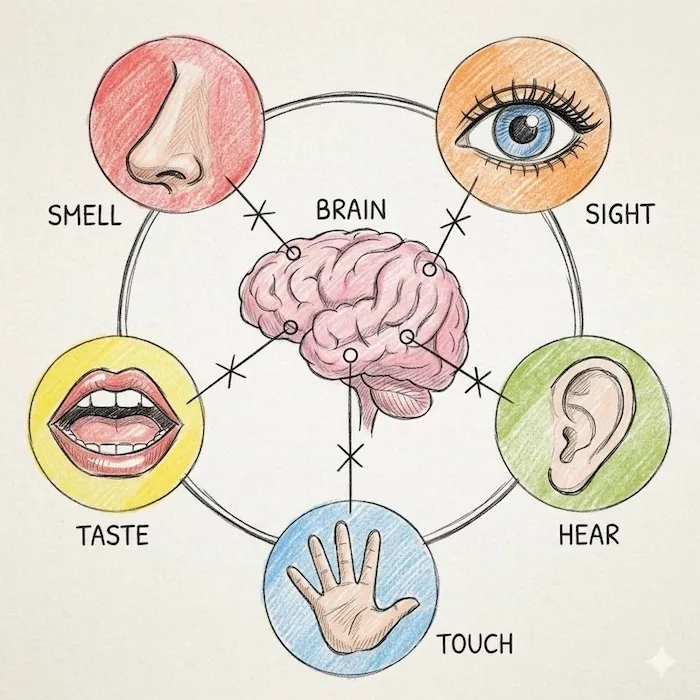
Your body has special parts called sense receptors that collect information from the world around you. Sense receptors are like tiny detectors in your eyes, ears, nose, tongue, and skin. Each type of sense receptor responds to different things. Your eyes respond to light, your ears respond to sound, your nose responds to smells, your tongue responds to tastes, and your skin responds to touch, temperature, and pain.
When a sense receptor detects something, it creates a signal. This signal travels along special pathways called nerves. Nerves are like wires that carry messages through your body. The nerves carry the signal from your sense receptors to your brain. The brain is your body's control center that receives and understands all the information from your senses.
Your brain processes the information, which means it figures out what the signal means and decides what to do. Processing is like solving a puzzle—your brain puts the pieces together to understand what is happening. Then your brain sends new signals back through nerves to tell your body how to respond.
Here is an example: You see a ball flying toward you. Light from the ball enters your eyes (sense receptors). Your eyes send signals through nerves to your brain. Your brain processes the information and recognizes the ball is coming. Your brain then sends signals to your arm muscles to reach out and catch the ball. Another example: You touch a hot pan. Sense receptors in your skin detect heat and pain. Nerves carry this signal to your brain. Your brain processes the danger and immediately sends signals to your hand muscles to pull away quickly. This sense-process-respond system happens very fast and keeps you safe every day.
Interesting Fact: Your brain can process information from your senses in less than one second! Some responses, like pulling your hand away from something hot, happen so fast that your brain responds before you even feel the pain.
What are sense receptors?
Tiny detectors in your bodyWires that carry messagesMuscles in your armsParts of your stomach
Where are nerves located in your body?
Only in your brainOnly in your eyesThroughout your body carrying messagesOnly in your skin
What does your brain do with signals?
Stores them foreverProcesses them and decides responsesSends them to your stomachIgnores them completely
Why does your hand pull away quickly?
Your brain processes danger and respondsYour hand acts without the brainYour eyes tell your hand directlyYour muscles work alone
How does catching a ball demonstrate senses?
Eyes see, brain processes, muscles respondOnly your hands are involvedYour ears hear the ballYour brain is not needed
What happens after sense receptors detect something?
Nothing happens at allThey create a signal sent to brainThey tell muscles what to doThey stop working immediately
Nerves are like wires in your body.
TrueFalse
What does 'processes' mean in the passage?
Ignoring information completelyFiguring out what information meansStoring information for laterDeleting information from memory
Perfect For:
👩🏫 Teachers
• Reading comprehension practice
• Auto-graded assessments
• Literacy skill development
👨👩👧👦 Parents
• Reading practice at home
• Comprehension improvement
• Educational reading time
🏠 Homeschoolers
• Reading curriculum support
• Independent reading practice
• Progress monitoring
Reading Features:
📖
Reading Passage
Engaging fiction or nonfiction text
❓
Comprehension Quiz
Auto-graded questions
📊
Instant Feedback
Immediate results and scoring
📄
Printable Version
Download for offline reading
🔊
Read Aloud
Voice-over with word highlighting
Reviews & Ratings
No reviews yet. Be the first to share your experience!
Related Content
What Is Spinal Cord
This engaging Grade 4 science reading passage introduces students to the spinal cord and its critical role in the human ...
NGSS 4-LS1-2LS1.ALS1.D
How We Smell, Taste, and Feel
This audio-integrated reading passage introduces fourth-grade students to the fundamental concept of how sensory organs ...
NGSS 4-LS1-2LS1.D
How the Body Responds
This 250-word reading passage introduces fourth-grade students to how the body responds to sensory information, aligned ...
NGSS 4-LS1-2LS1.D
How Animals Use Their Senses
This Grade 4 science reading passage introduces students to how animals use their senses to receive information about th...
NGSS 4-LS1-2
How Animals Use Smell and Touch
This engaging 250-word reading passage introduces fourth-grade students to how animals use smell and touch as critical s...
NGSS 4-LS1-2LS1.D
How Animals Respond to Danger
This engaging 250-word reading passage introduces fourth-grade students to the sense-process-respond chain in animals, a...
NGSS 4-LS1-2LS1.D
How Animals Learn from Experience
This engaging 250-word reading passage introduces fourth-grade students to the concept of animal learning and behavioral...
NGSS 4-LS1-2LS1.D
What Is Nervous System
This Grade 4 science reading passage introduces students to the nervous system as the body's communication network align...
NGSS 4-LS1-2LS1.ALS1.D
Brain as Control Center
This engaging 250-word reading passage teaches fourth-grade students about the brain as the body's control center, align...
NGSS 4-LS1-2LS1.ALS1.D
How Nerves Carry Messages
This engaging 250-word reading passage introduces fourth-grade students to the nervous system and how nerves carry messa...
NGSS 4-LS1-2LS1.ALS1.D
How Our Eyes and Ears Work
This engaging 250-word reading passage introduces fourth-grade students to the specialized functions of sense organs, sp...
NGSS 4-LS1-2DCI LS1.D
How We Store Memories
How We Store Memories is an engaging Grade 4 science reading passage aligned with NGSS standard 4-LS1-2 (LS1.D). This 25...