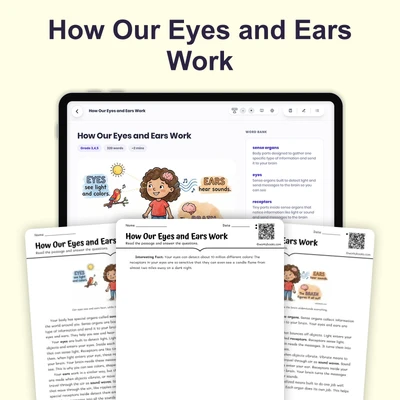
This learning resource is available in interactive and printable formats. The interactive worksheet can be played online and assigned to students. The Printable PDF version can be downloaded and printed for completion by hand.
This 250-word reading passage introduces fourth-grade students to how the body responds to sensory information, aligned with NGSS standard 4-LS1-2 and the Disciplinary Core Idea LS1.D. Students explore how the brain processes information from the senses and sends instructions throughout the body. The passage explains both fast, automatic responses like reflexes and slower, thoughtful responses like decision-making. Through relatable examples such as pulling a hand away from something hot or deciding what to eat for lunch, students build foundational understanding of the nervous system's role in coordinating body responses. The content includes audio integration for accessibility and engagement. Key vocabulary terms are bolded and defined in context, making complex concepts accessible to grade-level readers. Students learn to recognize their own body responses throughout the day, connecting science concepts to everyday experiences. The passage includes an interesting fact about reflex speed to spark curiosity. Accompanying activities include multiple-choice questions testing recall and comprehension, writing prompts requiring explanation and application, and graphic organizers for analyzing cause-and-effect relationships and sequencing processes. A simplified differentiated version ensures all learners can access the core science content, and Spanish translations support English language learners.
CONTENT PREVIEW
Expand content preview
When you hear a loud noise, you might jump or cover your ears. Image credit Andrea Piacquadio / Pexels.
Your body is always responding to the world around you. A response is how your body reacts to information from your senses. This happens because your brain is constantly receiving messages from your eyes, ears, skin, nose, and tongue. After the brain processes this information, it sends instructions back to different parts of your body to respond.
Some responses happen very quickly. These fast responses are called reflexes. A reflex is an automatic reaction that happens without you thinking about it. When you touch something hot, you pull your hand away instantly. When you hear a loud noise, you might jump or cover your ears. Your brain processes the danger signal and tells your body to move before you even realize what happened. Reflexes protect you from harm.
Other responses take more time because they involve thinking and making choices. These are called voluntary responses. When you decide what to eat for lunch, your brain thinks about different options. When you choose which path to take home from school, you consider different routes. Your brain processes information and helps you make a decision.
Throughout your day, your body makes hundreds of responses. Some are so fast you don't notice them. Others require careful thought. All of these responses help you interact safely and successfully with the world.
Interesting Fact: Your fastest reflexes can send signals through your body at speeds up to 250 miles per hour—that's faster than a race car!
What does the brain do with sensory information?
Ignores it completelyProcesses it and sends instructionsStores it for later useSends it to the heart
What is a reflex?
A slow, thoughtful decisionAn automatic, fast body reactionA type of sense organA part of the brain
Which example shows a voluntary response?
Pulling hand from hot stoveJumping at loud noiseDeciding what to eat for lunchBlinking when dust hits eye
Why do reflexes protect you from harm?
They happen very slowly and carefullyThey require lots of thinking firstThey move body before thinking about dangerThey only work during the day
What happens before the brain sends instructions?
The body responds automaticallyThe brain processes sensory informationThe muscles move on their ownThe senses stop working
Which requires more thinking and time?
Reflexes like jumping at loud soundsAutomatic reactions to hot objectsVoluntary responses like choosing a pathPulling hand away from danger
All body responses help you interact with world.
TrueFalse
What does 'voluntary' mean in the passage?
Happening automatically without thinkingInvolving thinking and making choicesMoving very quickly to stay safeProcessing information from the senses
Perfect For:
👩🏫 Teachers
• Reading comprehension practice
• Auto-graded assessments
• Literacy skill development
👨👩👧👦 Parents
• Reading practice at home
• Comprehension improvement
• Educational reading time
🏠 Homeschoolers
• Reading curriculum support
• Independent reading practice
• Progress monitoring
Reading Features:
📖
Reading Passage
Engaging fiction or nonfiction text
❓
Comprehension Quiz
Auto-graded questions
📊
Instant Feedback
Immediate results and scoring
📄
Printable Version
Download for offline reading
🔊
Read Aloud
Voice-over with word highlighting
Reviews & Ratings
No reviews yet. Be the first to share your experience!
Related Content
How Animals See Differently
This engaging 250-word reading passage introduces fourth-grade students to the fascinating world of animal vision and ey...
NGSS 4-LS1-1LS1.D
What Is Spinal Cord
This engaging Grade 4 science reading passage introduces students to the spinal cord and its critical role in the human ...
NGSS 4-LS1-2LS1.ALS1.D
How We Smell, Taste, and Feel
This audio-integrated reading passage introduces fourth-grade students to the fundamental concept of how sensory organs ...
NGSS 4-LS1-2LS1.D
How Animals Use Smell and Touch
This engaging 250-word reading passage introduces fourth-grade students to how animals use smell and touch as critical s...
NGSS 4-LS1-2LS1.D
How Animals Respond to Danger
This engaging 250-word reading passage introduces fourth-grade students to the sense-process-respond chain in animals, a...
NGSS 4-LS1-2LS1.D
How Animals Learn from Experience
This engaging 250-word reading passage introduces fourth-grade students to the concept of animal learning and behavioral...
NGSS 4-LS1-2LS1.D
What Is Nervous System
This Grade 4 science reading passage introduces students to the nervous system as the body's communication network align...
NGSS 4-LS1-2LS1.ALS1.D
Brain as Control Center
This engaging 250-word reading passage teaches fourth-grade students about the brain as the body's control center, align...
NGSS 4-LS1-2LS1.ALS1.D
How Nerves Carry Messages
This engaging 250-word reading passage introduces fourth-grade students to the nervous system and how nerves carry messa...
NGSS 4-LS1-2LS1.ALS1.D
How We Store Memories
How We Store Memories is an engaging Grade 4 science reading passage aligned with NGSS standard 4-LS1-2 (LS1.D). This 25...
NGSS 4-LS1-2LS1.D
How Animals Use Their Senses
This Grade 4 science reading passage introduces students to how animals use their senses to receive information about th...
NGSS 4-LS1-2
How Brain Processes Senses
This 250-word reading passage introduces fourth-grade students to the sense-process-respond model aligned with NGSS stan...
NGSS 4-LS1-2
How Our Eyes and Ears Work
This engaging 250-word reading passage introduces fourth-grade students to the specialized functions of sense organs, sp...