This learning resource is available in interactive and printable formats. The interactive worksheet can be played online and assigned to students. The Printable PDF version can be downloaded and printed for completion by hand.
This engaging 250-word reading passage introduces fourth-grade students to the nervous system and how nerves carry messages throughout the body. Aligned with NGSS standard 4-LS1-2, the passage explains that nerves are like tiny wires connecting the brain to every part of the body. Students learn how nerves send messages incredibly fast—faster than you can think—when you touch something hot or need to move a muscle. The passage uses age-appropriate language and real-world examples to help students understand this foundational concept about how the body receives and processes information. Audio-integrated features support diverse learners, while the simplified differentiated version ensures accessibility for all reading levels. The passage includes bold key vocabulary terms with immediate definitions, a relatable analogy comparing nerves to wires, and an interesting fact about nerve message speed. Supplementary activities include comprehension questions testing recall and application, writing prompts requiring explanation and connection to real life, and graphic organizers that help students visualize the sequence of nerve messages and the structure-function relationship of the nervous system. Spanish translations of both passage versions support English language learners. This comprehensive resource builds foundational understanding of body systems necessary for hands-on investigations and deeper NGSS learning.
CONTENT PREVIEW
Expand content preview
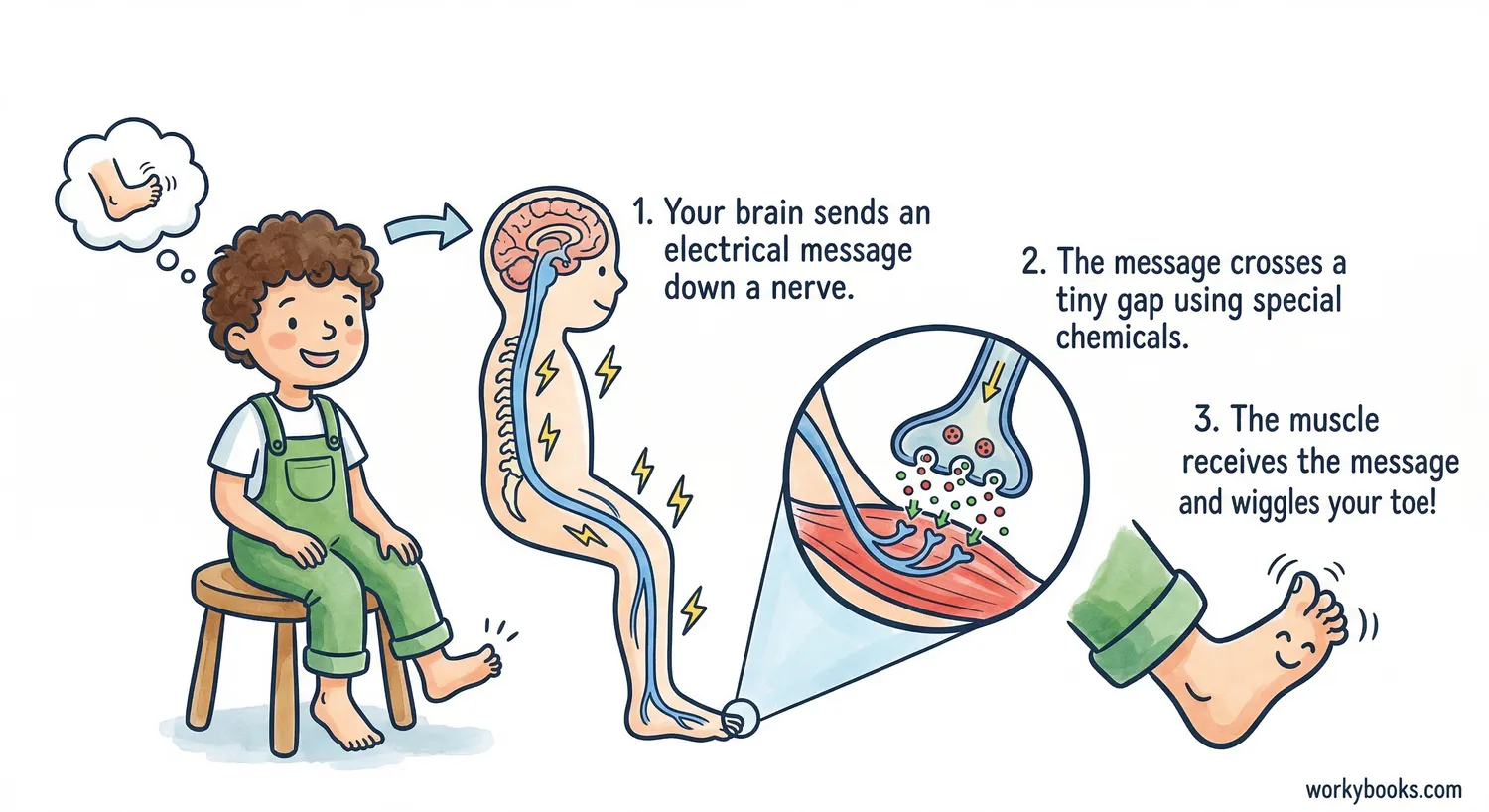
Your brain sends signals through nerves to make your body move!
Nerves are like tiny wires inside your body that carry messages. These messages travel between your brain and every part of your body. Nerves help your body know what is happening around you and tell your body how to respond.
When you touch something hot, nerves in your skin send a message to your brain. The message says, "That is hot!" Your brain receives this message and quickly sends a message back through the nerves. The return message tells your muscles to pull your hand away. This happens incredibly fast—faster than you can even think about it!
Nerves reach everywhere in your body. They go to your skin, your muscles, your organs (body parts like your heart and stomach), and everywhere in between. Without nerves, your brain could not control your body. You would not be able to feel things, move your arms and legs, or even know when you are hungry.
The nervous system is made up of your brain, your spinal cord (a thick bundle of nerves in your back), and all the nerves throughout your body. This system works together like a communication network. It helps you sense the world, make decisions, and take action.
Interesting Fact: Nerve messages can travel through your body at speeds up to 268 miles per hour—that is faster than a race car!
What are nerves like in your body?
Tiny wires that carry messagesLarge tubes that pump bloodBones that support musclesAir sacs that help breathing
Where do nerves reach in your body?
Only in your brainOnly in your skinEverywhere including skin, muscles, and organsOnly in your arms
What is the spinal cord?
A muscle in your legA thick bundle of nervesA bone in your armAn organ in your chest
Why do nerves send messages to brain?
To pump blood through bodyTo digest food in stomachTo tell brain what is happeningTo make bones grow stronger
What happens when you touch something hot?
Your stomach digests food fasterNerves send message then brain respondsYour heart beats more slowlyYour bones become stronger
If nerves did not work, could you feel?
Yes, you could feel everythingNo, you could not feel thingsOnly on sunny daysOnly when you are sleeping
Nerve messages travel faster than you think.
TrueFalse
What does the nervous system include?
Only the heart and lungsOnly the muscles and bonesBrain, spinal cord, and all nervesOnly the skin and hair
Perfect For:
👩🏫 Teachers
• Reading comprehension practice
• Auto-graded assessments
• Literacy skill development
👨👩👧👦 Parents
• Reading practice at home
• Comprehension improvement
• Educational reading time
🏠 Homeschoolers
• Reading curriculum support
• Independent reading practice
• Progress monitoring
Reading Features:
📖
Reading Passage
Engaging fiction or nonfiction text
❓
Comprehension Quiz
Auto-graded questions
📊
Instant Feedback
Immediate results and scoring
📄
Printable Version
Download for offline reading
🔊
Read Aloud
Voice-over with word highlighting
Reviews & Ratings
No reviews yet. Be the first to share your experience!
Related Content
What Are Bones Made Of
This engaging 250-word reading passage introduces Grade 4 students to the structure and function of bones, aligned with ...
NGSS 4-LS1-1LS1.A
How Bones Protect Organs
This engaging 250-word reading passage helps Grade 4 students understand how bones protect organs, aligned with NGSS sta...
NGSS 4-LS1-1LS1.A
How Joints Connect Bones
This 250-word reading passage teaches fourth-grade students about joints and their role in the human skeletal system. Al...
NGSS 4-LS1-1LS1.A
Layers of the Skin
This engaging 250-word reading passage introduces fourth-grade students to the three layers of skin and their functions....
NGSS 4-LS1-1LS1.A
Parts of Plant Stems
This engaging 250-word reading passage introduces fourth-grade students to the internal structure and function of plant ...
NGSS 4-LS1-1LS1.A
Parts of a Flower
This comprehensive 250-word reading passage introduces fourth-grade students to the essential parts of a flower and thei...
NGSS 4-LS1-1LS1.A
How Leaves Make Food
This engaging Grade 4 science reading passage explains how leaves make food through photosynthesis. Students discover th...
NGSS 4-LS1-1LS1.A
How Animal Hearts Work
This 250-word audio-integrated reading passage introduces fourth-grade students to the essential function of the heart a...
NGSS 4-LS1-1LS1.A
Animal Skeleton Structure
This 250-word reading passage introduces fourth grade students to animal skeleton structure, aligned with NGSS 4-LS1-1 a...
NGSS 4-LS1-1LS1.A
How Animal Lungs Work
This 250-word reading passage introduces fourth-grade students to how animal lungs work, aligned with NGSS standard 4-LS...
NGSS 4-LS1-1LS1.A
Parts of a Leaf
This 250-word reading passage introduces Grade 4 students to the internal structure of leaves, aligned with NGSS standar...
NGSS 4-LS1-1LS1.A
Stamen and Pistil
This 250-word reading passage introduces fourth-grade students to the stamen and pistil, the key reproductive structures...
NGSS 4-LS1-1LS1.A
How Internal Structures Help Plants Survive
This 250-word informational reading passage is designed for Grade 4 students and aligns with NGSS standard 4-LS1-1 (LS1....
NGSS 4-LS1-1LS1.A
How Stems Support Plants
This engaging 250-word reading passage helps Grade 4 students understand how stems support plants and contribute to thei...
NGSS 4-LS1-1LS1.A
How Plants Reproduce
This 250-word reading passage introduces fourth-grade students to plant reproduction aligned with NGSS 4-LS1-1 and the D...
NGSS 4-LS1-1LS1.A
How External Structures Help Plants Survive
This 250-word reading passage introduces fourth-grade students to how external plant structures help plants survive, gro...
NGSS 4-LS1-1LS1.A
How Internal Structures Keep Animals Alive
This engaging 250-word reading passage introduces fourth-grade students to the essential internal structures that keep a...
NGSS 4-LS1-1LS1.A
Animal External Structures
This engaging 250-word reading passage introduces fourth-grade students to the concept of animal external structures ali...
NGSS 4-LS1-1LS1.A
What Are Exoskeletons
This engaging 250-word reading passage introduces fourth-grade students to the concept of exoskeletons, aligning with NG...
NGSS 4-LS1-1LS1.A
How Skin Protects Animals
This engaging 250-word reading passage introduces fourth-grade students to the protective functions of skin, the largest...