This learning resource is available in interactive and printable formats. The interactive worksheet can be played online and assigned to students. The Printable PDF version can be downloaded and printed for completion by hand.
How We Store Memories is an engaging Grade 4 science reading passage aligned with NGSS standard 4-LS1-2 (LS1.D). This 250-word passage introduces students to the concept that the brain stores memories as patterns, helping them understand how learning and practice strengthen these patterns over time. The passage uses age-appropriate language and relatable examples like learning to ride a bike and remembering that stoves are hot. Students explore how memories help make better decisions and develop new skills. The resource includes audio integration for accessibility, a simplified differentiated version for struggling readers, complete Spanish translations of both versions, a comprehensive glossary, an 8-question multiple-choice quiz testing recall and application, three writing prompts with suggested answers, and two graphic organizers. The activities reinforce understanding of how the brain processes and stores information, connecting to real-world experiences that fourth graders encounter daily. This complete lesson package supports diverse learners while building foundational neuroscience knowledge essential for understanding how living organisms process information.
CONTENT PREVIEW
Expand content preview
Memory helps your brain learn from experiences to stay safe.
Your brain is an organ inside your head that controls your body and helps you think. The brain does not just respond to information right now. It also saves important information for later. This saved information is called memory. Memory is your brain's way of keeping facts, experiences, and skills so you can use them again.
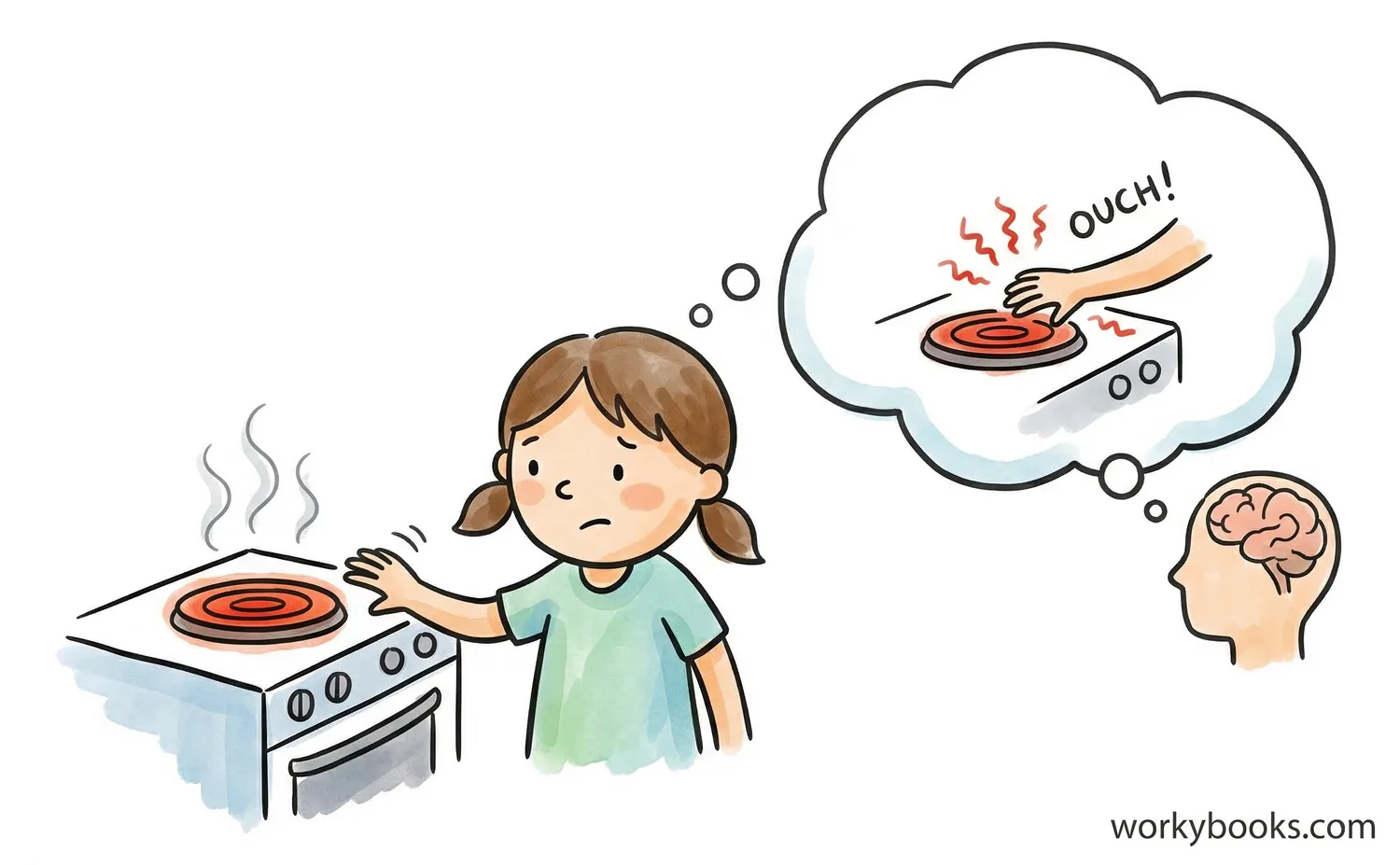
When you touch a hot stove, your brain feels the pain and stores that memory. The next time you see a stove, your brain remembers it can be hot, so you are more careful. This memory helps keep you safe. When you practice riding a bike, your brain remembers how to balance and pedal. At first, riding feels hard. But each time you practice, the memory gets stronger. Soon, you can ride without thinking about every move.
Memories are stored in the brain as patterns. A pattern is like a path that information follows. When you learn something new, your brain creates a pattern. When you practice that skill, the pattern becomes clearer and easier to follow. This is why practicing makes you better at things. Your brain gets better at remembering because the pattern is stronger.
Memories help you make better decisions and learn new skills. Without memory, you would have to learn everything over and over again. Your brain saves what you learn so you can build on it and grow smarter every day.
Interesting Fact: Scientists believe your brain can store about 2.5 petabytes of information—that's enough to record 3 million hours of TV shows!
What is memory?
Saved information in your brainA part of your heartHow you see thingsYour sense of smell
Where are memories stored?
In your stomachIn your brain as patternsIn your musclesIn your lungs
What happens when you practice a skill?
The memory pattern gets weakerYou forget how to do itThe memory pattern gets strongerNothing changes
Why does remembering a hot stove help you?
It makes you hungryIt keeps you safe next timeIt helps you cook betterIt makes stoves cooler
How does practice help you learn skills?
It erases old memoriesIt makes your brain smallerIt strengthens memory patternsIt stops you from thinking
What would happen without memory?
You would learn fasterYou would never sleepYou would learn everything onceYou would relearn everything repeatedly
The brain stores memories as patterns.
TrueFalse
What is a pattern in the brain?
A color your brain likesA path that information followsA type of foodA way to exercise
Perfect For:
👩🏫 Teachers
• Reading comprehension practice
• Auto-graded assessments
• Literacy skill development
👨👩👧👦 Parents
• Reading practice at home
• Comprehension improvement
• Educational reading time
🏠 Homeschoolers
• Reading curriculum support
• Independent reading practice
• Progress monitoring
Reading Features:
📖
Reading Passage
Engaging fiction or nonfiction text
❓
Comprehension Quiz
Auto-graded questions
📊
Instant Feedback
Immediate results and scoring
📄
Printable Version
Download for offline reading
🔊
Read Aloud
Voice-over with word highlighting
Reviews & Ratings
No reviews yet. Be the first to share your experience!
Related Content
How Animals See Differently
This engaging 250-word reading passage introduces fourth-grade students to the fascinating world of animal vision and ey...
NGSS 4-LS1-1LS1.D
What Is Spinal Cord
This engaging Grade 4 science reading passage introduces students to the spinal cord and its critical role in the human ...
NGSS 4-LS1-2LS1.ALS1.D
How We Smell, Taste, and Feel
This audio-integrated reading passage introduces fourth-grade students to the fundamental concept of how sensory organs ...
NGSS 4-LS1-2LS1.D
How the Body Responds
This 250-word reading passage introduces fourth-grade students to how the body responds to sensory information, aligned ...
NGSS 4-LS1-2LS1.D
How Animals Use Smell and Touch
This engaging 250-word reading passage introduces fourth-grade students to how animals use smell and touch as critical s...
NGSS 4-LS1-2LS1.D
How Animals Respond to Danger
This engaging 250-word reading passage introduces fourth-grade students to the sense-process-respond chain in animals, a...
NGSS 4-LS1-2LS1.D
How Animals Learn from Experience
This engaging 250-word reading passage introduces fourth-grade students to the concept of animal learning and behavioral...
NGSS 4-LS1-2LS1.D
What Is Nervous System
This Grade 4 science reading passage introduces students to the nervous system as the body's communication network align...
NGSS 4-LS1-2LS1.ALS1.D
Brain as Control Center
This engaging 250-word reading passage teaches fourth-grade students about the brain as the body's control center, align...
NGSS 4-LS1-2LS1.ALS1.D
How Nerves Carry Messages
This engaging 250-word reading passage introduces fourth-grade students to the nervous system and how nerves carry messa...
NGSS 4-LS1-2LS1.ALS1.D
How Animals Use Their Senses
This Grade 4 science reading passage introduces students to how animals use their senses to receive information about th...
NGSS 4-LS1-2
How Brain Processes Senses
This 250-word reading passage introduces fourth-grade students to the sense-process-respond model aligned with NGSS stan...
NGSS 4-LS1-2
How Our Eyes and Ears Work
This engaging 250-word reading passage introduces fourth-grade students to the specialized functions of sense organs, sp...