Layers of the Atmosphere
Interactive passage with audio narration, comprehension questions, and printable PDF.
By completing this purchase you agree to our Terms of Use and Privacy Policy. Your subscription renews automatically until you cancel. You can cancel anytime from your account settings. All sales are final and non-refundable. Digital content is available for download in your account immediately upon purchase.
What's included
Layers of the Atmosphere preview and details
About this printable Layers of the Atmosphere science reading passage, NGSS-aligned (Grades 5-8)
Sample passage and quiz from Layers of the Atmosphere
Reading passage and comprehension quiz preview
Layers of the Atmosphere
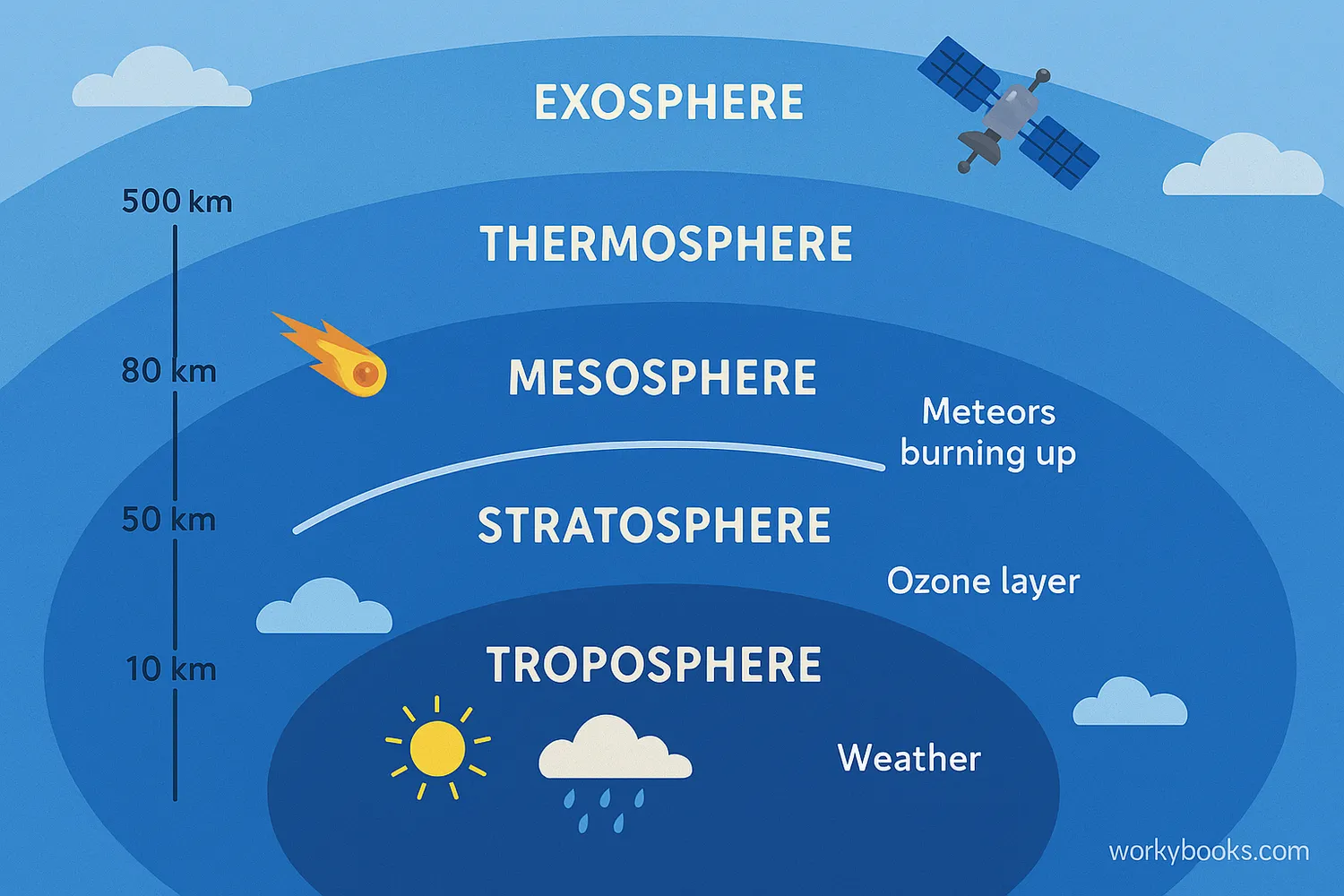
Earth’s atmosphere is a complex system with distinct layers that play vital roles in supporting life and shaping global phenomena. The atmosphere is not just empty space; it is structured into layers based on changes in temperature with altitude. Understanding these layers helps scientists explain weather patterns, protect human health, and even support space exploration.
Structure of the Atmosphere
The lowest layer, called the troposphere, extends from Earth’s surface up to about 12 kilometers (km). This layer contains about 75% of the atmosphere’s mass and nearly all of its water vapor. Weather occurs here because warm air near the surface rises, cools, and condenses to form clouds and precipitation. As you move upward, temperature in the troposphere decreases rapidly, dropping by about 6.5°C for every kilometer. The boundary above is the tropopause.
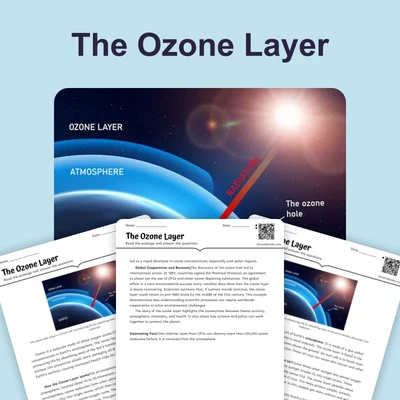
Above the troposphere is the stratosphere, which stretches from about 12 km to 50 km. Unlike the troposphere, temperature in the stratosphere increases with altitude. This warming is caused by the ozone layer—a region rich in ozone molecules that absorb ultraviolet radiation from the Sun. The stratosphere is stable and has little vertical mixing, so weather does not occur here. The stratopause marks its upper limit.
Higher Layers and Their Functions
The mesosphere extends from 50 km to 80 km above Earth. In this layer, temperature drops again, reaching the coldest values in the atmosphere—down to −90°C. The mesosphere protects Earth by burning up most meteors before they can reach the surface. Its upper boundary is called the mesopause.
The thermosphere lies above the mesosphere, reaching up to about 700 km. Here, temperature rises dramatically, sometimes exceeding 2,000°C. This is because solar energy excites sparse gas molecules, though the air is so thin that it would not feel hot to humans. The thermosphere is home to auroras—brilliant lights caused by charged particles from space—and is where the International Space Station orbits.
Beyond the thermosphere is the exosphere, gradually fading into outer space above 700 km. In the exosphere, air molecules are extremely far apart and may escape into space, marking the transition from our planet to the wider universe.
Why Layers Differ
Each atmospheric layer has unique temperature patterns due to different heat sources. In the troposphere, the ground absorbs sunlight and warms the air above. In the stratosphere, the ozone layer absorbs ultraviolet light, creating a temperature rise with altitude. Higher up, solar radiation directly energizes particles in the thermosphere. Boundaries like the tropopause, stratopause, and mesopause form where temperature trends reverse. Scientists determine these structures by measuring temperature, composition, and pressure using weather balloons and satellites.
These layers work together as a system, influencing everything from weather and climate to the survival of living things and the safety of astronauts. Understanding the structure and function of the atmosphere helps us predict storms, protect against harmful radiation, and explore outer space.
Interesting Fact: The ozone layer in the stratosphere absorbs over 97% of the Sun’s harmful ultraviolet radiation, making life on Earth possible.
Comprehension quiz (10 questions)
1. Which atmospheric layer contains most of Earth's air and where weather occurs?
2. What causes the temperature to increase with altitude in the stratosphere?
3. In which layer do most meteors burn up before reaching Earth's surface?
4. What is the primary heat source for the troposphere?
5. What is the ozone layer’s main function?
6. What does the word 'tropopause' mean as used in the passage?
7. Why doesn’t weather occur in the stratosphere?
8. How do scientists determine the structure of the atmosphere?
9. True or False: The thermosphere is where auroras can be seen and the International Space Station orbits.
10. True or False: The exosphere is the layer where most of Earth’s weather occurs.
Perfect for the way you teach
- Build comprehension skills
- Auto-graded quiz
- Differentiated reading
- Read together at home
- Improve fluency
- Quiet reading time
- Reading curriculum support
- Independent practice
- Track Lexile growth