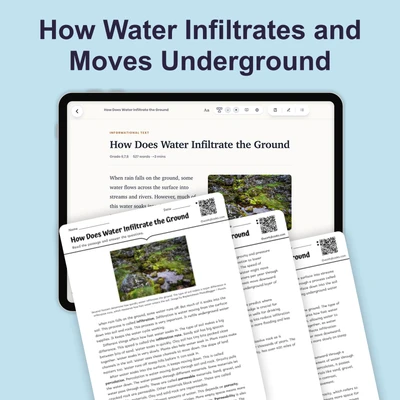
This learning resource is available in interactive and printable formats. The interactive worksheet can be played online and assigned to students. The Printable PDF version can be downloaded and printed for completion by hand.
This middle school science passage explores the essential topic of groundwater, aligned to NGSS standards MS-ESS2-4 and MS-ESS3-1. Students learn how groundwater forms, moves, and is stored in different types of aquifers, as well as the importance of porosity and permeability. The passage covers critical environmental issues such as overdraft, land subsidence, and saltwater intrusion, with a special focus on the Ogallala Aquifer. Vocabulary is embedded and explained in context, supporting comprehension and science literacy. The passage is accompanied by a glossary, multiple-choice quiz, writing activities, and graphic organizers, making it ideal for classrooms and independent study. Audio integration supports diverse learners. This resource emphasizes scientific thinking, cause and effect, and sustainable management of natural resources.
CONTENT PREVIEW
Expand content preview
Groundwater
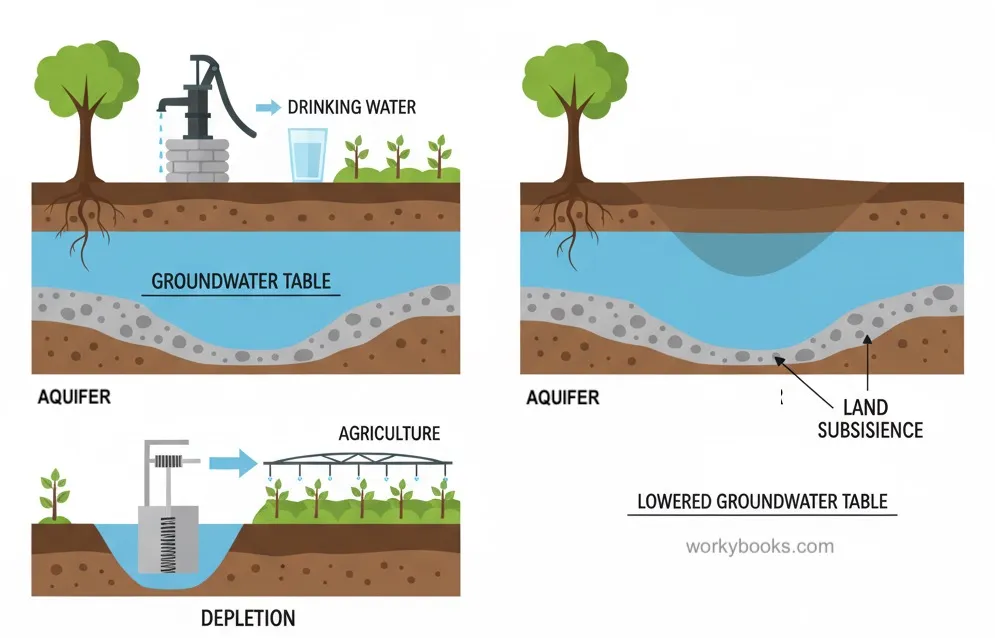
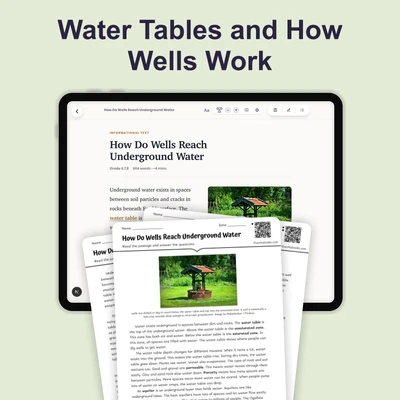
Groundwater is the vast supply of water stored beneath Earth's surface in the spaces between soil, sand, and rocks. In many regions, wells and springs provide water for drinking, farming, and industry. The movement and storage of groundwater depend on the characteristics of the underground materials and the way water interacts with them.
Scientists have learned that groundwater exists in tiny spaces called pore spaces. The amount of open space in a material is called porosity. The ability of water to flow through a material is known as permeability. When rain falls, some water seeps down through the soil and rock, filling these spaces. This process is called recharge. The top of the zone where all the spaces are filled with water is called the water table.
Types of Aquifers and How Groundwater Moves
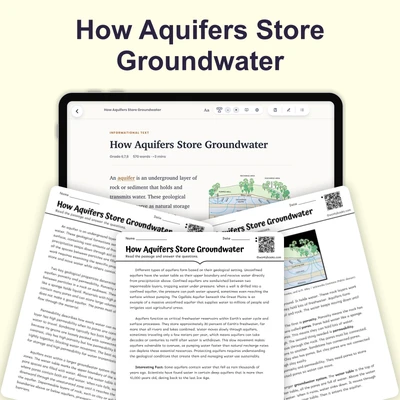
Groundwater is stored in underground layers called aquifers. An unconfined aquifer has a water table that rises and falls with rainfall because it is open to the surface through permeable materials. In contrast, a confined aquifer is trapped between layers of impermeable rock or clay, which puts the water under pressure. When a well taps into a confined aquifer, the water may rise on its own, sometimes even flowing to the surface without pumping.
Water leaves aquifers through discharge processes, such as springs, wells, or seepage into rivers and lakes. In a balanced system, recharge and discharge rates are about equal. However, if people pump water from wells faster than it is replaced, problems can occur.
Groundwater Challenges and the Ogallala Aquifer
Overpumping, or overdraft, happens when water is withdrawn from an aquifer faster than it is recharged. This can lower the water table, making wells dry up. In some places, the ground sinks or cracks in a process called land subsidence. Near the coast, removing too much groundwater can allow salty ocean water to move in, called saltwater intrusion.
A major example is the Ogallala Aquifer in the central United States. It supplies drinking and irrigation water to millions of people, but is being depleted much faster than it is refilled. Some areas of the Ogallala have dropped over 30 meters in just 50 years. Protecting groundwater means using water wisely, preventing pollution, and supporting recharge by preserving wetlands and natural areas.
Groundwater and the Water Cycle
Groundwater is a key part of the water cycle. It interacts with surface water in rivers, lakes, and wetlands. Changes in groundwater levels can affect ecosystems, agriculture, and drinking water supplies. Scientists use monitoring wells and computer models to study groundwater flow and predict future changes. Sustainable management is necessary to ensure that this hidden resource remains available for generations to come.
Interesting Fact: It is estimated that about 30% of all the fresh water on Earth is groundwater. The rest is mostly locked in ice caps and glaciers!
What is groundwater?
Water stored beneath Earth's surface in spaces between soil and rock.Water found only in rivers and lakes.Water that falls as rain.Water used only by plants.
What is the water table?
The top of the groundwater zone where all spaces are filled with water.A type of aquifer found at the bottom of the ocean.A table scientists use to measure water.A process for cleaning water.
What does the term 'porosity' mean in the passage?
The ability of water to flow through a material.The amount of open space in a material for storing water.A process of removing water from an aquifer.A type of underground spring.
What is the main difference between an unconfined and a confined aquifer?
Unconfined aquifers are open to the surface; confined aquifers are trapped between impermeable layers.Unconfined aquifers are found only near the ocean.Confined aquifers are always dry.Unconfined aquifers do not store any water.
How can overdraft affect groundwater systems?
It can cause the water table to rise.It can lead to land subsidence and wells drying up.It makes groundwater cleaner.It causes more rain to fall.
Which statement best describes recharge?
Recharge is when water is pumped out of an aquifer.Recharge is the process of water entering an aquifer from the surface.
True or False: The Ogallala Aquifer is being refilled faster than it is being used.
TrueFalse
True or False: Saltwater intrusion can happen when too much groundwater is removed near the coast.
TrueFalse
Which of the following is an example of groundwater discharge?
Water flowing out of a spring.Rainwater soaking into the soil.Pumping water into an aquifer.Evaporation from a lake.
Why is sustainable management of groundwater important?
It prevents groundwater pollution and ensures water for the future.It allows saltwater to enter aquifers.It makes it easier to build wells.It stops rainfall from reaching the ground.
Perfect For:
👩🏫 Teachers
• Reading comprehension practice
• Auto-graded assessments
• Literacy skill development
👨👩👧👦 Parents
• Reading practice at home
• Comprehension improvement
• Educational reading time
🏠 Homeschoolers
• Reading curriculum support
• Independent reading practice
• Progress monitoring
Reading Features:
📖
Reading Passage
Engaging fiction or nonfiction text
❓
Comprehension Quiz
Auto-graded questions
📊
Instant Feedback
Immediate results and scoring
📄
Printable Version
Download for offline reading
🔊
Read Aloud
Voice-over with word highlighting
Reviews & Ratings
No reviews yet. Be the first to share your experience!
Related Content
The Intertropical Convergence Zone (ITCZ): Earth's Weather Belt
This science passage explains the Intertropical Convergence Zone (ITCZ), a key equatorial weather system. Covering NGSS ...
MS-ESS2-5MS-ESS2-4RI.6.7
What Type of Cloud Is Associated with Hail?
This NGSS-aligned science reading passage for middle school explains that cumulonimbus clouds are the main cloud type re...
MS-ESS2-4
Earth's Spheres
This middle school science passage introduces students to Earth's four major spheres: the geosphere, hydrosphere, atmosp...
MS-ESS2-4MS-ESS2-6
Surface Water: Rivers, Lakes, and Wetlands
This engaging middle school science passage explores the dynamic world of surface water, focusing on the complex systems...
MS-ESS2-4
Distribution of Water on Earth
This middle school science reading passage explores the distribution of water on Earth, aligned with NGSS standards MS-E...
MS-ESS2-4MS-ESS3-1
Water in Ecosystems
This engaging passage for grades 6-8 explores the essential role of water in ecosystems, tracing its movement through va...
MS-LS2-3MS-ESS2-4
The Ozone Layer
This engaging NGSS-aligned passage explores the science and importance of the ozone layer for middle school students (gr...
MS-ESS2-4MS-ESS3-3
Layers of the Atmosphere
This middle school science reading passage, aligned to NGSS standard MS-ESS2-4, guides students through the structure an...
MS-ESS2-4
How Do Solar Panels Work?
This middle school reading passage explains how solar panels work by turning sunlight into electricity. The passage desc...
MS-ESS3-1
How Do Wind Turbines Work?
This NGSS-aligned reading passage for middle school students explains how wind turbines convert the energy of moving air...
MS-ESS3-1
How Does a Hydroelectric Dam Work?
This NGSS-aligned science passage for middle school students explains how hydroelectric dams work to produce clean, rene...
MS-ESS3-1
What Is Biofuel?
This NGSS-aligned middle school science passage explains what biofuel is, how it is made, and why it is important as a c...
MS-ESS3-1
What Is Tidal Energy?
This engaging reading passage for middle school students introduces tidal energy, a form of renewable energy that uses t...
MS-ESS3-1
What Is Wave Energy?
This passage introduces middle school students to wave energy—a clean, renewable energy source that comes from the movem...
MS-ESS3-1
What Is Green Energy?
This science passage introduces middle school students to the concept of green energy—clean, renewable energy that comes...
MS-ESS3-1
Igneous Rocks
This comprehensive passage introduces middle school students to igneous rocks, focusing on how these rocks form from mol...
MS-ESS2-1MS-ESS3-1
Sedimentary Rocks
This comprehensive middle school science passage introduces students to sedimentary rocks, detailing their step-by-step ...
MS-ESS2-1MS-ESS2-3MS-ESS3-1
Metamorphic Rocks
This engaging middle school science passage introduces students to the fascinating world of metamorphic rocks. Aligned w...
MS-ESS2-1MS-ESS3-1
Topographic Maps
This comprehensive passage introduces middle school students to topographic maps, with a focus on how these maps represe...