This learning resource is available in interactive and printable formats. The interactive worksheet can be played online and assigned to students. The Printable PDF version can be downloaded and printed for completion by hand.
This engaging NGSS-aligned passage explores the science and importance of the ozone layer for middle school students (grades 6-8). Students will learn what ozone is, how it forms and protects life by absorbing ultraviolet radiation, and why the discovery of the ozone hole in 1985 was a global concern. The passage delves into the chemical process by which CFCs (chlorofluorocarbons) destroy ozone, the health risks of increased UV exposure, and the international response through the Montreal Protocol. The text highlights the ozone layer as an example of global cooperation in solving environmental problems, connecting to broader Earth systems and human impacts. Activities include a comprehension quiz, writing prompts, vocabulary, and graphic organizers to support diverse learners. Audio integration and Spanish translations make this resource accessible for all classrooms.
CONTENT PREVIEW
Expand content preview
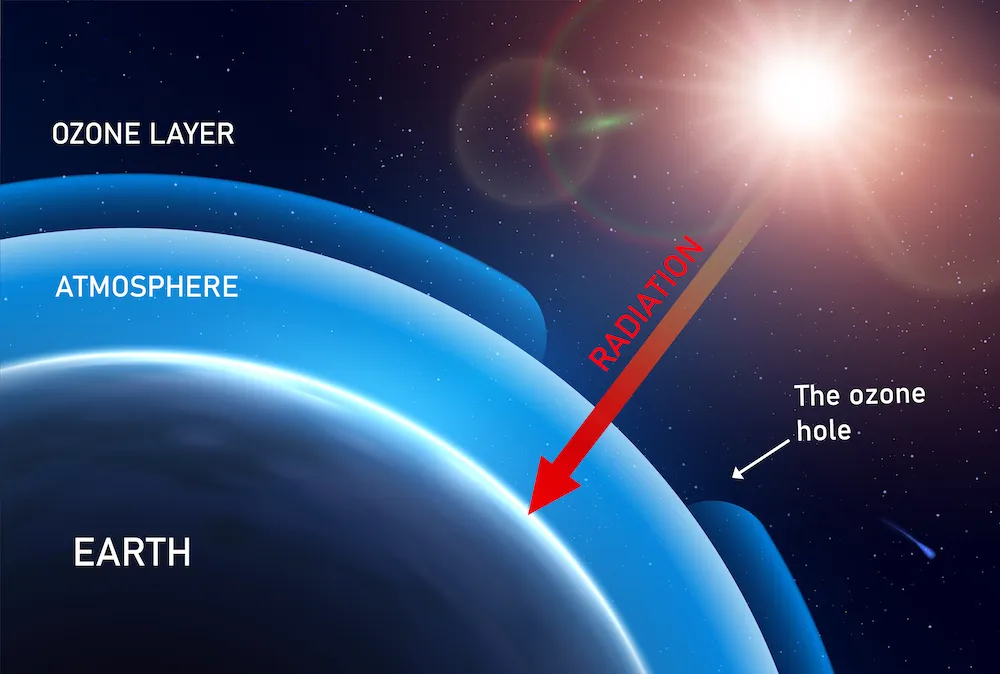
The ozone layer plays a critical role in protecting life by absorbing most of the Sun’s harmful ultraviolet (UV) radiation.
Ozone is a molecule made of three oxygen atoms (O₃) and is found in high concentrations in Earth’s stratosphere. The ozone layer plays a critical role in protecting life by absorbing most of the Sun’s harmful ultraviolet (UV) radiation. Without this protective shield, more damaging UV-B and UV-C rays would reach Earth’s surface, causing increased health risks for humans and other organisms.
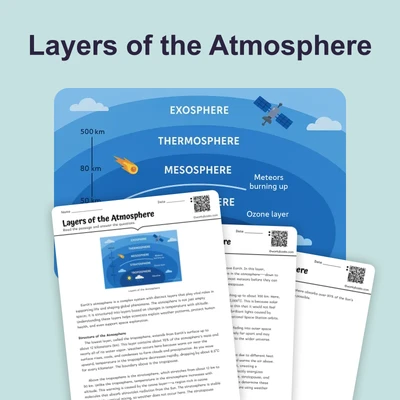
How the Ozone Layer Works The stratosphere is the second layer of Earth’s atmosphere, located about 10 to 50 kilometers above the surface. Within the stratosphere, ozone molecules form when ultraviolet light splits ordinary oxygen molecules (O₂) into single atoms, which then combine with other O₂ to make O₃. This process is called the ozone-oxygen cycle. The ozone layer absorbs about 97-99% of UV-B and almost all UV-C radiation. This protection is vital because excessive exposure to UV rays can cause skin cancer, cataracts, and weaken the immune system. For example, in places where the ozone layer is thinner, people have higher rates of skin cancer.
The Ozone Hole and CFCs In 1985, scientists discovered a dramatic thinning of the ozone layer over Antarctica, known as the ozone hole. This problem was traced to human-made chemicals called chlorofluorocarbons (CFCs), which were used in refrigerators, air conditioners, and spray cans. When CFCs reach the stratosphere, sunlight breaks them apart, releasing chlorine atoms. A single chlorine atom can destroy over 100,000 ozone molecules by breaking their bonds. This chain reaction led to a rapid decrease in ozone concentration, especially over polar regions.
Global Cooperation and Recovery The discovery of the ozone hole led to international action. In 1987, countries signed the Montreal Protocol, an agreement to phase out the use of CFCs and other ozone-depleting substances. This global effort is a rare environmental success story: satellite data show that the ozone layer is slowly recovering. Scientists estimate that, if current trends continue, the ozone layer could return to pre-1980 levels by the middle of the 21st century. This example demonstrates how understanding scientific processes can inspire worldwide cooperation to solve environmental challenges.
The story of the ozone layer highlights the connections between human activity, atmospheric chemistry, and health. It also shows how science and policy can work together to protect the planet.
Interesting Fact: One chlorine atom from CFCs can destroy more than 100,000 ozone molecules before it is removed from the atmosphere.
What is the main function of the ozone layer?
Absorbing harmful ultraviolet radiation from the SunProducing oxygen for living thingsProviding heat to the stratosphereCausing weather patterns
Where is most of Earth's ozone located?
In the stratosphereIn the troposphereOn the groundIn the ocean
What health problems can increased UV exposure cause?
Skin cancer and cataractsAsthma and diabetesBroken bonesHigh blood pressure
What are CFCs, and how do they affect the ozone layer?
Human-made chemicals that destroy ozone by releasing chlorineNatural gases that help make ozoneParticles that block sunlightWater vapor that forms clouds
What does the Montreal Protocol do?
It bans the use of CFCs and other ozone-depleting substancesIt increases CFC productionIt measures temperatureIt creates more ozone
What does 'ozone hole' mean in the passage?
A region where the ozone layer has become much thinnerA hole in Earth's surfaceA type of cloudA place with extra ozone
What is the 'ozone-oxygen cycle'?
A process where ozone is formed and destroyed in the stratosphereThe movement of oxygen in plantsA cycling raceThe creation of water vapor
Why is the ozone layer described as a 'success story'?
Because global action has helped the ozone layer recoverBecause it is not importantBecause CFCs are still widely usedBecause the ozone hole is growing
True or False: One chlorine atom can destroy thousands of ozone molecules.
TrueFalse
True or False: The ozone layer is found closest to Earth's surface.
TrueFalse
Perfect For:
👩🏫 Teachers
• Reading comprehension practice
• Auto-graded assessments
• Literacy skill development
👨👩👧👦 Parents
• Reading practice at home
• Comprehension improvement
• Educational reading time
🏠 Homeschoolers
• Reading curriculum support
• Independent reading practice
• Progress monitoring
Reading Features:
📖
Reading Passage
Engaging fiction or nonfiction text
❓
Comprehension Quiz
Auto-graded questions
📊
Instant Feedback
Immediate results and scoring
📄
Printable Version
Download for offline reading
🔊
Read Aloud
Voice-over with word highlighting
Reviews & Ratings
No reviews yet. Be the first to share your experience!
Related Content
Natural Disaster: Volcanic Eruptions
Volcanoes can erupt with lava and ash, changing the landscape. While dangerous, they also create fertile land and new la...
RI.3.1RI.4.4RI.4.2RI.5.2
The Intertropical Convergence Zone (ITCZ): Earth's Weather Belt
This science passage explains the Intertropical Convergence Zone (ITCZ), a key equatorial weather system. Covering NGSS ...
MS-ESS2-5MS-ESS2-4RI.6.7
What Type of Cloud Is Associated with Hail?
This NGSS-aligned science reading passage for middle school explains that cumulonimbus clouds are the main cloud type re...
MS-ESS2-4
Human Impacts: Pollution
This middle school science reading passage, aligned with NGSS standards MS-LS2-4 and MS-ESS3-3, examines the mechanisms ...
MS-LS2-4MS-ESS3-3
Human Impacts: Habitat Destruction
This grade 6-8 science passage explores human impacts on ecosystems, focusing on habitat destruction as the leading caus...
MS-LS2-4MS-LS2-5MS-ESS3-3
Ecosystem Services
This engaging middle school science passage introduces students to the concept of ecosystem services, the vital benefits...
MS-LS2-5MS-ESS3-3
Environmental Problems and Solutions
This passage for grades 6-8 introduces major environmental problems such as habitat loss, pollution, climate change, inv...
MS-LS2-4MS-ESS3-3MS-ESS3-4
Earth's Spheres
This middle school science passage introduces students to Earth's four major spheres: the geosphere, hydrosphere, atmosp...
MS-ESS2-4MS-ESS2-6
Remote Sensing
This middle school science passage introduces students to the concept of remote sensing—the collection of information ab...
MS-ESS3-3MS-PS4-2MS-ETS1-1MS-ETS1-3
Geographic Information Systems (GIS)
This engaging middle school science passage introduces students to Geographic Information Systems (GIS), aligning with N...
MS-ESS3-3MS-ETS1-1MS-ETS1-2MS-ETS1-3
Renewable vs. Nonrenewable Energy
This engaging passage, aligned with NGSS standards MS-PS3-4, MS-ESS3-3, and MS-ESS3-4, helps middle school students diff...
MS-PS3-4MS-ESS3-3MS-ESS3-4
Fossil Fuels: Coal
This middle school science reading passage explores the science behind coal, a major fossil fuel. Students will learn ho...
MS-PS3-4MS-ESS3-3MS-ESS3-4
Solar Energy
This engaging passage for grades 6-8 explores the science of solar energy, focusing on how sunlight is converted into el...
MS-PS3-4MS-ESS3-3MS-ESS3-4
Wind Energy
This comprehensive middle school science passage explores the scientific principles behind wind energy and how wind turb...
MS-PS3-4MS-ESS3-3MS-ESS3-4
Hydroelectric Energy
This comprehensive passage introduces middle school students to the science behind hydroelectric energy, directly aligni...
MS-PS3-4MS-ESS3-3MS-ESS3-4
Surface Water: Rivers, Lakes, and Wetlands
This engaging middle school science passage explores the dynamic world of surface water, focusing on the complex systems...
MS-ESS2-4
Geothermal Energy
This comprehensive science passage introduces middle school students to the mechanisms and applications of geothermal en...
MS-PS3-4MS-ESS3-3MS-ESS3-4
Biomass and Biofuels
This NGSS-aligned passage introduces grades 6-8 students to the science of biomass and biofuels, explaining how organic ...
MS-PS3-4MS-ESS3-3MS-ESS3-4
Nuclear Energy as a Resource
This NGSS-aligned informational science passage, designed for grades 6-8, explores nuclear energy as a resource in the c...
MS-PS3-4MS-ESS3-3MS-ESS3-4
Groundwater
This middle school science passage explores the essential topic of groundwater, aligned to NGSS standards MS-ESS2-4 and ...