Distribution of Water on Earth
Interactive passage with audio narration, comprehension questions, and printable PDF.
By completing this purchase you agree to our Terms of Use and Privacy Policy. Your subscription renews automatically until you cancel. You can cancel anytime from your account settings. All sales are final and non-refundable. Digital content is available for download in your account immediately upon purchase.
What's included
Distribution of Water on Earth preview and details
About this printable Distribution of Water on Earth science reading passage, NGSS-aligned (Grades 5-8)
Sample passage and quiz from Distribution of Water on Earth
Reading passage and comprehension quiz preview
Distribution of Water on Earth
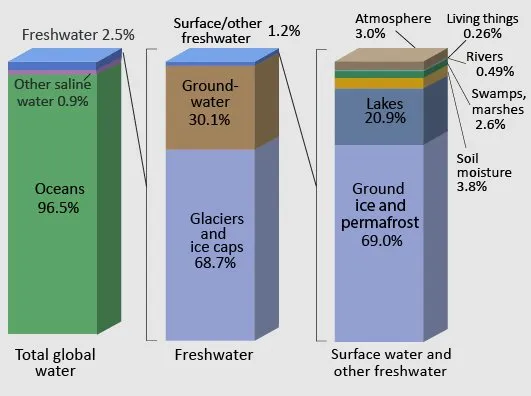
Distribution of water on Earth , 1993, NASA, Wikimedia Commons (Public domain).
Water is essential for all living things on Earth, yet its distribution is far from even. While our planet appears blue from space because of its vast oceans, very little of that water is suitable for drinking or farming. Understanding where water is found, and how much is actually usable, is key to addressing one of the world’s most urgent environmental challenges: water scarcity.
Where Is Earth’s Water?
Earth’s water exists in several reservoirs, including oceans, glaciers, ice caps, groundwater, lakes, rivers, and the atmosphere. About 97% of all water on Earth is saltwater found in oceans and some lakes and groundwater. This saltwater cannot be used directly for most drinking or agricultural purposes without expensive desalination. Only about 3% of Earth’s water is freshwater. However, most freshwater is not accessible: nearly 68.7% is locked away in glaciers and ice caps, mainly in Antarctica and Greenland. Another 30.1% is stored as groundwater, which is found deep beneath the Earth’s surface and often difficult or costly to reach. Just 0.3% of the world’s freshwater is found in surface water such as lakes, rivers, and swamps, and only 0.04% is in the atmosphere as water vapor.
Why Is Accessible Freshwater So Limited?
Accessible freshwater—water we can easily use for drinking, irrigation, and industry—makes up less than 1% of all the water on Earth. Most is trapped in locations we cannot reach, like glaciers or deep underground. This means the amount of water available for people, crops, and natural ecosystems is very small. The uneven distribution of water means that some regions are rich in water resources, while others face water scarcity. More than two billion people live in areas where water is scarce, and this number is expected to rise as the world’s population grows and climate change affects weather patterns. For example, parts of Sub-Saharan Africa and the Middle East struggle with water shortages, while places like Canada and the Amazon basin have abundant freshwater supplies.
Human Impact and Virtual Water
Humans use freshwater for drinking, growing food, making products, and supporting industries. However, the demand for water is increasing, especially in cities and areas with growing populations. Another important concept is virtual water, which is the hidden water used to produce goods and food. For instance, producing one kilogram of beef can require up to 15,000 liters of water, considering the water used to grow animal feed, provide drinking water to cattle, and process the meat. This means that our daily choices about what we eat and buy also affect global water resources. Scientists use satellite data, field studies, and mathematical models to track water movement and predict shortages, helping communities prepare for and solve water challenges.
Understanding water’s distribution and the systems that move and store water helps us make better decisions about conservation and resource management. By learning how water is shared among oceans, glaciers, groundwater, and surface water, we can appreciate its value and the need to protect this vital resource for future generations.
Interesting Fact: Less than 0.01% of Earth’s water is found in rivers and lakes, yet these sources provide nearly all the water we use daily!
Comprehension quiz (10 questions)
1. What percentage of Earth's water is saltwater?
2. Where is most of Earth's accessible freshwater found?
3. What is virtual water?
4. Why can't saltwater be used directly for drinking and farming?
5. What does the word 'reservoirs' mean as used in the passage?
6. What is the best definition of 'uneven distribution' as used in the text?
7. Why is accessible freshwater so limited on Earth?
8. How can human choices affect water resources?
9. True or False: More than two billion people live in areas with water scarcity.
10. True or False: All freshwater on Earth is easily accessible for humans to use.
Perfect for the way you teach
- Build comprehension skills
- Auto-graded quiz
- Differentiated reading
- Read together at home
- Improve fluency
- Quiet reading time
- Reading curriculum support
- Independent practice
- Track Lexile growth