This learning resource is available in interactive and printable formats. The interactive worksheet can be played online and assigned to students. The Printable PDF version can be downloaded and printed for completion by hand.
This 250-word reading passage introduces fourth-grade students to the important scientific practice of modeling waves. Aligned with NGSS 4-PS4-1 and the Disciplinary Core Idea PS4.A, the passage explains how scientists and students use simple tools like ropes, springs, and drawings to create models that demonstrate wave behavior and properties. Students learn that models are simplified representations that help us understand complex phenomena without needing to observe actual waves in nature. The passage uses age-appropriate language and familiar examples to explain key concepts including wave models, wave properties, and wave patterns. Audio-integrated features support diverse learners by providing text-to-speech functionality. The passage emphasizes the connection between hands-on modeling activities and scientific understanding, preparing students for investigations where they will create their own wave models. Supplementary activities include comprehension questions, writing prompts that ask students to explain and apply their understanding of wave models, and graphic organizers that help students compare different types of wave models and understand the structure and function of modeling tools. This resource builds foundational knowledge about waves and scientific modeling practices essential for elementary physical science education.
CONTENT PREVIEW
Expand content preview
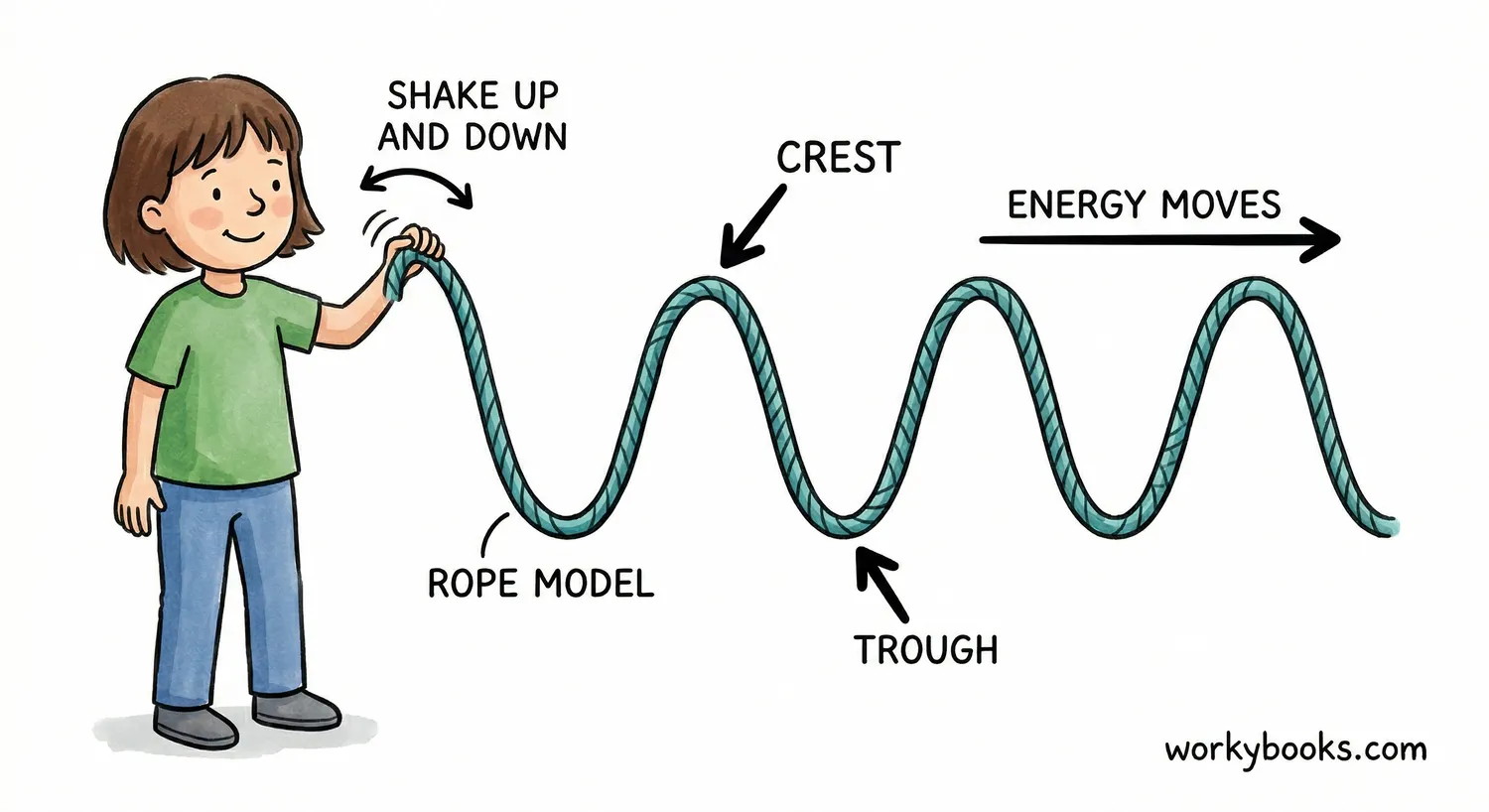
Using a rope model to visualize wave energy and patterns.
Scientists use models to help them understand things that are hard to see or study. A model is something that represents a real object or process in a simpler way. Models help scientists learn about waves without needing to watch real ocean waves or sound waves all the time.
One way to model waves is with a rope. When you shake one end of a rope up and down, you can see wave patterns move along it. Wave patterns are the repeating shapes that waves make. The high points are called crests, and the low points are called troughs. This rope model shows how energy moves through a wave even though the rope itself doesn't travel forward.
Another useful model is a spring toy. When you push and pull a spring, you can see how waves move back and forth. This is similar to how sound waves travel through air. Scientists also draw pictures and diagrams to model waves. These drawings show important wave properties like height and length. Wave properties are the features that describe how a wave looks and behaves.
Using models is an important science practice. Models let students test ideas and make predictions about how real waves will act. You can build models with simple materials like ropes, springs, or even your hand moving through water. Each model teaches us something different about wave behavior.
What is a model in science?
A real ocean waveSomething that represents something real simplyA type of soundA picture in a book
What are the high points of waves?
TroughsPropertiesCrestsPatterns
Which tool can model waves?
A ropeA pencilA bookA chair
Why do scientists use models?
To make things harder to understandTo test ideas and make predictionsTo avoid doing experimentsTo draw pretty pictures
What does a spring toy show?
How waves move back and forthHow to play gamesHow to make noiseHow to build things
Wave properties describe wave features and behavior.
TrueFalse
What moves forward in a rope wave?
The rope itselfThe energyThe handThe air
What are wave patterns?
Random movements with no shapeRepeating shapes that waves makeColors in the waterSounds that waves create
Perfect For:
👩🏫 Teachers
• Reading comprehension practice
• Auto-graded assessments
• Literacy skill development
👨👩👧👦 Parents
• Reading practice at home
• Comprehension improvement
• Educational reading time
🏠 Homeschoolers
• Reading curriculum support
• Independent reading practice
• Progress monitoring
Reading Features:
📖
Reading Passage
Engaging fiction or nonfiction text
❓
Comprehension Quiz
Auto-graded questions
📊
Instant Feedback
Immediate results and scoring
📄
Printable Version
Download for offline reading
🔊
Read Aloud
Voice-over with word highlighting
Reviews & Ratings
No reviews yet. Be the first to share your experience!
Related Content
What Is Wave Amplitude
This engaging 250-word reading passage introduces fourth-grade students to the concept of wave amplitude as outlined in ...
NGSS 4-PS4-1
Crest and Trough
This engaging 250-word reading passage introduces fourth-grade students to the fundamental vocabulary of wave motion: cr...
NGSS 4-PS4-1
Circular Wave Patterns
This engaging 250-word science passage introduces Grade 4-5 students to circular wave patterns and how they behave in na...
NGSS 4-PS4-1
What Are Parts of a Wave
This comprehensive Grade 4 physical science reading passage introduces students to the fundamental parts of a wave, alig...
NGSS 4-PS4-1
How Waves Move Objects
This engaging 250-word reading passage introduces fourth-grade students to the fundamental concept of how waves move obj...
NGSS 4-PS4-1
Straight Wave Pattern
This engaging reading passage introduces fourth-grade students to the concept of straight wave patterns as outlined in N...
NGSS 4-PS4-1
What Is Wavelength
This 250-word reading passage introduces fourth-grade students to the concept of wavelength as outlined in NGSS standard...
NGSS 4-PS4-1
What Are Waves
This comprehensive reading passage on waves is specifically designed for Grade 4 students and aligns with NGSS standard ...