This learning resource is available in interactive and printable formats. The interactive worksheet can be played online and assigned to students. The Printable PDF version can be downloaded and printed for completion by hand.
This history reading passage, 'New Nation America,' covers how the United States struggled to become a united country after the American Revolution. Students will learn about the problems the thirteen original states faced, such as different laws and money, and how leaders worked to create a stronger national government. The passage highlights important vocabulary and uses concrete examples to help students understand the concepts of unity, compromise, and national identity. It is designed to build literacy skills while teaching foundational history knowledge. Activities include a glossary, timeline, comprehension questions, writing prompts, and graphic organizers to support learning. The passage aligns with standards HSS 5.6.1 and RI.4.2 and includes both read aloud audio and a Spanish translation, making it accessible for a range of learners.
CONTENT PREVIEW
Expand content preview
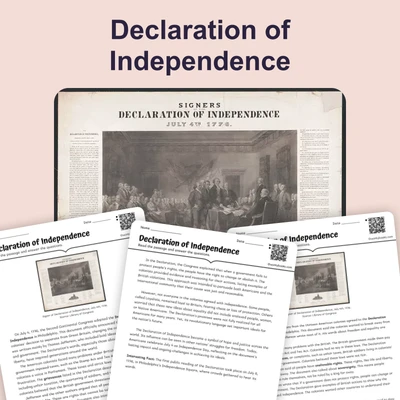
[Signing the Declaration of Independence]. Source: Library of Congress - Library of Congress
The United States became a new country after winning the Revolutionary War in 1783. The war was hard, but making one nation from thirteen different states was even harder. Each state had its own laws, money, and ways of doing things. The states wanted to keep their independence because they were used to making their own choices. But to be strong, they needed to work together as one country.
After the war, the states created the Articles of Confederation. This was the first plan for a national government. The Articles gave most of the power to the states and made a weak national government. Congress could not collect taxes or make strong laws. This caused many problems. For example, states argued about borders and trade. Sometimes, they even made their own deals with other countries.
Leaders like George Washington, James Madison, and Benjamin Franklin saw that the country needed a better plan. In 1787, they met in Philadelphia at the Constitutional Convention. They talked and argued for months. In the end, they wrote the United States Constitution. This new plan made a stronger national government with three branches: the legislative, executive, and judicial branches. Each branch had its own job.
But not everyone agreed right away. Many people worried that the new government would be too strong. To help everyone agree, the leaders promised to add a Bill of Rights. This is a list of important rights for the people. In 1789, the Constitution and Bill of Rights were accepted.
Building unity was not easy. The states had to learn to work together. They gave up some of their independence to build a stronger country. This helped America become the United States—one nation with many states.
Interesting Fact: The first U.S. flag had thirteen stars and thirteen stripes—one for each original state.
When did the Revolutionary War end?
1783177617871789
What was the first plan of government?
Articles of ConfederationDeclaration of IndependenceBill of RightsEmancipation Proclamation
Who was NOT at the Constitutional Convention?
George WashingtonJames MadisonBenjamin FranklinAbraham Lincoln
Why did states keep their own laws?
They wanted independenceThey liked British ruleThey had no leadersThey wanted new money
What problem did the Articles cause?
States argued and made own dealsToo much tradeNo leadersToo many taxes
Why was the Bill of Rights added?
To protect people's rightsTo make more moneyTo end the warTo create borders
The Constitution was written in 1787. True or false?
TrueFalse
What does 'legislative' mean?
Makes lawsCarries out lawsDecides lawsCollects taxes
Perfect For:
👩🏫 Teachers
• Reading comprehension practice
• Auto-graded assessments
• Literacy skill development
👨👩👧👦 Parents
• Reading practice at home
• Comprehension improvement
• Educational reading time
🏠 Homeschoolers
• Reading curriculum support
• Independent reading practice
• Progress monitoring
Reading Features:
📖
Reading Passage
Engaging fiction or nonfiction text
❓
Comprehension Quiz
Auto-graded questions
📊
Instant Feedback
Immediate results and scoring
📄
Printable Version
Download for offline reading
🔊
Read Aloud
Voice-over with word highlighting
Reviews & Ratings
No reviews yet. Be the first to share your experience!
Related Content
Identify Main Idea Graphic Organizer
This graphic organizer on main idea includes space to write the main idea and three supporting details.
RI.1.2RI.2.2RI.3.2RI.4.2
Main Idea and Suporting Details Graphic Organizer
This graphic organizer on main idea includes space to write the main idea and three supporting details.
RI.1.2RI.2.2RI.3.2RI.4.2
Snorkeling & Scuba Diving
RI.2.2RI.2.6RI.2.10RF.2.4.A
Main Idea and Details Graphic Organizer
This graphic organizer on main idea includes space to write the main idea and three supporting details.
RI.1.2RI.2.2RI.3.2RI.4.2
The Space Needle
Students read a passage about the history and features of Seattle's Space Needle, then answer comprehension questions to...
RI.4.2
The Rubik's Cube
RI.2.2RI.2.6RI.2.10RF.2.4.A
Graphic Organizer for Main Idea
This graphic organizer on main idea includes space to write the main idea and three supporting details.
RI.1.2RI.2.2RI.3.2RI.4.2
Pollination: A Crucial Ecosystem Service
Explore the vital role of pollination beyond plant reproduction, as it sustains ecosystems by ensuring food security, pr...
RI.4.2RI.4.3RI.4.4RI.5.1
The States of Matter: Solid
Discover the differences between solids, liquids and gases by exploring how their particles are arranged and move. This ...
RI.4.2RI.4.3RI.4.4RI.5.1
What is a Simple Machine
Discover the power of simple machines! This informational text explores how basic tools like levers, pulleys and incline...
RI.4.2RI.4.3RI.4.4RI.5.1
How Do Scientists Study Past Climates?
Students will analyze how tools like ice cores and tree rings provide scientific evidence about Earth’s historical clima...
RI.4.1RI.4.2RI.4.3.4.RI.4.74-ESS2-2
The Role of Pollinators in Nature
Learn about the fascinating world of pollinators and discover their crucial role in the reproductive process of flowerin...
RI.4.2RI.4.3RI.4.4RI.5.1
Seed Dispersal: How Plants Travel
Plants may seem stationary, but their seeds have amazing ways to travel! Explore the fascinating world of seed dispersal...
RI.4.2RI.4.3RI.4.4RI.5.1
Earth Day and Types of Pollution
Earth Day is coming! Get ready to learn about pollution and test your knowledge. Click for a free reading passage and qu...
RI.4.1RI.4.2ESS3.CESS3.A
Earth Day and Green Initiatives
Celebrate Earth Day with this fun and educational activity! Students will begin by reading a short passage that explains...
RI.4.1RI.4.2ESS3.CESS3.A
Exploring Space: Rockets and Spacecraft
Space exploration has been one of humanity's greatest achievements, made possible by rockets and spacecraft. Rockets act...
RI.4.4RI.4.2
The Water Cycle
The water cycle describes how water continuously moves through our planet via evaporation, condensation, precipitation, ...
RI.4.4RI.4.2
The Nitrogen Cycle
The nitrogen cycle describes how nitrogen moves through the air, soil, and living organisms. It involves processes like ...
RI.4.4RI.4.2
The Life Cycle of a Frog
The frog's life cycle takes it from water to land in amazing stages. Starting as eggs, they hatch into tadpoles, grow le...