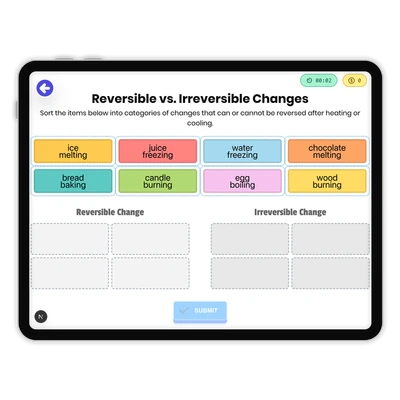
This learning resource is available in interactive and printable formats. The interactive worksheet can be played online and assigned to students. The Printable PDF version can be downloaded and printed for completion by hand.
This engaging science passage introduces Grade 4-5 students to the concept of how matter can change, meeting NGSS standards for understanding matter and its interactions. The passage explains key vocabulary such as physical and chemical changes, properties, and states of matter, using real-world examples like melting ice, burning wood, and baking a cake. Students will learn the difference between changes that can be reversed and those that cannot. The resource includes a glossary, Spanish translation, a multiple-choice quiz, and writing activities to deepen understanding and encourage critical thinking. Designed at the Grade 4-5 reading level, the passage uses clear language and is audio integrated, making it accessible for all learners. This is an excellent resource for teachers looking to reinforce science concepts and vocabulary in the classroom.
CONTENT PREVIEW
Expand content preview
Burning wood is chemical change. Image by Antonio Batinić / Pexels.
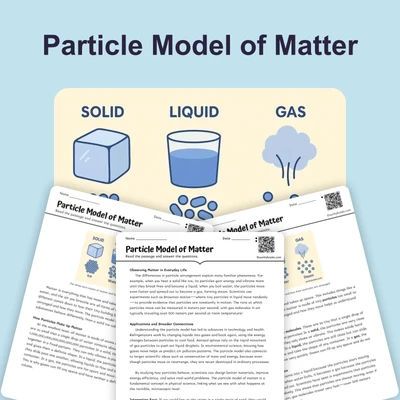
Matter is anything that takes up space and has mass. Everything around you—water, air, rocks, and even your favorite snack—is made of matter. Matter can be found in three main forms called states of matter: solid, liquid, and gas. But did you know that matter can change from one form to another?
There are two main ways that matter can change: physical changes and chemical changes. A physical change happens when matter changes its size, shape, or state, but it is still the same substance. For example, when ice melts into water, it is still water. Cutting paper into smaller pieces is also a physical change, because the paper is still paper. Physical changes are often easy to reverse.
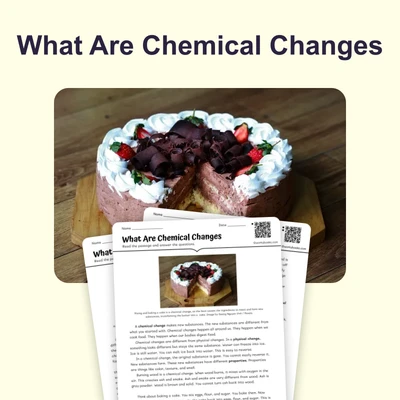
A chemical change happens when matter forms a new substance with different properties. This means the change cannot be easily undone. For example, when you bake a cake, the ingredients mix and react to make something new. Burning wood is another chemical change. After the wood burns, it turns into ash and cannot become wood again. Signs of a chemical change include a color change, heat or light being given off, or the formation of gas bubbles.
Scientists use the word property to describe how matter looks, feels, or behaves. Properties can include color, texture, and whether something is hard or soft. Changing the state of matter, like boiling water to make steam, is a physical change because water is still water, just in a different state.
Understanding how matter changes helps us in everyday life. We use physical changes when we freeze juice to make popsicles. We use chemical changes when we cook food, like baking bread or frying eggs.
Interesting Fact: The Statue of Liberty’s green color is a result of a chemical change called oxidation, which happened when the copper surface reacted with air and water over many years!
What are the three states of matter?
Solid, liquid, gasRock, water, airWood, metal, plasticEarth, wind, fire
What is a physical change?
Change in size or shapeMaking a new substanceChanging color onlyMixing liquids
Which is a chemical change?
Burning woodMelting iceCutting paperFreezing juice
What happens when you bake a cake?
A chemical change occursNothing changesA physical change onlyIt becomes a liquid
Which is an example of a reversible change?
Melting iceBurning woodBaking breadRusting iron
Why does the Statue of Liberty look green?
OxidationPaintingSunlightPhysical change
All physical changes are easy to reverse.
TrueFalse
What does 'property' mean in science?
How matter looks or behavesWhere matter is foundWho owns somethingHow much it costs
Perfect For:
👩🏫 Teachers
• Reading comprehension practice
• Auto-graded assessments
• Literacy skill development
👨👩👧👦 Parents
• Reading practice at home
• Comprehension improvement
• Educational reading time
🏠 Homeschoolers
• Reading curriculum support
• Independent reading practice
• Progress monitoring
Reading Features:
📖
Reading Passage
Engaging fiction or nonfiction text
❓
Comprehension Quiz
Auto-graded questions
📊
Instant Feedback
Immediate results and scoring
📄
Printable Version
Download for offline reading
🔊
Read Aloud
Voice-over with word highlighting
Reviews & Ratings
No reviews yet. Be the first to share your experience!
Related Content
Physical Properties of Matter
This comprehensive reading passage introduces grades 6-8 students to the concept of physical properties of matter, perfe...
MS-PS1-1
What Are Physical Changes?
This engaging Grade 4-5 science passage introduces students to the concept of physical changes in matter, aligning with ...
Physical Changes: Evaporation
This middle school science passage examines the process of evaporation, a fundamental physical change where a liquid tur...
MS-PS1-4
Kinetic Theory of Matter
This middle school science reading passage introduces students to the kinetic theory of matter, aligning with NGSS MS-PS...
MS-PS1-4
The Nature of Science
This passage explores the nature of science for middle school students, aligning with NGSS standards MS-ETS1-4, MS-PS1-1...
MS-ETS1-4MS-PS1-1MS-LS1-1
Particle Model of Matter
This comprehensive science reading passage for grades 6-8 explores the particle model of matter, aligning with NGSS stan...
MS-PS1-1MS-PS1-4
Physical Changes: Deposition
This middle school science passage explores the concept of deposition, a type of physical change where matter transition...
MS-PS1-4
Physical Changes: Sublimation
This educational passage for grades 6-8 explores the science of sublimation—a physical change where a solid transforms d...
MS-PS1-4
Physical Changes: Condensation
This middle school science passage explores the process of condensation, the physical change where a gas becomes a liqui...
MS-PS1-4
Is Evaporation a Physical Change
"This reading passage is designed for middle school students to explore the concept of evaporation and its classificatio...
Chemical Properties of Matter
This engaging middle school science passage explores the chemical properties of matter, focusing on how these properties...
MS-PS1-2
Science Vocabulary
This worksheet on domain-specific words will help students learn some science vocabulary. Students will be asked to matc...
L.3.6L.3.4.A
Simple Machines Science Report
This science writing task requires students to clearly explain how three simple machines work using precise domain-speci...
W.5.4
Matter States Word Sort
This interactive word sort focuses on helping students understand the different states of matter through real-world exam...
PS1.A
What Is Density?
This comprehensive science passage introduces middle school students (grades 6-8) to the concept of density, aligned wit...
MS-PS1-1
Matter States Word Sort
This classification activity helps students understand how particles are arranged in different states of matter. Student...
5-PS1-1
The Idea of the Atom
This informational science passage introduces middle school students (grades 6-8) to the concept that all matter is made...
MS-PS1-1
What Is Earth Science?
This engaging middle school science passage introduces students to the field of Earth science, aligning with NGSS standa...
MS-ESS1MS-ESS2MS-ESS3SEP
Citizen Science and Ecological Monitoring
This engaging passage for grades 6-8 introduces the concept of citizen science and its critical role in ecological monit...