This learning resource is available in interactive and printable formats. The interactive worksheet can be played online and assigned to students. The Printable PDF version can be downloaded and printed for completion by hand.
This science reading passage provides a clear and engaging explanation of ionic bonds for a middle school audience. It defines ionic bonds as the result of electron transfer between atoms, leading to the formation of positively charged cations and negatively charged anions. The passage uses relatable examples like table salt (sodium chloride) to illustrate the concept. It also highlights the properties of ionic compounds, such as their high melting points and conductivity when molten or dissolved. The content aligns with NGSS standards related to the structure and properties of matter (MS-PS1-1), fostering a deeper understanding of chemical bonding in everyday substances.
CONTENT PREVIEW
Expand content preview
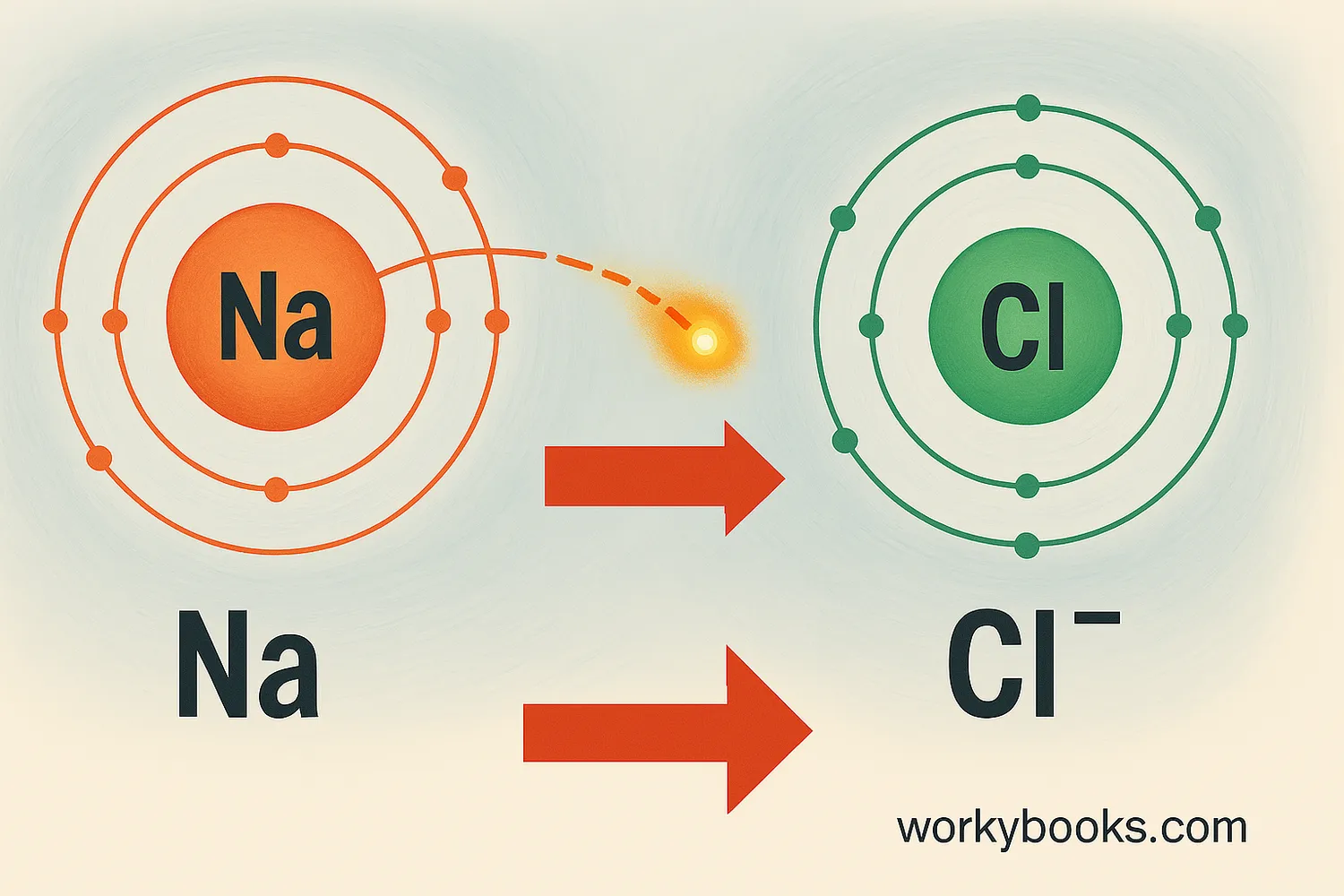
This illustration depicts the formation of an ionic bond between a sodium atom and a chlorine atom, showcasing the transfer of an electron and the resulting attraction of oppositely charged ions to form sodium chloride (table salt).
An ionic bond is a fundamental type of chemical bond formed by the electrostatic attraction between oppositely charged ions. This bond results from the complete transfer of one or more electrons from one atom to another. The formation of ionic bonds is driven by the atoms' tendency to achieve a stable electron configuration, typically a full outermost electron shell.
The process begins with the formation of ions. Atoms that readily lose electrons are typically metals (like sodium) and become positively charged ions, known as cations. Conversely, atoms that tend to gain electrons are usually nonmetals (like chlorine) and become negatively charged ions, called anions. The electrostatic force of attraction between these oppositely charged cations and anions is what constitutes the ionic bond.
A classic example of an ionic bond is the formation of sodium chloride (table salt). A sodium atom (Na), a metal, has one electron in its outer shell. It transfers this electron to a chlorine atom (Cl), a nonmetal, which needs one electron to complete its outer shell. This transfer results in a stable, positively charged sodium cation (Na+) and a stable, negatively charged chloride anion (Cl−). The powerful electrostatic attraction between these two ions forms the ionic bond in the compound NaCl.
Ionic compounds, such as sodium chloride, exhibit several distinct properties due to the strength of their ionic bonds. They typically form crystalline solids with ordered structures and possess very high melting and boiling points. This is because a significant amount of energy is required to overcome the strong electrostatic forces holding the ions together. Furthermore, while ionic compounds are poor conductors of electricity in their solid state, they become excellent conductors when melted or dissolved in water, as the ions are then free to move and carry an electrical charge.
Fun Fact: Every single atom in a giant crystal of table salt (sodium chloride) is held in place by an ionic bond, creating a repeating 3D lattice structure.
What is the primary characteristic of an ionic bond?
Sharing of electronsTransfer of electronsWeak attraction between atomsFormation of neutral atoms
What type of ion is formed when an atom loses electrons?
AnionCationMoleculeCompound
Which type of element typically forms cations in an ionic bond?
NonmetalsMetalsNoble gasesHalogens
What is the name of the negatively charged ion formed when a chlorine atom gains an electron?
ChlorateChlorideChlorine ionChlorite
Why do atoms form ionic bonds?
To become largerTo change colorTo achieve stabilityTo become less reactive
Which of the following is a common property of ionic compounds mentioned in the passage?
Low melting pointsGaseous at room temperatureGood conductors when moltenSoft and easily broken
What is the main idea of this reading passage?
All chemical bonds involve electron sharing.Ionic bonds are only found in living organisms.Ionic bonds involve electron transfer to form charged ions.Metals are always negatively charged.
If an atom of potassium (a metal) reacts with an atom of fluorine (a nonmetal), what type of bond is most likely to form?
Covalent bondMetallic bondIonic bondHydrogen bond
Perfect For:
👩🏫 Teachers
• Reading comprehension practice
• Auto-graded assessments
• Literacy skill development
👨👩👧👦 Parents
• Reading practice at home
• Comprehension improvement
• Educational reading time
🏠 Homeschoolers
• Reading curriculum support
• Independent reading practice
• Progress monitoring
Reading Features:
📖
Reading Passage
Engaging fiction or nonfiction text
❓
Comprehension Quiz
Auto-graded questions
📊
Instant Feedback
Immediate results and scoring
📄
Printable Version
Download for offline reading
🔊
Read Aloud
Voice-over with word highlighting
Reviews & Ratings
No reviews yet. Be the first to share your experience!
Related Content
Physical Properties of Matter
This comprehensive reading passage introduces grades 6-8 students to the concept of physical properties of matter, perfe...
MS-PS1-1
Changes in Matter
This engaging science passage introduces Grade 4-5 students to the concept of how matter can change, meeting NGSS standa...
What Are Physical Changes?
This engaging Grade 4-5 science passage introduces students to the concept of physical changes in matter, aligning with ...
Physical Changes: Evaporation
This middle school science passage examines the process of evaporation, a fundamental physical change where a liquid tur...
MS-PS1-4
Kinetic Theory of Matter
This middle school science reading passage introduces students to the kinetic theory of matter, aligning with NGSS MS-PS...
MS-PS1-4
The Nature of Science
This passage explores the nature of science for middle school students, aligning with NGSS standards MS-ETS1-4, MS-PS1-1...
MS-ETS1-4MS-PS1-1MS-LS1-1
Physical Changes: Deposition
This middle school science passage explores the concept of deposition, a type of physical change where matter transition...
MS-PS1-4
Particle Model of Matter
This comprehensive science reading passage for grades 6-8 explores the particle model of matter, aligning with NGSS stan...
MS-PS1-1MS-PS1-4
Physical Changes: Sublimation
This educational passage for grades 6-8 explores the science of sublimation—a physical change where a solid transforms d...
MS-PS1-4
Physical Changes: Condensation
This middle school science passage explores the process of condensation, the physical change where a gas becomes a liqui...
MS-PS1-4
Is Evaporation a Physical Change
"This reading passage is designed for middle school students to explore the concept of evaporation and its classificatio...
Chemical Properties of Matter
This engaging middle school science passage explores the chemical properties of matter, focusing on how these properties...
MS-PS1-2
Science Vocabulary
This worksheet on domain-specific words will help students learn some science vocabulary. Students will be asked to matc...
L.3.6L.3.4.A
Simple Machines Science Report
This science writing task requires students to clearly explain how three simple machines work using precise domain-speci...
W.5.4
Matter States Word Sort
This interactive word sort focuses on helping students understand the different states of matter through real-world exam...
PS1.A
What Is Density?
This comprehensive science passage introduces middle school students (grades 6-8) to the concept of density, aligned wit...
MS-PS1-1
The Idea of the Atom
This informational science passage introduces middle school students (grades 6-8) to the concept that all matter is made...
MS-PS1-1
What Is Earth Science?
This engaging middle school science passage introduces students to the field of Earth science, aligning with NGSS standa...
MS-ESS1MS-ESS2MS-ESS3SEP
Matter States Word Sort
This classification activity helps students understand how particles are arranged in different states of matter. Student...
5-PS1-1
Citizen Science and Ecological Monitoring
This engaging passage for grades 6-8 introduces the concept of citizen science and its critical role in ecological monit...