16th Amendment
Interactive passage with audio narration, comprehension questions, and printable PDF.
By completing this purchase you agree to our Terms of Use and Privacy Policy. Your subscription renews automatically until you cancel. You can cancel anytime from your account settings. All sales are final and non-refundable. Digital content is available for download in your account immediately upon purchase.
What's included
16th Amendment preview and details
About this printable 16th Amendment reading passage (Grades 6-8)
Sample passage and quiz from 16th Amendment
Reading passage and comprehension quiz preview
16th Amendment
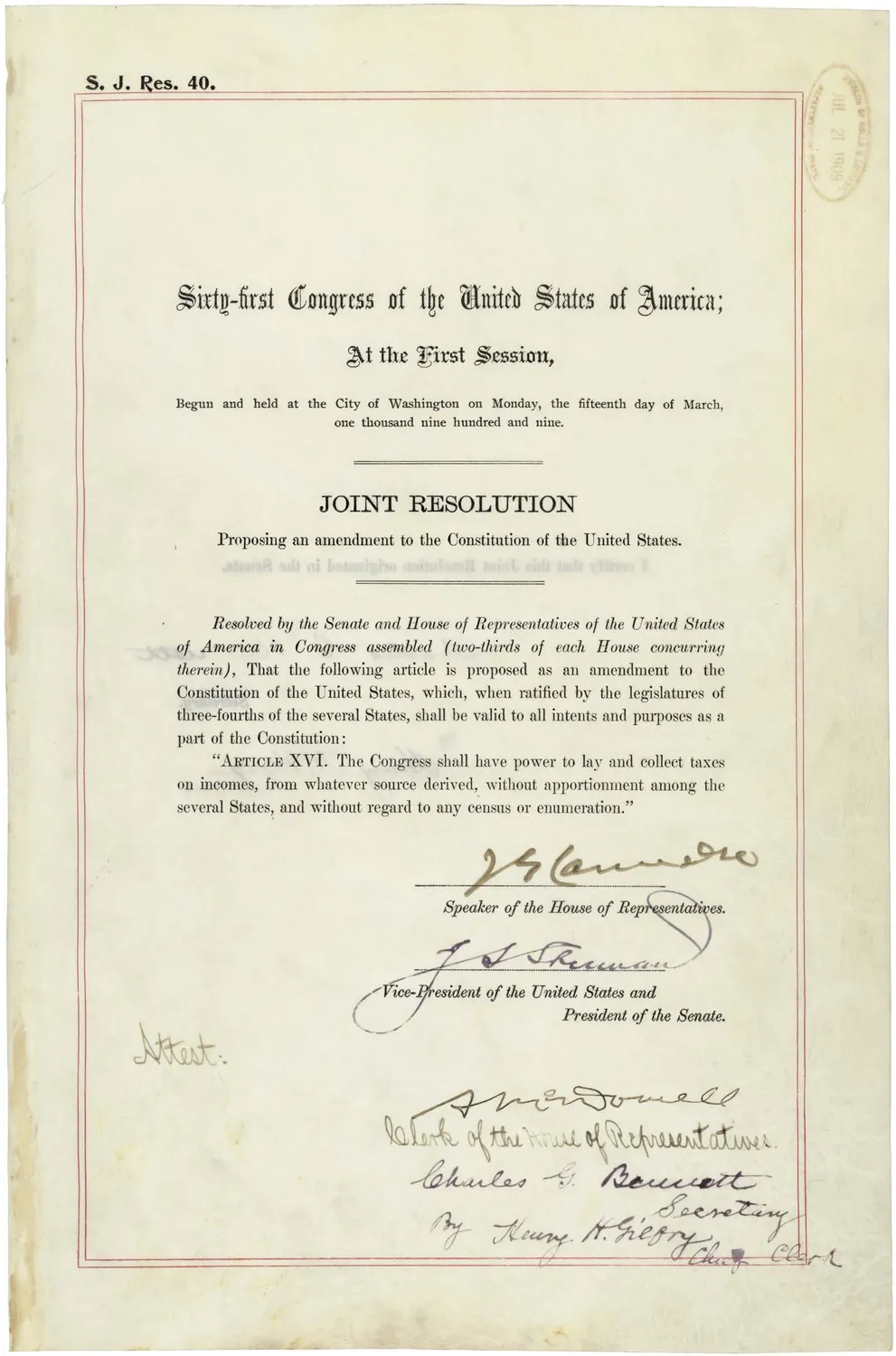
"16th Amendment Pg1of1 AC" by National Archives of the United States / Wikimedia Commons (Public domain).
The 16th Amendment to the United States Constitution, ratified in 1913, gave Congress the power to collect a federal income tax. Before this amendment, the federal government mostly relied on tariffs—taxes on imported goods—for revenue. However, tariffs were often seen as unfair because they made everyday items more expensive, especially for working-class Americans. As the nation grew in the late 1800s and early 1900s, demands for government services increased. The Progressive Era was a time when many Americans wanted reforms to make society fairer and reduce economic inequality.
One major problem was that the government did not have enough money to fund new programs, such as public schools, roads, and sanitation. At the same time, the tax system was considered regressive, meaning poorer people paid a higher percentage of their income compared to the wealthy. Progressives argued that a federal income tax would be more equitable, requiring those with higher incomes to pay a larger share.
Efforts to create an income tax began before the 16th Amendment. In 1894, Congress passed a law establishing a national income tax, but the Supreme Court ruled it unconstitutional in the case of Pollock v. Farmers' Loan & Trust Co. This setback convinced reformers that a constitutional amendment was necessary to solve the problem. After years of debate and advocacy, Congress approved the 16th Amendment in 1909, and it was ratified by the states in 1913.
The new income tax system was designed to be progressive, so wealthier people paid higher rates. This change provided the federal government with a stable source of revenue and allowed it to expand its role in American life. It also shifted the balance of power between the federal and state governments, giving Congress more control over national policies.
Despite these benefits, the amendment was not without controversy. Some Americans feared that a federal income tax would give the government too much power over individuals’ finances. Others worried about the potential for unfair tax laws. However, supporters argued that a fair tax system was essential for funding public services and promoting the common good.
In the years following its adoption, the federal income tax enabled the government to invest in infrastructure, education, defense, and social programs. Over time, tax rates and policies have changed, but the principle established by the 16th Amendment remains central to the way the U.S. government operates today.
Interesting Fact: The first federal income tax rates were very low compared to modern times, with most Americans paying just 1% of their income.
Comprehension quiz (8 questions)
1. When was the 16th Amendment ratified?
2. What tax did the 16th Amendment allow?
3. Which era led to the amendment?
4. Why did some people dislike the income tax?
5. How did income tax help government?
6. What does a progressive tax mean?
7. The 16th Amendment is still important today. True or false?
8. What is 'ratified'?
Perfect for the way you teach
- Build comprehension skills
- Auto-graded quiz
- Differentiated reading
- Read together at home
- Improve fluency
- Quiet reading time
- Reading curriculum support
- Independent practice
- Track Lexile growth