Mercy Otis Warren: Political Writer — Reading Comprehension
Rate this
Premium Resource
Present
Present in classroom. No work saved
Assign
Classroom with student accounts, Track progress
Quick Play
No student accounts, assign with a link
Grades
6
7
8
Standards
HSS 5.6.3
8.1
RI.6-8.1
RI.6-8.6
PRINT+DIGITAL RESOURCE
This learning resource is available in interactive and printable formats. The interactive worksheet can be played online and assigned to students. The Printable PDF version can be downloaded and printed for completion by hand.
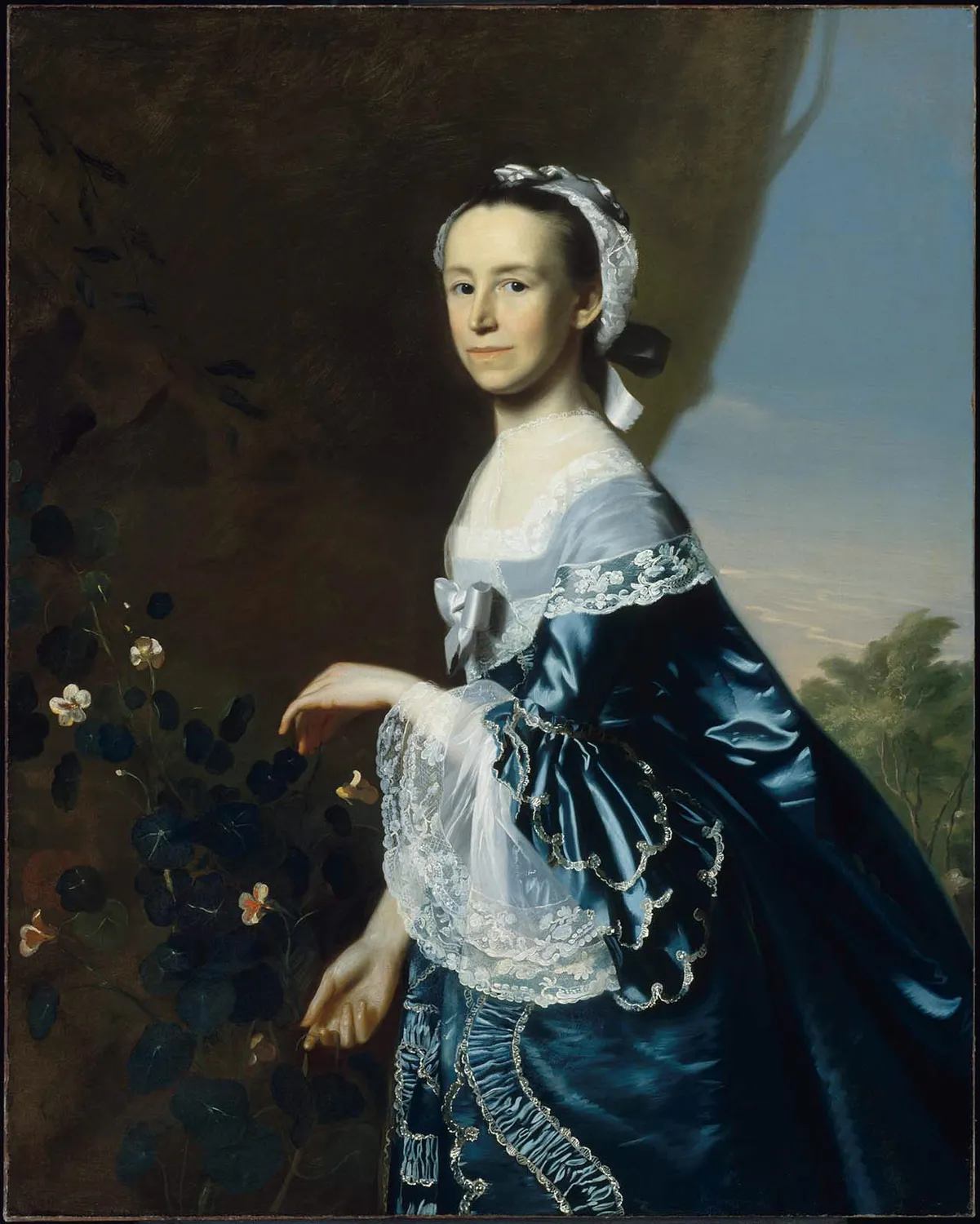
This passage explores the life and impact of Mercy Otis Warren, a significant political writer during the American Revolution. Students will learn how Warren used her talent for satire and propaganda to challenge British authority and influence colonial opinion. The text highlights her role as an intellectual and historian, including her authorship of the first comprehensive history of the Revolution. The passage addresses key academic vocabulary, encourages analysis of the power of writing in shaping events, and models evidence-based historical reasoning. Activities include quizzes, writing prompts, graphic organizers, and a timeline. Spanish translation, differentiated versions, and read aloud audio are provided. This resource aligns with standards HSS 5.6.3, 8.1, RI.6-8.1, and RI.6-8.6, making it an ideal tool for developing historical understanding and literacy skills.
Mercy Otis Warren was a leading political writer during the American Revolution. In a time when few women were public figures, Warren used her sharp mind and powerful words to challenge British authority in the colonies. She wrote satire-filled plays and pamphlets that criticized British officials, exposing their unjust actions and influencing public opinion. Her work became a form of propaganda, aiming to persuade colonists to resist British rule.
Warren was born in Massachusetts in 1728, into a family that valued education. Unlike most girls at the time, she had access to her brother's books and learned about history, politics, and literature. This early education helped her develop into a strong intellectual leader. Although women were expected to remain silent in political matters, Warren refused to follow these restrictions. Instead, she formed deep friendships with key revolutionary figures such as Samuel Adams, John Adams, and Abigail Adams. These connections allowed her to stay informed and share her ideas within influential circles.
During the years leading up to the Revolution, colonists faced growing problems from British laws and taxes. Warren responded by turning her pen into a weapon. Through her writing, she highlighted the unfairness of British policies like the Stamp Act and Townshend Acts. Her satirical plays, including "The Adulator" and "The Group," mocked British leaders and revealed the dangers of colonial obedience to unjust laws. These works not only entertained but also rallied colonists to stand against tyranny.
Warren's pamphlets and plays served as tools of resistance. She showed that words could inspire action and unite people toward a common purpose. Her ability to use evidence and sharp reasoning made her a credible voice in the debate for independence. As the Revolution unfolded, Warren recorded important events and debates, carefully considering multiple viewpoints. This approach demonstrated a key skill of a true historian: examining the complexities of history rather than presenting only one side.
After the war, Warren continued her work by writing one of the first complete histories of the American Revolution. Her book, published in 1805, offered a detailed account of the conflict, the ideas that fueled it, and the people who shaped its outcome. She believed it was important for future generations to understand both the achievements and the challenges of the nation's founding.
Warren's legacy reminds us that the fight for justice and freedom often requires courage, determination, and the power of ideas. As a political writer, she proved that anyone—regardless of gender—can shape history through words and critical thought.
Interesting Fact: Mercy Otis Warren signed many of her early works anonymously or as "A Columbian Patriot" because it was uncommon for women to publish political writings during her time.
What did Mercy Otis Warren write?
Plays and pamphletsNovels and poemsLetters and diariesMaps and charts
When was Mercy Otis Warren born?
1728175018051776
What was one result of Warren's writing?
Colonists were inspired to resistBritish leaders praised herShe became a soldierShe moved to England
Why did Warren use satire in her plays?
To criticize British leadersTo tell fairy talesTo teach mathTo report news
How did Warren challenge women's roles?
She spoke about politicsShe became a queenShe was a farmerShe joined the army
Which act did Warren oppose?
Stamp ActSugar ActNavigation ActAlien Act
Mercy Otis Warren was a historian. True or false?
TrueFalse
What is propaganda?
Information to persuade peopleA type of foodA British lawA famous battle
Perfect For:
👩🏫 Teachers
• Reading comprehension practice
• Auto-graded assessments
• Literacy skill development
👨👩👧👦 Parents
• Reading practice at home
• Comprehension improvement
• Educational reading time
🏠 Homeschoolers
• Reading curriculum support
• Independent reading practice
• Progress monitoring
Reading Features:
📖
Reading Passage
Engaging fiction or nonfiction text
❓
Comprehension Quiz
Auto-graded questions
📊
Instant Feedback
Immediate results and scoring
📄
Printable Version
Download for offline reading
🔊
Read Aloud
Voice-over with word highlighting
Reviews & Ratings
No reviews yet. Be the first to share your experience!
Related Content
Benjamin Franklin in Colonial America
This U.S. History reading passage explores the life and influence of Benjamin Franklin, a key colonial leader whose idea...
HSS 5.58.1RI.6-8.1RI.6-8.3
Colonial Printing Press
This passage explores the revolutionary impact of the colonial printing press in America, examining how it enabled the s...
HSS 5.58.1RI.6-8.1RI.6-8.2
Cities in Colonial America
This engaging U.S. history reading passage explores the rise of colonial American cities such as Boston, Philadelphia, a...
HSS 5.4.68.1RI.6-8.1RI.6-8.7
Frontier Life in Colonial America
This passage examines the realities of frontier life in colonial America, highlighting both the promise and peril faced ...
HSS 5.4.68.1RI.6-8.1RI.6-8.2
Crispus Attucks
This comprehensive U.S. History reading passage examines the life and legacy of Crispus Attucks, the first person killed...
HSS 5.5.38.1RI.6-8.1RI.6-8.3
Pocahontas: Myth vs. Historical Reality
This passage explores the nuanced history of Pocahontas, moving beyond the myth made popular by movies and stories. Stud...
HSS 5.3.1RI.6-8.1RI.6-8.8
Roger Williams Religious Freedom
This passage explores the life and legacy of Roger Williams, a key figure in Colonial America who was banished from Mass...
HSS 5.4.38.2.2RI.6-8.1RI.6-8.6
Colonial Apprenticeship System
This comprehensive passage explores the Colonial Apprenticeship System and its role in education during Colonial America...
HSS 5.4.6RI.6-8.1RI.6-8.2
Lewis and Clark Expedition
This comprehensive U.S. History reading passage explores the Lewis and Clark Expedition (1804-1806), a pivotal journey l...
HSS 8.4.18.8.2RI.6-8.1RI.6-8.3
Exodusters
This passage explores the migration of Exodusters—African Americans who left the South in the 1870s to escape discrimina...
HSS 8.12.1RI.6-8.1RI.6-8.2
Uncle Tom's Cabin
This passage explores the impact of Harriet Beecher Stowe’s Uncle Tom’s Cabin on American society in the 1850s. It exami...
HSS 8.9.48.10.2RI.6-8.1RI.6-8.6
Dred Scott Decision
This rigorous history reading passage delves into the 1857 Dred Scott Decision, a pivotal moment in the lead-up to the C...
HSS 8.9.48.10.3RI.6-8.1RI.6-8.8
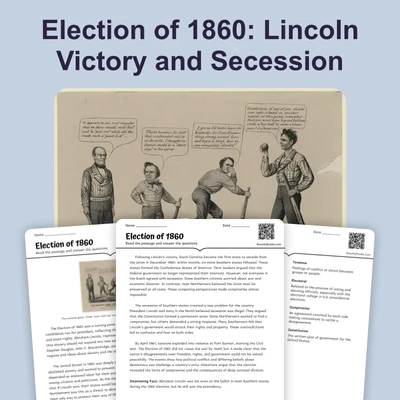
Election of 1860
This passage explores Abraham Lincoln’s election in 1860 and the critical reactions from Southern states, which set the ...
HSS 8.10.4RI.6-8.1RI.6-8.6
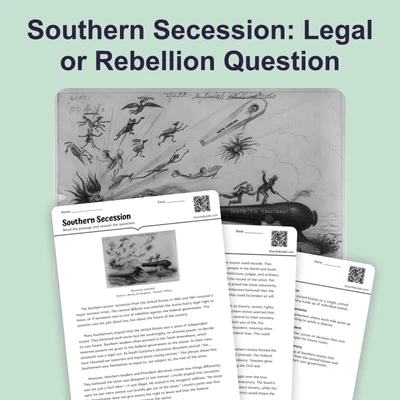
Southern Secession
This passage explores the significant moment in U.S. history when seven Southern states seceded from the Union after Abr...
HSS 8.10.4RI.6-8.1RI.6-8.2
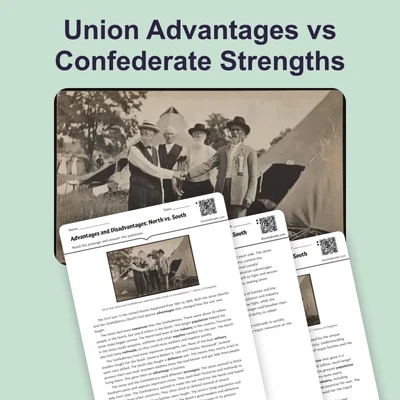
Advantages and Disadvantages: North vs. South
This history reading passage examines the contrasting strengths of the Union and Confederacy during the U.S. Civil War. ...
HSS 8.10.5RI.6-8.1RI.6-8.3
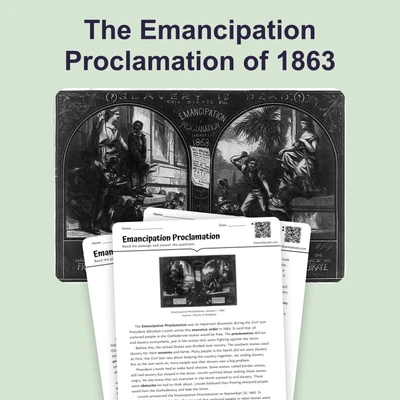
Emancipation Proclamation
This U.S. history passage explores the Emancipation Proclamation of 1863, an executive order issued by President Abraham...
HSS 8.10.6RI.6-8.1RI.6-8.3
Women's Roles in Civil War
This reading passage explores the critical roles women played during the U.S. Civil War, highlighting how they managed f...
HSS 8.10.7RI.6-8.1RI.6-8.2
Surrender at Appomattox
This reading passage explores the historic surrender at Appomattox Court House in April 1865, which marked the conclusio...
HSS 8.10.7RI.6-8.1RI.6-8.6
Abraham Lincoln Assassination
This passage explores the significant event of President Abraham Lincoln's assassination in April 1865, just days after ...