Martin Luther King Jr: Nonviolent Leader
Interactive passage with audio narration, comprehension questions, and printable PDF.
By completing this purchase you agree to our Terms of Use and Privacy Policy. Your subscription renews automatically until you cancel. You can cancel anytime from your account settings. All sales are final and non-refundable. Digital content is available for download in your account immediately upon purchase.
What's included
Martin Luther King Jr: Nonviolent Leader preview and details
About this printable Martin Luther King Jr: Nonviolent Leader reading passage (Grades 6-8)
Sample passage and quiz from Martin Luther King Jr: Nonviolent Leader
Reading passage and comprehension quiz preview
Martin Luther King Jr
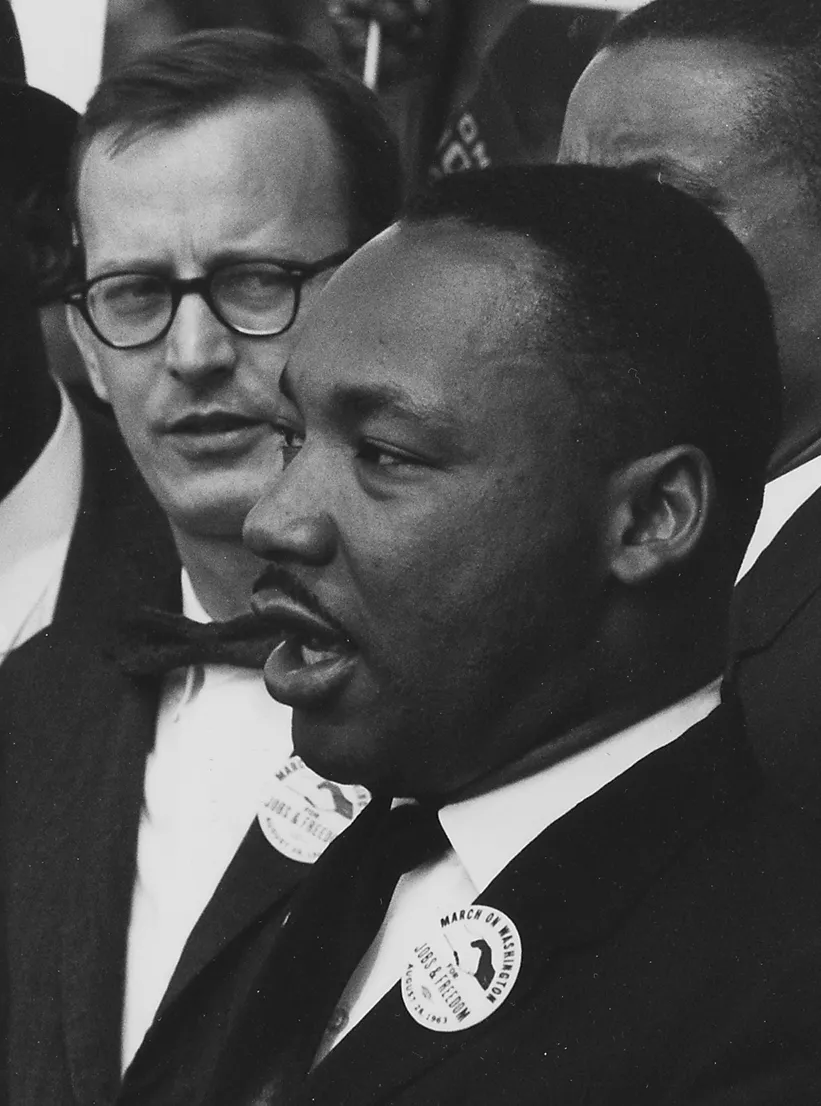
"Martin Luther King Jr and Matthew Ahmann" by Rowland Scherman / Wikimedia Commons (Public domain).
Martin Luther King Jr. became a central figure in the United States Civil Rights Movement because of his leadership and commitment to nonviolence. During the 1950s, many African Americans faced segregation and unfair treatment. Buses, schools, and even restaurants were separated by race. In 1955, Rosa Parks was arrested for refusing to give up her seat on a Montgomery, Alabama bus. This event sparked the Montgomery Bus Boycott, a protest demanding equal rights in public transportation.
King, a young minister at the time, was chosen to lead the boycott. His leadership was shaped by his study of Mahatma Gandhi's philosophy of nonviolent resistance. Gandhi had used peaceful protest to challenge British rule in India. King believed that using nonviolence would help African Americans achieve justice without causing more violence or hatred. He often spoke about the power of love and moral courage in facing injustice.
The Montgomery Bus Boycott lasted over a year, as African Americans refused to ride city buses. King and others faced threats, violence, and even arrests. Despite these hardships, they remained dedicated to their principles. Their determination inspired people across the country. In December 1956, the Supreme Court ruled that bus segregation was unconstitutional, ending the boycott and marking a significant victory for the movement.
King's approach was not without challenges. Some activists questioned whether nonviolence was effective or too slow in achieving change. Others admired King’s leadership, which helped to unite diverse groups within the movement. King became president of the Southern Christian Leadership Conference (SCLC), an organization that coordinated nonviolent protests throughout the South. He encouraged people to participate in marches, sit-ins, and other forms of peaceful protest. Each action was carefully planned to show discipline and respect, even when faced with hostility.
The philosophy of nonviolent resistance required participants to accept suffering without retaliation. King argued that this method could transform society and win support from people of all backgrounds. The Civil Rights Movement, under King’s guidance, achieved major successes, such as the Civil Rights Act of 1964 and the Voting Rights Act of 1965. However, the struggle for equality was complex, and progress depended on the courage and unity of many individuals, not just King alone.
Today, King’s legacy is remembered for advancing civil rights through nonviolent means. His methods influenced movements for justice around the world. While the fight for equality continues, King’s example shows how determined, peaceful actions can bring about lasting change.
Interesting Fact: Martin Luther King Jr. was the youngest person to receive the Nobel Peace Prize when he won it in 1964 for his efforts to end racial discrimination through nonviolent means.
Comprehension quiz (8 questions)
1. Who was arrested in Montgomery in 1955?
2. What did the Montgomery Bus Boycott protest?
3. What was King’s main strategy?
4. What did nonviolent resistance require?
5. Why did some activists question nonviolence?
6. What group did King lead?
7. King’s methods influenced others worldwide. True or false?
8. What does segregation mean?
Perfect for the way you teach
- Build comprehension skills
- Auto-graded quiz
- Differentiated reading
- Read together at home
- Improve fluency
- Quiet reading time
- Reading curriculum support
- Independent practice
- Track Lexile growth