Lewis and Clark Expedition — Reading Comprehension
Rate this|
1
Premium Resource
Present
Present in classroom. No work saved
Assign
Classroom with student accounts, Track progress
Quick Play
No student accounts, assign with a link
Grades
6
7
8
Standards
HSS 8.4.1
8.8.2
RI.6-8.1
RI.6-8.3
PRINT+DIGITAL RESOURCE
This learning resource is available in interactive and printable formats. The interactive worksheet can be played online and assigned to students. The Printable PDF version can be downloaded and printed for completion by hand.
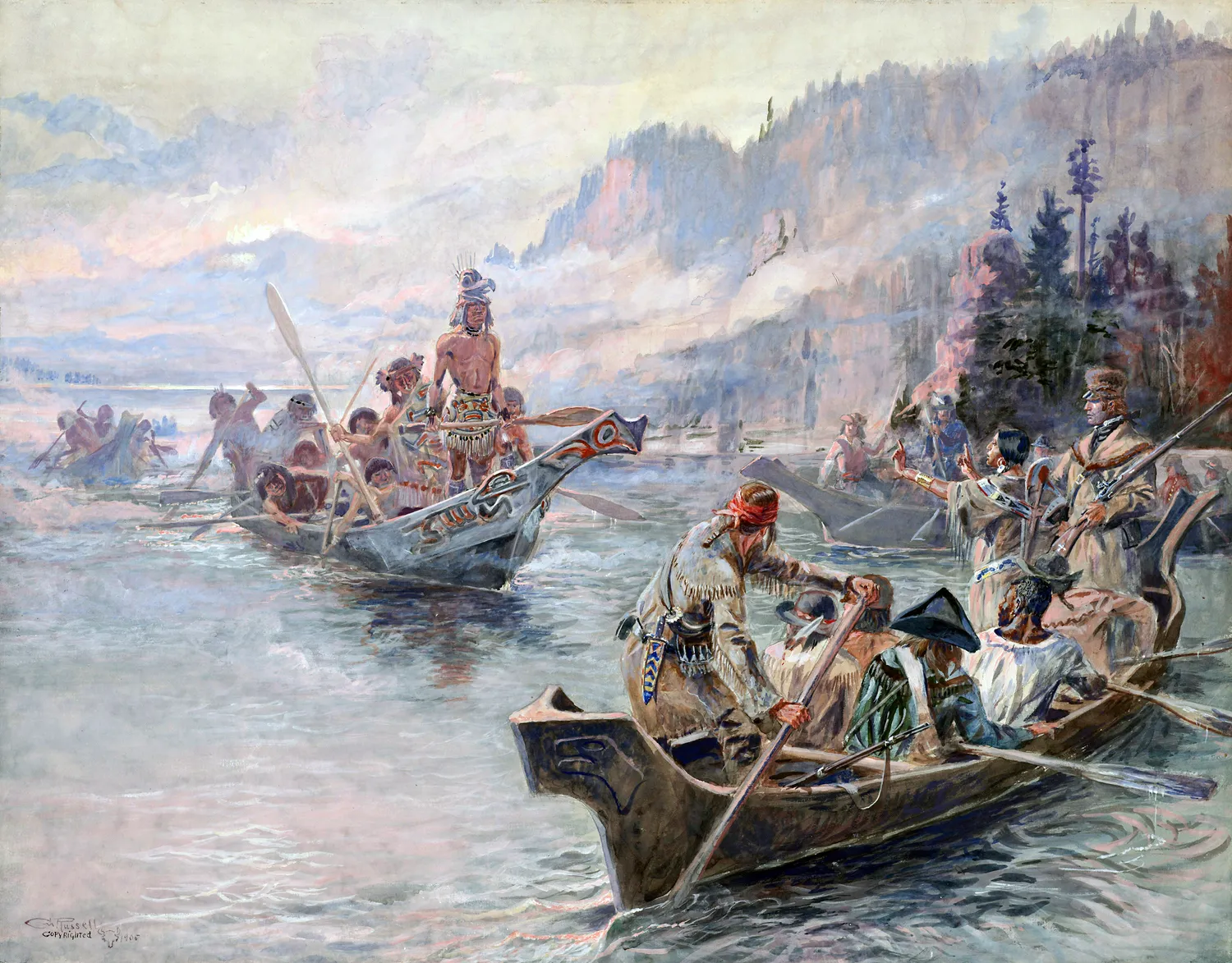
This comprehensive U.S. History reading passage explores the Lewis and Clark Expedition (1804-1806), a pivotal journey led by Meriwether Lewis and William Clark after President Thomas Jefferson acquired the Louisiana Purchase. Aligned to HSS 8.4.1, 8.8.2 and CCSS.RI.6-8.1, RI.6-8.3, the passage presents a nuanced look at the goals, challenges, and accomplishments of the Corps of Discovery. Students will analyze the expedition’s impact on American expansion, scientific documentation, and relationships with Native nations. In addition to the main passage, the resource includes a simplified differentiated version, a full Spanish translation, glossary, multiple-choice quiz, writing prompts, and graphic organizers. A timeline and a public domain image further support learning. This history reading passage is ideal for developing critical thinking, reading, and historical reasoning skills, and is supported by read aloud audio, accessible Spanish content, and rigorous activities for classroom or independent study.
The Lewis and Clark Expedition was a turning point in United States history. In 1803, President Thomas Jefferson doubled the size of the United States by purchasing the Louisiana Territory from France. However, very little was known about this vast land. To solve this problem, Jefferson sent Meriwether Lewis and William Clark to lead an expedition westward. Their goal was to explore the new territory, map travel routes, and learn about the region's plants, animals, and people.
Setting out in May 1804, Lewis and Clark led a group called the Corps of Discovery. This team included soldiers, boatmen, and later, important guides like Sacagawea, a Shoshone woman. Traveling mostly by river, the expedition faced difficult terrain, unpredictable weather, and the challenge of carrying supplies. The group demonstrated strong cooperation and problem-solving skills in order to survive the journey.
One of their main tasks was documentation. Lewis and Clark made detailed notes about unfamiliar plants, animals, and natural features. They also recorded information about the Native nations they met, such as the Mandan, Nez Perce, and Shoshone. These encounters were complex. While some meetings led to peaceful exchanges and alliances, misunderstandings and cultural differences sometimes resulted in tension.
The exploration also had a scientific purpose. The Corps of Discovery collected specimens and created maps that helped future settlers and scientists. Their observations became some of the first formal records of the American West. However, the expedition’s arrival signaled change for Native nations, as future waves of settlers would transform these lands.
After nearly two and a half years, the expedition returned to St. Louis in September 1806. Their journey had mapped a practical route to the Pacific and increased American knowledge of western geography, plants, and animals. The expedition’s legacy is both a story of discovery and of the complicated beginnings of westward expansion, which brought both opportunity and conflict.
Interesting Fact: The Corps of Discovery traveled more than 8,000 miles and only lost one member during their entire journey.
Who sent Lewis and Clark west?
President JeffersonPresident LincolnGeorge WashingtonBenjamin Franklin
What was the Corps of Discovery?
Lewis and Clark's teamA Native nationA French armyA river
When did the expedition begin?
May 1804July 1776September 1806March 1803
Why did Jefferson send the expedition?
Explore new territoryStart a warFind goldBuild a city
What was a challenge faced?
Difficult terrainPlenty of foodNo riversEasy weather
How did the expedition affect Native nations?
Brought change and conflictNo impactBrought peace onlyMade lands smaller
The Corps of Discovery lost only one member.
TrueFalse
What does 'documentation' mean?
Writing down informationFighting a warBuilding boatsMaking food
Perfect For:
👩🏫 Teachers
• Reading comprehension practice
• Auto-graded assessments
• Literacy skill development
👨👩👧👦 Parents
• Reading practice at home
• Comprehension improvement
• Educational reading time
🏠 Homeschoolers
• Reading curriculum support
• Independent reading practice
• Progress monitoring
Reading Features:
📖
Reading Passage
Engaging fiction or nonfiction text
❓
Comprehension Quiz
Auto-graded questions
📊
Instant Feedback
Immediate results and scoring
📄
Printable Version
Download for offline reading
🔊
Read Aloud
Voice-over with word highlighting
Reviews & Ratings
No reviews yet. Be the first to share your experience!
Related Content
Pocahontas: Myth vs. Historical Reality
This passage explores the nuanced history of Pocahontas, moving beyond the myth made popular by movies and stories. Stud...
HSS 5.3.1RI.6-8.1RI.6-8.8
Roger Williams Religious Freedom
This passage explores the life and legacy of Roger Williams, a key figure in Colonial America who was banished from Mass...
HSS 5.4.38.2.2RI.6-8.1RI.6-8.6
Benjamin Franklin in Colonial America
This U.S. History reading passage explores the life and influence of Benjamin Franklin, a key colonial leader whose idea...
HSS 5.58.1RI.6-8.1RI.6-8.3
Colonial Apprenticeship System
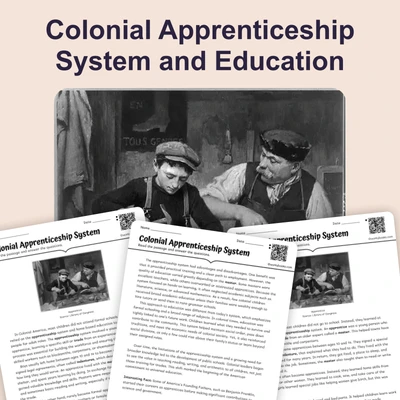
This comprehensive passage explores the Colonial Apprenticeship System and its role in education during Colonial America...
HSS 5.4.6RI.6-8.1RI.6-8.2
Colonial Printing Press
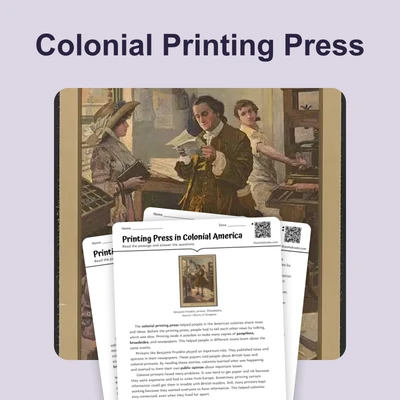
This passage explores the revolutionary impact of the colonial printing press in America, examining how it enabled the s...
HSS 5.58.1RI.6-8.1RI.6-8.2
Cities in Colonial America
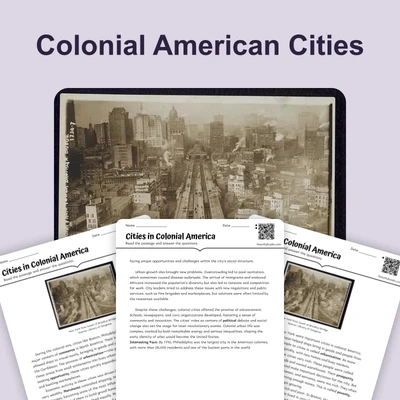
This engaging U.S. history reading passage explores the rise of colonial American cities such as Boston, Philadelphia, a...
HSS 5.4.68.1RI.6-8.1RI.6-8.7
Frontier Life in Colonial America
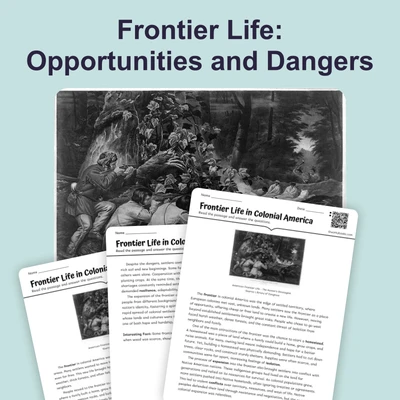
This passage examines the realities of frontier life in colonial America, highlighting both the promise and peril faced ...
HSS 5.4.68.1RI.6-8.1RI.6-8.2
Mercy Otis Warren: Political Writer
This passage explores the life and impact of Mercy Otis Warren, a significant political writer during the American Revol...
HSS 5.6.38.1RI.6-8.1RI.6-8.6
Crispus Attucks
This comprehensive U.S. History reading passage examines the life and legacy of Crispus Attucks, the first person killed...
HSS 5.5.38.1RI.6-8.1RI.6-8.3
Exodusters
This passage explores the migration of Exodusters—African Americans who left the South in the 1870s to escape discrimina...
HSS 8.12.1RI.6-8.1RI.6-8.2
Uncle Tom's Cabin
This passage explores the impact of Harriet Beecher Stowe’s Uncle Tom’s Cabin on American society in the 1850s. It exami...
HSS 8.9.48.10.2RI.6-8.1RI.6-8.6
Dred Scott Decision
This rigorous history reading passage delves into the 1857 Dred Scott Decision, a pivotal moment in the lead-up to the C...
HSS 8.9.48.10.3RI.6-8.1RI.6-8.8
Election of 1860
This passage explores Abraham Lincoln’s election in 1860 and the critical reactions from Southern states, which set the ...
HSS 8.10.4RI.6-8.1RI.6-8.6
Southern Secession
This passage explores the significant moment in U.S. history when seven Southern states seceded from the Union after Abr...
HSS 8.10.4RI.6-8.1RI.6-8.2
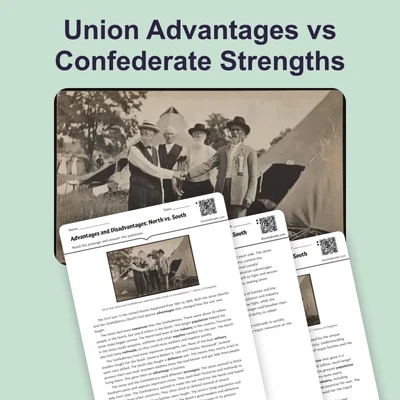
Advantages and Disadvantages: North vs. South
This history reading passage examines the contrasting strengths of the Union and Confederacy during the U.S. Civil War. ...
HSS 8.10.5RI.6-8.1RI.6-8.3
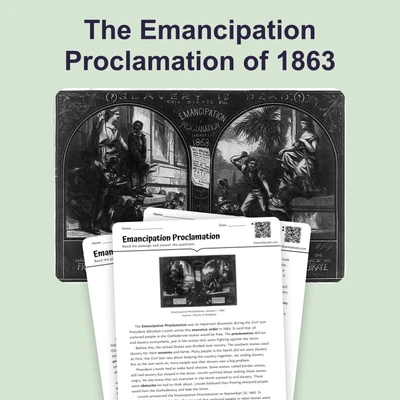
Emancipation Proclamation
This U.S. history passage explores the Emancipation Proclamation of 1863, an executive order issued by President Abraham...
HSS 8.10.6RI.6-8.1RI.6-8.3
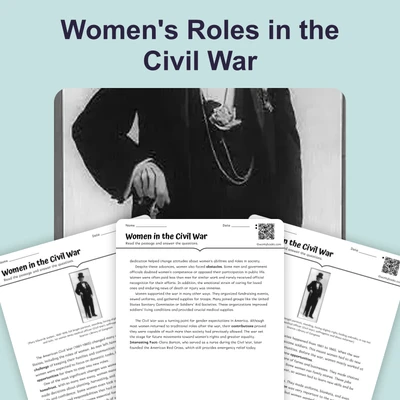
Women's Roles in Civil War
This reading passage explores the critical roles women played during the U.S. Civil War, highlighting how they managed f...
HSS 8.10.7RI.6-8.1RI.6-8.2
Surrender at Appomattox
This reading passage explores the historic surrender at Appomattox Court House in April 1865, which marked the conclusio...
HSS 8.10.7RI.6-8.1RI.6-8.6
Abraham Lincoln Assassination
This passage explores the significant event of President Abraham Lincoln's assassination in April 1865, just days after ...