Hoovervilles
Interactive passage with audio narration, comprehension questions, and printable PDF.
By completing this purchase you agree to our Terms of Use and Privacy Policy. Your subscription renews automatically until you cancel. You can cancel anytime from your account settings. All sales are final and non-refundable. Digital content is available for download in your account immediately upon purchase.
What's included
Hoovervilles preview and details
About this printable Hoovervilles reading passage (Grades 6-8)
Sample passage and quiz from Hoovervilles
Reading passage and comprehension quiz preview
Hoovervilles
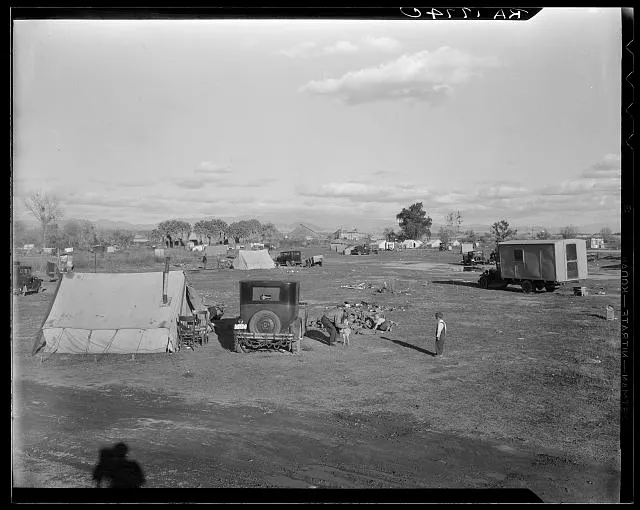
Source: Library of Congress - Lange, Dorothea
The Great Depression was a severe economic crisis that began in 1929 and lasted through the 1930s. During this period, millions of Americans lost their jobs and homes. With unemployment rising and few government relief programs available, many people had nowhere to live. In response to this growing problem, communities of makeshift shelters called Hoovervilles appeared in cities across the United States. These settlements were named after President Herbert Hoover, who many blamed for not doing enough to end the crisis.
Hoovervilles were a type of shantytown, which means a group of crudely built shelters. Residents constructed their homes from scrap wood, metal, cardboard, and other discarded materials found in city dumps or abandoned lots. The living conditions in Hoovervilles were harsh. There was little access to clean water, sanitation, or medical care. Overcrowding and poor hygiene often led to disease. Still, for many unemployed and homeless Americans, these camps provided the only option for shelter and community during desperate times.
The emergence of Hoovervilles raised important questions about the government's role in helping citizens during a crisis. As the number of homeless people increased, public opinion grew more critical of the government's lack of effective intervention. Many believed that President Hoover's policies were inadequate, and the camps became symbols of political and economic failure. In some cities, local officials tolerated Hoovervilles, while in others, police forcibly removed residents.
Despite the many challenges, people living in Hoovervilles demonstrated resilience and resourcefulness. They organized their communities by establishing informal rules, sharing food, and supporting each other. Some camps even had schools, churches, or social gatherings, showing how Americans adapted to adversity. However, life in Hoovervilles was often uncertain and filled with hardship. The presence of these camps drew attention to the urgent need for government assistance and reform.
The problems faced by Hooverville residents contributed to changes in national policy. When Franklin D. Roosevelt became president in 1933, he introduced the New Deal, a series of government programs designed to provide relief and recovery. Some New Deal programs built public housing and created jobs, which eventually reduced the need for Hoovervilles. Although most of these camps disappeared by the end of the 1930s, their existence left a lasting impact on American society and government policy.
Today, historians study Hoovervilles as evidence of the human cost of economic depression and the importance of social safety nets. The story of these shantytowns encourages us to consider how societies respond to widespread hardship and the role of government in supporting vulnerable populations.
Interesting Fact: The largest Hooverville in the United States was in St. Louis, Missouri. It housed thousands of people and had its own mayor, churches, and businesses.
Comprehension quiz (8 questions)
1. What was a Hooverville?
2. When did the Great Depression begin?
3. Who was president when the New Deal started?
4. Why did people build Hoovervilles?
5. How did people survive in Hoovervilles?
6. What did the New Deal aim to do?
7. Hoovervilles disappeared after the New Deal. True or false?
8. What does 'shantytown' mean?
Perfect for the way you teach
- Build comprehension skills
- Auto-graded quiz
- Differentiated reading
- Read together at home
- Improve fluency
- Quiet reading time
- Reading curriculum support
- Independent practice
- Track Lexile growth