This learning resource is available in interactive and printable formats. The interactive worksheet can be played online and assigned to students. The Printable PDF version can be downloaded and printed for completion by hand.
This engaging U.S. history reading passage explores the experiences of migrant workers during the Great Depression, aligning with HSS 11.6.3 and CCSS RI.6-8.1, RI.6-8.2. Students learn about the economic, social, and environmental challenges faced by migrant families as they traveled in search of farm work. The passage highlights key vocabulary, analyzes the causes and consequences of their struggles, and encourages students to think critically about historical evidence. Included are a glossary of essential terms, a Spanish translation, a simplified version for differentiated instruction, and a suite of activities such as a quiz, writing prompts, graphic organizers, and a timeline. Audio support is provided for accessibility. This resource is ideal for developing reading comprehension and historical analysis skills in social studies classrooms.
CONTENT PREVIEW
Expand content preview
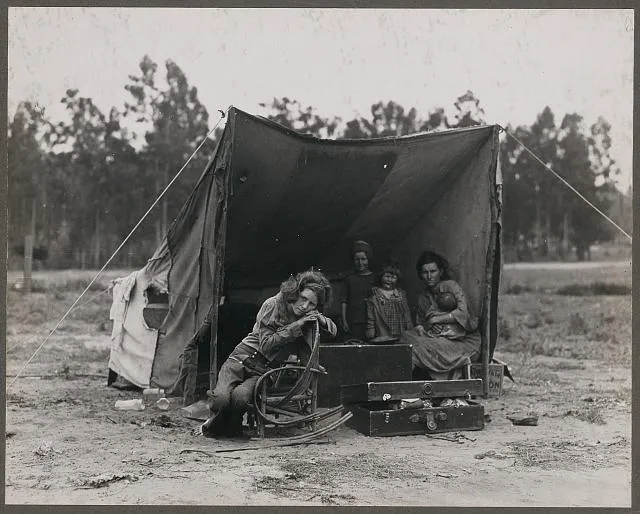
Migrant agricultural worker's family. Seven hungry children. Mother aged thirty-two. Father is native Californian. Nipomo, California. Source: Library of Congress - Lange, Dorothea
The Great Depression was a period of severe economic crisis in the United States that lasted from 1929 to the late 1930s. During this time, millions of Americans lost their jobs and homes. Families who relied on farming were especially hard hit. Many faced not only economic hardship but also environmental disasters such as the Dust Bowl, which destroyed crops and forced thousands to leave their land.
These displaced families became migrant workers, traveling long distances to find temporary labor on farms in California and other states. The journey itself was dangerous and exhausting. Families often traveled in old vehicles, carrying very few possessions. Along the way, they encountered many obstacles, including scarce resources, discrimination from local communities, and uncertain job prospects. Despite these challenges, their determination to survive kept them moving forward.
Migrant workers faced extremely poor living and working conditions. They usually lived in makeshift camps or overcrowded shelters with little access to clean water or medical care. Wages were very low, and there was fierce competition for even the lowest-paying jobs. Farm owners often took advantage of the vulnerable position of these workers, paying them less than promised or denying basic rights. This led to exploitation, as families struggled to earn enough money for food and shelter.
In addition to economic difficulties, migrant families dealt with social isolation and prejudice. Many local residents viewed them as outsiders and blamed them for problems in their communities. This discrimination made it even harder for migrants to find work and live in dignity. Despite these hardships, some migrant workers organized strikes and protests, demanding better conditions and fair treatment. Their efforts brought attention to their struggles and slowly led to reforms in labor laws.
The story of migrant workers during the Great Depression reveals the complex connections between economic forces, environmental disasters, and social attitudes. It shows how individuals and families can endure hardship and fight for their rights, even when facing overwhelming obstacles. Historians use photographs, personal stories, and government records as evidence to understand this period and its lasting effects on American society.
Interesting Fact: In 1936, photographer Dorothea Lange captured an image called "Migrant Mother," which became a powerful symbol of the struggles faced by migrant families during the Great Depression.
When did the Great Depression start?
1929190119451950
Which disaster destroyed crops?
HurricaneDust BowlEarthquakeFlood
Who took the 'Migrant Mother' photo?
Dorothea LangeAnsel AdamsLewis HineWalker Evans
Why did families migrate?
For better weatherTo find workTo see familyFor education
What problem did migrants face?
High wagesGood housingDiscriminationShort work hours
How did some migrants respond to poor conditions?
Organized strikesLeft the countryChanged jobsBought land
Migrant workers were always treated fairly. True or false?
TrueFalse
What does 'exploitation' mean?
Unfair treatment for profitGetting a rewardA weather eventMoving to a new home
Perfect For:
👩🏫 Teachers
• Reading comprehension practice
• Auto-graded assessments
• Literacy skill development
👨👩👧👦 Parents
• Reading practice at home
• Comprehension improvement
• Educational reading time
🏠 Homeschoolers
• Reading curriculum support
• Independent reading practice
• Progress monitoring
Reading Features:
📖
Reading Passage
Engaging fiction or nonfiction text
❓
Comprehension Quiz
Auto-graded questions
📊
Instant Feedback
Immediate results and scoring
📄
Printable Version
Download for offline reading
🔊
Read Aloud
Voice-over with word highlighting
Reviews & Ratings
No reviews yet. Be the first to share your experience!
Related Content
Pocahontas: Myth vs. Historical Reality
This passage explores the nuanced history of Pocahontas, moving beyond the myth made popular by movies and stories. Stud...
HSS 5.3.1RI.6-8.1RI.6-8.8
Roger Williams Religious Freedom
This passage explores the life and legacy of Roger Williams, a key figure in Colonial America who was banished from Mass...
HSS 5.4.38.2.2RI.6-8.1RI.6-8.6
Benjamin Franklin in Colonial America
This U.S. History reading passage explores the life and influence of Benjamin Franklin, a key colonial leader whose idea...
HSS 5.58.1RI.6-8.1RI.6-8.3
Colonial Apprenticeship System
This comprehensive passage explores the Colonial Apprenticeship System and its role in education during Colonial America...
HSS 5.4.6RI.6-8.1RI.6-8.2
Cities in Colonial America
This engaging U.S. history reading passage explores the rise of colonial American cities such as Boston, Philadelphia, a...
HSS 5.4.68.1RI.6-8.1RI.6-8.7
Frontier Life in Colonial America
This passage examines the realities of frontier life in colonial America, highlighting both the promise and peril faced ...
HSS 5.4.68.1RI.6-8.1RI.6-8.2
Colonial Printing Press
This passage explores the revolutionary impact of the colonial printing press in America, examining how it enabled the s...
HSS 5.58.1RI.6-8.1RI.6-8.2
Mercy Otis Warren: Political Writer
This passage explores the life and impact of Mercy Otis Warren, a significant political writer during the American Revol...
HSS 5.6.38.1RI.6-8.1RI.6-8.6
Crispus Attucks
This comprehensive U.S. History reading passage examines the life and legacy of Crispus Attucks, the first person killed...
HSS 5.5.38.1RI.6-8.1RI.6-8.3
Lewis and Clark Expedition
This comprehensive U.S. History reading passage explores the Lewis and Clark Expedition (1804-1806), a pivotal journey l...
HSS 8.4.18.8.2RI.6-8.1RI.6-8.3
Exodusters
This passage explores the migration of Exodusters—African Americans who left the South in the 1870s to escape discrimina...
HSS 8.12.1RI.6-8.1RI.6-8.2
Uncle Tom's Cabin
This passage explores the impact of Harriet Beecher Stowe’s Uncle Tom’s Cabin on American society in the 1850s. It exami...
HSS 8.9.48.10.2RI.6-8.1RI.6-8.6
Dred Scott Decision
This rigorous history reading passage delves into the 1857 Dred Scott Decision, a pivotal moment in the lead-up to the C...
HSS 8.9.48.10.3RI.6-8.1RI.6-8.8
Election of 1860
This passage explores Abraham Lincoln’s election in 1860 and the critical reactions from Southern states, which set the ...
HSS 8.10.4RI.6-8.1RI.6-8.6
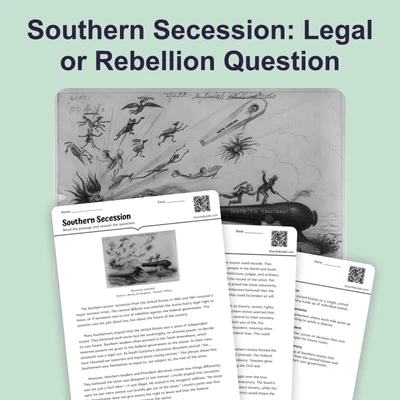
Southern Secession
This passage explores the significant moment in U.S. history when seven Southern states seceded from the Union after Abr...
HSS 8.10.4RI.6-8.1RI.6-8.2
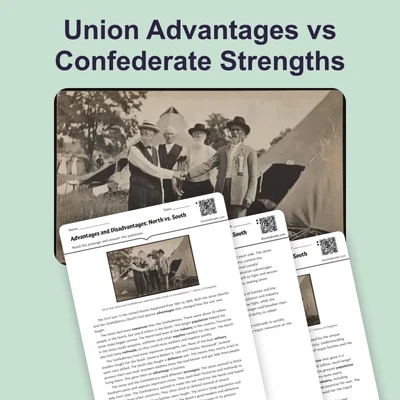
Advantages and Disadvantages: North vs. South
This history reading passage examines the contrasting strengths of the Union and Confederacy during the U.S. Civil War. ...
HSS 8.10.5RI.6-8.1RI.6-8.3
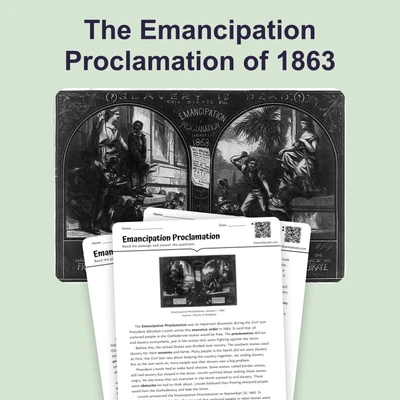
Emancipation Proclamation
This U.S. history passage explores the Emancipation Proclamation of 1863, an executive order issued by President Abraham...
HSS 8.10.6RI.6-8.1RI.6-8.3
Women's Roles in Civil War
This reading passage explores the critical roles women played during the U.S. Civil War, highlighting how they managed f...
HSS 8.10.7RI.6-8.1RI.6-8.2
Surrender at Appomattox
This reading passage explores the historic surrender at Appomattox Court House in April 1865, which marked the conclusio...