Colonial Games and Entertainment — Reading Comprehension
Rate this
Premium Resource
Present
Present in classroom. No work saved
Assign
Classroom with student accounts, Track progress
Quick Play
No student accounts, assign with a link
Grades
3
4
5
Standards
D2.HIS.1.3-5
RI.4.3
RI.4.4
PRINT+DIGITAL RESOURCE
This learning resource is available in interactive and printable formats. The interactive worksheet can be played online and assigned to students. The Printable PDF version can be downloaded and printed for completion by hand.
This engaging history reading passage explores the types of games and entertainment enjoyed by children and families in colonial America. Students will learn about common colonial pastimes, including outdoor sports, handmade toys, and community gatherings. The passage provides a clear, chronological narrative with direct cause and effect relationships, helping students understand how daily life and limited resources shaped entertainment during this era. Activities include a multiple-choice quiz, writing prompts, and a timeline of events. Key vocabulary is highlighted and defined for literacy development. The passage aligns with the C3 Framework and Common Core standards, making it perfect for classroom use. Spanish translation and read aloud audio are included for accessibility. Students will gain a deeper appreciation of history, teamwork, and creativity through this foundational national narrative.
CONTENT PREVIEW
Expand content preview
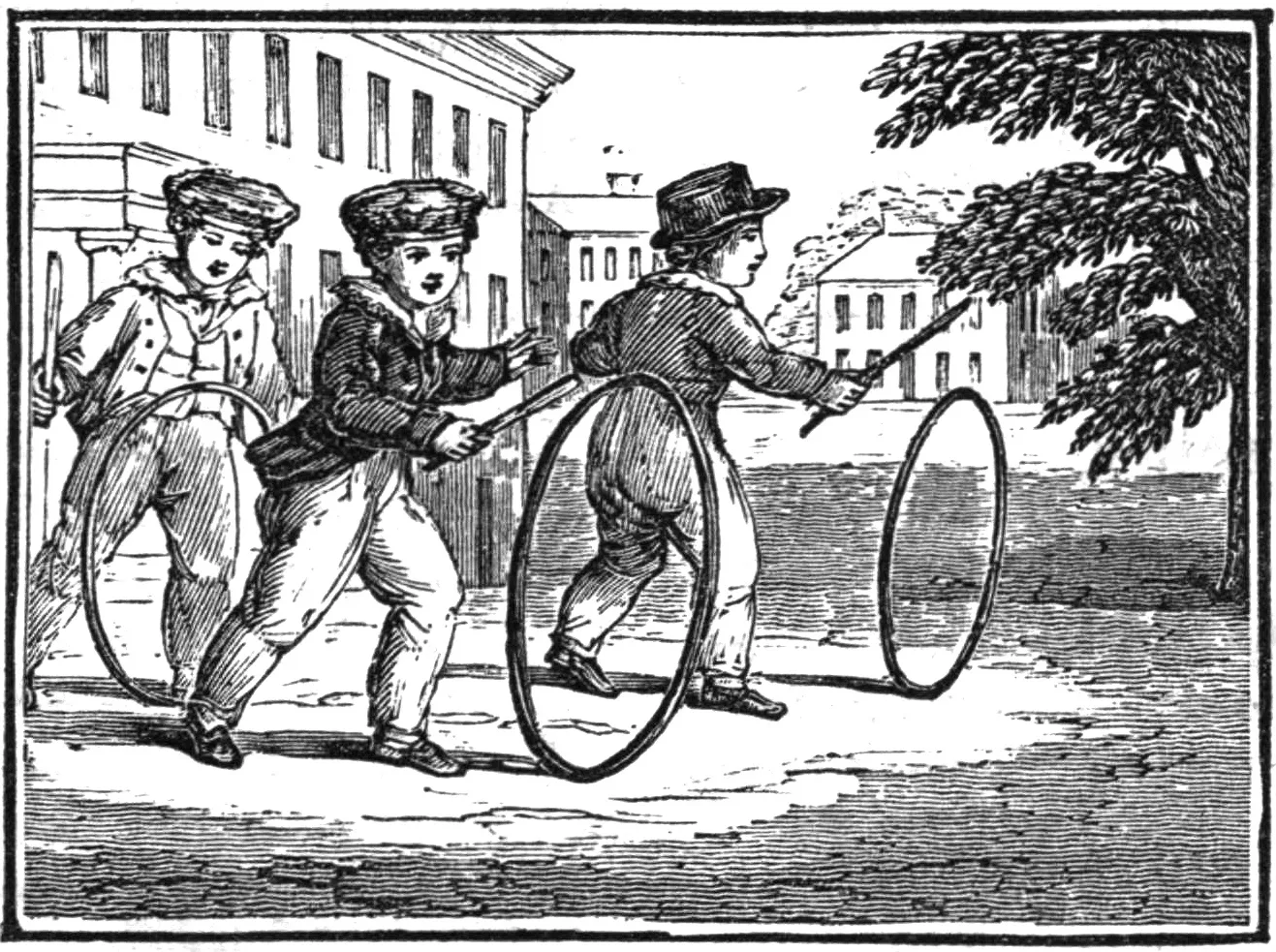
Boys playing hoops.jpg. Source: Wikimedia Commons - Anonymous engraver
Children in Colonial America did not have computers, video games, or television. Instead, they played simple games and made their own toys from things they found around them. Life in the colonies was not easy. Children worked hard helping their families with chores like fetching water and gathering firewood. But when they had a little free time, they turned ordinary objects into fun games.
Some favorite colonial games included marbles, hopscotch, and hoops. Children played marbles by drawing circles in the dirt and trying to knock each other's marbles out. For hopscotch, they drew squares on the ground with chalk or a stick, then tossed a stone and jumped from square to square. Rolling hoops was another popular game. Children used a stick to push a large wooden hoop along the ground, keeping it upright as long as possible. These games helped children practice important skills like balance, aim, and teamwork.
Many toys in colonial times were handmade. Girls often made dolls from rags or corn husks. Sometimes, they used buttons, yarn, or leftover fabric to decorate their dolls. Boys made toy boats, spinning tops, or whistles from wood scraps. These simple toys were precious because children made them themselves, or their family made them as a special gift.
Because most families were not wealthy, colonial children learned to use what they had. They turned sticks, stones, and scraps into playthings. Playing together helped them build strong friendships. It also gave them a break from their daily chores and a chance to be creative.
Games were not just for fun. They taught important lessons about fairness, patience, and following rules. Children learned to share and take turns. Sometimes, families played games together in the evening, like cards or checkers. These activities helped everyone relax and enjoy each other's company after a long day.
Even with little free time, colonial children found ways to have fun. Their creativity and teamwork show us how people made the best of what they had. Today, some of these games, like marbles and hopscotch, are still played by children around the world.
Interesting Fact: The first hopscotch games were played by Roman soldiers for training before becoming a favorite children's game in colonial America.
What did colonial children use for toys?
Sticks, stones, and scrapsPlastic and batteriesStore-bought action figuresElectronic devices
Which was a popular colonial game?
HopscotchBasketballVideo gamesSoccer
What were colonial dolls made from?
Corn husks and ragsPlasticMetalGlass
Why did children make their own toys?
Families were not wealthyThey wanted to sell toysToys were always freeStores were everywhere
How did colonial games help children?
Learn skills and teamworkBuy new thingsWatch TV togetherWaste time
What lesson did games teach?
Share and take turnsHow to build housesHow to driveHow to use computers
Colonial children played marbles. True or false?
TrueFalse
What does 'handmade' mean?
Made by handBought at a storeMade by machineDelivered by mail
Perfect For:
👩🏫 Teachers
• Reading comprehension practice
• Auto-graded assessments
• Literacy skill development
👨👩👧👦 Parents
• Reading practice at home
• Comprehension improvement
• Educational reading time
🏠 Homeschoolers
• Reading curriculum support
• Independent reading practice
• Progress monitoring
Reading Features:
📖
Reading Passage
Engaging fiction or nonfiction text
❓
Comprehension Quiz
Auto-graded questions
📊
Instant Feedback
Immediate results and scoring
📄
Printable Version
Download for offline reading
🔊
Read Aloud
Voice-over with word highlighting
Reviews & Ratings
No reviews yet. Be the first to share your experience!
Related Content
Native American Tribes Across America
This engaging history reading passage introduces students to Native American tribes across America, focusing on their da...
D2.HIS.1.3-5D2.HIS.2.3-5RI.4.1RI.4.2
The Sioux: Warriors and Tribal Leaders
This history reading passage explores the Sioux Nation, focusing on their roles as warriors and tribal leaders. Students...
D2.HIS.1.3-5D2.HIS.2.3-5RI.4.1RI.4.3
Jamestown: The First Permanent English Colony
This engaging history passage explores the founding of Jamestown, the first permanent English colony in America. Aligned...
D2.HIS.1.3-5D2.HIS.2.3-5RI.4.3RI.4.4
Pocahontas and the Powhatan People
This engaging reading passage explores the life of Pocahontas and the Powhatan people and their important role in early ...
D2.HIS.1.3-5D2.HIS.2.3-5RI.4.1RI.4.3
Colonial Towns and Village Life
This engaging history reading passage explores the daily life, work, and unity found in colonial towns and villages. Ali...
D2.HIS.1.3-5D2.HIS.2.3-5RI.4.3RI.4.4
George Washington Leads the Army
This engaging history reading passage explores how George Washington bravely led the Continental Army during the America...
D2.HIS.1.3-5D2.HIS.2.3-5RI.4.3RI.4.4
The Battle of Yorktown Ends War
This engaging U.S. history reading passage explores the Battle of Yorktown, a key event that ended the American Revoluti...
D2.HIS.1.3-5D2.HIS.2.3-5RI.4.1RI.4.3
Life as a Continental Soldier
This passage explores the daily life of a Continental Soldier during the American Revolutionary War, highlighting challe...
D2.HIS.1.3-5RI.4.1RI.4.3
Loyalists vs. Patriots: Divided Families
This engaging U.S. history reading passage explores the division between Loyalists and Patriots during the American Revo...
D2.HIS.1.3-5D2.HIS.2.3-5RI.4.3RI.4.4
Manifest Destiny: Coast to Coast
This engaging U.S. history reading passage explores Manifest Destiny and the westward expansion of the United States. St...
D2.HIS.1.3-5D2.HIS.2.3-5RI.4.3RI.4.4
Abraham Lincoln Becomes President
This engaging U.S. history reading passage introduces students to the story of Abraham Lincoln’s rise to the presidency....
D2.HIS.1.3-5D2.HIS.2.3-5RI.4.3RI.4.4
The Southern States Leave the Union
This engaging reading passage explores the key events leading up to the Southern states leaving the Union before the Civ...
D2.HIS.1.3-5D2.HIS.2.3-5RI.4.3RI.4.4
Lincoln Assassinated at Ford's Theatre
This history reading passage explores the events of President Abraham Lincoln's assassination at Ford's Theatre in 1865....
D2.HIS.1.3-5D2.HIS.2.3-5RI.4.3RI.4.4
Juan Cabrillo Explores California
This engaging U.S. history reading passage introduces students to Juan Cabrillo, the first European explorer to reach Ca...
D2.HIS.1.3-5D2.HIS.2.3-5D2.HIS.3.3-5RI.4.3
California's Early Spanish Settlements
This engaging U.S. history reading passage explores life during the early Spanish settlements in America, highlighting t...
D2.HIS.1.3-5D2.HIS.2.3-5D2.HIS.3.3-5RI.4.1
Discovery of Gold in 1848 by James Marshall
This engaging U.S. History passage introduces students to the discovery of gold in 1848 by James Marshall and the beginn...
D2.HIS.1.3-5D2.HIS.2.3-5D2.HIS.3.3-5RI.4.1
The Gold Rush Changes California Forever
This engaging U.S. History reading passage explores how the Gold Rush changed California forever. Students will learn ab...
D2.HIS.1.3-5D2.HIS.2.3-5D2.HIS.16.3-5RI.4.3
The Golden Spike: Connecting California to the Nation
This engaging U.S. history reading passage teaches students about the Golden Spike and how the first transcontinental ra...
D2.HIS.1.3-5D2.HIS.2.3-5D2.HIS.14.3-5RI.4.3
Farms, Factories, and Growing Cities
This engaging U.S. history reading passage explores the dramatic changes in America during the Progressive Era, focusing...