Lincoln Assassinated at Ford's Theatre — Reading Comprehension
Rate this
Premium Resource
Present
Present in classroom. No work saved
Assign
Classroom with student accounts, Track progress
Quick Play
No student accounts, assign with a link
Grades
3
4
5
Standards
D2.HIS.1.3-5
D2.HIS.2.3-5
RI.4.3
RI.4.4
PRINT+DIGITAL RESOURCE
This learning resource is available in interactive and printable formats. The interactive worksheet can be played online and assigned to students. The Printable PDF version can be downloaded and printed for completion by hand.
This history reading passage explores the events of President Abraham Lincoln's assassination at Ford's Theatre in 1865. Students will learn about the key figures involved, the sequence of events, and the impact on the United States. The passage uses clear, simple language and includes bolded vocabulary words to support literacy development. Activities include a multiple-choice quiz, writing prompts, and a timeline of events. This resource is aligned with the C3 Framework and Common Core standards, making it ideal for building history knowledge and ELA skills. A Spanish translation and read aloud audio are provided, supporting diverse learners. Keywords include Abraham Lincoln, Ford's Theatre, assassination, John Wilkes Booth, Civil War, and U.S. presidents.
CONTENT PREVIEW
Expand content preview
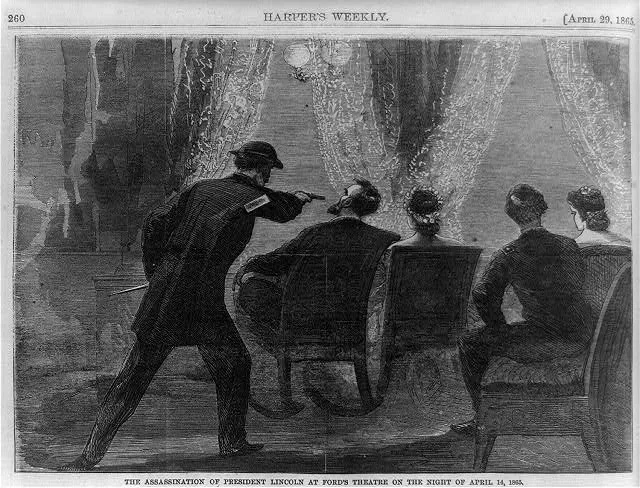
The Assassination of President Lincoln at Ford's theatre on the night of April 14, 1865 Source: Library of Congress - Library of Congress
President Abraham Lincoln was shot on April 14, 1865, just five days after the Civil War ended. The nation was celebrating peace after four long years of war. Lincoln had worked hard to keep the country together and end slavery. People were hopeful for a better future.
On the night of April 14, Lincoln went to Ford's Theatre in Washington, D.C. He planned to watch a play called Our American Cousin. The president sat in a special box with his wife, Mary Todd Lincoln, and friends.
As the play went on, a man named John Wilkes Booth slipped quietly into the theater. Booth was an actor who did not agree with Lincoln's ideas. He wanted to stop Lincoln from helping the country heal after the war.
Booth entered the president's box and shot Lincoln in the head. The crowd was shocked and confused. Booth jumped onto the stage, shouted, and escaped out the back door. People tried to catch him, but Booth got away in the darkness.
Doctors rushed to help Lincoln. They carried him across the street to a small house. Many people stayed nearby, hoping for good news. But Lincoln died the next morning, on April 15, 1865.
The news of Lincoln's death spread quickly. People all across the United States mourned. What was supposed to be a time of joy turned into a moment of deep sorrow. Lincoln had led the country through its hardest times. Now, he was gone.
Booth was hunted by the army for almost two weeks. He was found hiding in a barn and refused to surrender. Soldiers captured him, and Booth died from his injuries.
Lincoln's death was a national tragedy. Many believed his leadership was needed to bring the country back together. His funeral train traveled from Washington, D.C., to his home in Illinois. Thousands of people paid their respects along the way. Lincoln is remembered as one of America's greatest presidents.
Interesting Fact: Lincoln's funeral train passed through 180 cities and towns so people could say goodbye to their leader.
Who shot President Lincoln?
John Wilkes BoothMary Todd LincolnUlysses S. GrantFord Theatre manager
Where was Lincoln shot?
Ford's TheatreWhite HouseIllinois homeTrain station
What war had just ended?
Civil WarWorld War IRevolutionary WarSpanish-American War
Why did Booth shoot Lincoln?
He disagreed with Lincoln's ideasHe wanted to watch the playHe was Lincoln's friendHe was a soldier
How did people react to Lincoln's death?
They mourned and felt deep sorrowThey celebratedThey ignored the newsThey did not care
What happened to Booth after the assassination?
He was found and diedHe became presidentHe escaped foreverHe was Lincoln's doctor
Lincoln's funeral train stopped in 180 cities. (True or False)
TrueFalse
What does 'mourned' mean?
To feel deep sadnessTo shout loudlyTo run awayTo celebrate
Perfect For:
👩🏫 Teachers
• Reading comprehension practice
• Auto-graded assessments
• Literacy skill development
👨👩👧👦 Parents
• Reading practice at home
• Comprehension improvement
• Educational reading time
🏠 Homeschoolers
• Reading curriculum support
• Independent reading practice
• Progress monitoring
Reading Features:
📖
Reading Passage
Engaging fiction or nonfiction text
❓
Comprehension Quiz
Auto-graded questions
📊
Instant Feedback
Immediate results and scoring
📄
Printable Version
Download for offline reading
🔊
Read Aloud
Voice-over with word highlighting
Reviews & Ratings
No reviews yet. Be the first to share your experience!
Related Content
Native American Tribes Across America
This engaging history reading passage introduces students to Native American tribes across America, focusing on their da...
D2.HIS.1.3-5D2.HIS.2.3-5RI.4.1RI.4.2
The Sioux: Warriors and Tribal Leaders
This history reading passage explores the Sioux Nation, focusing on their roles as warriors and tribal leaders. Students...
D2.HIS.1.3-5D2.HIS.2.3-5RI.4.1RI.4.3
Jamestown: The First Permanent English Colony
This engaging history passage explores the founding of Jamestown, the first permanent English colony in America. Aligned...
D2.HIS.1.3-5D2.HIS.2.3-5RI.4.3RI.4.4
Pocahontas and the Powhatan People
This engaging reading passage explores the life of Pocahontas and the Powhatan people and their important role in early ...
D2.HIS.1.3-5D2.HIS.2.3-5RI.4.1RI.4.3
Colonial Games and Entertainment
This engaging history reading passage explores the types of games and entertainment enjoyed by children and families in ...
D2.HIS.1.3-5RI.4.3RI.4.4
Colonial Towns and Village Life
This engaging history reading passage explores the daily life, work, and unity found in colonial towns and villages. Ali...
D2.HIS.1.3-5D2.HIS.2.3-5RI.4.3RI.4.4
George Washington Leads the Army
This engaging history reading passage explores how George Washington bravely led the Continental Army during the America...
D2.HIS.1.3-5D2.HIS.2.3-5RI.4.3RI.4.4
The Battle of Yorktown Ends War
This engaging U.S. history reading passage explores the Battle of Yorktown, a key event that ended the American Revoluti...
D2.HIS.1.3-5D2.HIS.2.3-5RI.4.1RI.4.3
Life as a Continental Soldier
This passage explores the daily life of a Continental Soldier during the American Revolutionary War, highlighting challe...
D2.HIS.1.3-5RI.4.1RI.4.3
Loyalists vs. Patriots: Divided Families
This engaging U.S. history reading passage explores the division between Loyalists and Patriots during the American Revo...
D2.HIS.1.3-5D2.HIS.2.3-5RI.4.3RI.4.4
Manifest Destiny: Coast to Coast
This engaging U.S. history reading passage explores Manifest Destiny and the westward expansion of the United States. St...
D2.HIS.1.3-5D2.HIS.2.3-5RI.4.3RI.4.4
Abraham Lincoln Becomes President
This engaging U.S. history reading passage introduces students to the story of Abraham Lincoln’s rise to the presidency....
D2.HIS.1.3-5D2.HIS.2.3-5RI.4.3RI.4.4
The Southern States Leave the Union
This engaging reading passage explores the key events leading up to the Southern states leaving the Union before the Civ...
D2.HIS.1.3-5D2.HIS.2.3-5RI.4.3RI.4.4
Juan Cabrillo Explores California
This engaging U.S. history reading passage introduces students to Juan Cabrillo, the first European explorer to reach Ca...
D2.HIS.1.3-5D2.HIS.2.3-5D2.HIS.3.3-5RI.4.3
California's Early Spanish Settlements
This engaging U.S. history reading passage explores life during the early Spanish settlements in America, highlighting t...
D2.HIS.1.3-5D2.HIS.2.3-5D2.HIS.3.3-5RI.4.1
Discovery of Gold in 1848 by James Marshall
This engaging U.S. History passage introduces students to the discovery of gold in 1848 by James Marshall and the beginn...
D2.HIS.1.3-5D2.HIS.2.3-5D2.HIS.3.3-5RI.4.1
The Gold Rush Changes California Forever
This engaging U.S. History reading passage explores how the Gold Rush changed California forever. Students will learn ab...
D2.HIS.1.3-5D2.HIS.2.3-5D2.HIS.16.3-5RI.4.3
The Golden Spike: Connecting California to the Nation
This engaging U.S. history reading passage teaches students about the Golden Spike and how the first transcontinental ra...
D2.HIS.1.3-5D2.HIS.2.3-5D2.HIS.14.3-5RI.4.3
Farms, Factories, and Growing Cities
This engaging U.S. history reading passage explores the dramatic changes in America during the Progressive Era, focusing...