Colonial Towns and Village Life — Reading Comprehension
Rate this|
12
Present
Present in classroom. No work saved
Assign
Classroom with student accounts, Track progress
Quick Play
No student accounts, assign with a link
Grades
3
4
5
Standards
D2.HIS.1.3-5
D2.HIS.2.3-5
RI.4.3
RI.4.4
W.4.2
PRINT+DIGITAL RESOURCE
This learning resource is available in interactive and printable formats. The interactive worksheet can be played online and assigned to students. The Printable PDF version can be downloaded and printed for completion by hand.
This engaging history reading passage explores the daily life, work, and unity found in colonial towns and villages. Aligned to the C3 Framework and Common Core standards, it takes students through a sequence of events showing how early American settlers worked together, built communities, and faced challenges. Using accessible vocabulary and concrete examples, the passage highlights important historical concepts such as cooperation, roles in the community, and the significance of colonial markets and meetings. It includes a glossary for key terms, a Spanish translation, a multiple-choice quiz, and a writing activity that encourages students to connect the past and present and analyze cause and effect. The timeline activity helps students track key events in colonial life. This resource is ideal for building foundational knowledge of U.S. history with read aloud audio and Spanish translation support.
CONTENT PREVIEW
Expand content preview
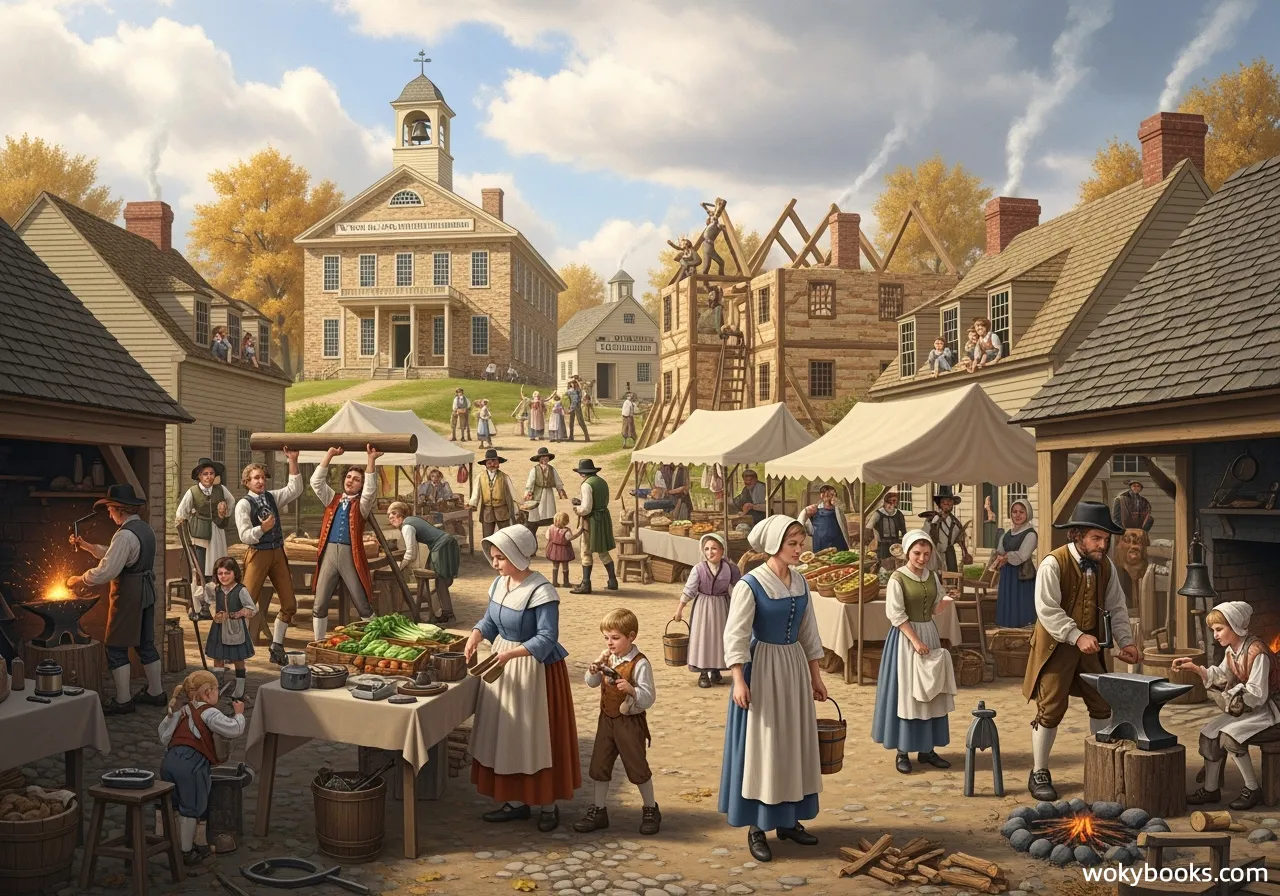
Depicts bustling colonial community life with various activities in a historical village setting.
In colonial America, towns were built around the idea of community. People lived close together so they could help each other. At the center of every town was the meetinghouse. Here, neighbors gathered to talk about town business, make rules, and worship together. The meetinghouse was often the largest building. Sometimes it was also used as a school or a place to hold important events.
Next to the meetinghouse, there was usually a village green. This was an open grassy area. People used the green for celebrations, markets, and even for letting cows or sheep graze. The village green was a place where everyone could gather. It helped people feel like they belonged to a group.
Close by, you would find the general store. The general store sold food, tools, cloth, and other important things. People traded or bought what they needed. The store was also a place to hear news, meet friends, and share stories. Since there were no phones or computers, the general store was the best place to learn what was happening in the town.
Most things in a colonial town were kept within walking distance. This made life easier. People could walk to the meetinghouse, the store, the blacksmith, or the school in just a few minutes. Children helped by carrying water, gathering firewood, or working in family shops. Everyone had a job to do. Work was often done together, which made it go faster and helped people become closer.
Colonial towns were built so people could be safe. If there was trouble, like a fire or a wild animal, neighbors could help right away. Living close made it easy to share tools, ideas, and food. People solved problems by holding meetings and making decisions as a group. This made the community stronger.
On Sundays, everyone gathered at the meetinghouse to worship. Afterward, families might share food or play games on the green. Special days, like harvest time, were celebrated with music, dancing, and feasts. These events helped people feel proud of their town and each other.
Some towns grew bigger and became cities. Others stayed small for many years. But all colonial towns shared the idea that working together and staying connected made life better for everyone.
Interesting Fact: Some colonial meetinghouses are still standing today. They remind us of how important community was in early America.
What was at the center of colonial towns?
The meetinghouseThe riverA large farmThe mayor's house
Why did people keep everything close?
To make life easierFor decorationTo hide from animalsTo look important
What was the general store for?
Selling food and toolsPlaying musicPlanting cropsBuilding houses
What did people do on Sundays?
Worship at the meetinghouseGo fishingTravel far awayWork all day
How did living close help people?
They could help each otherThey could sleep moreThey could travel farThey could grow more crops
What happened at the village green?
Celebrations and marketsBuilding boatsMining for goldMaking laws
Colonial towns were built for people to be safe. True or false?
TrueFalse
What does 'community' mean?
A group living close togetherA type of buildingA kind of animalA kind of food
Perfect For:
👩🏫 Teachers
• Reading comprehension practice
• Auto-graded assessments
• Literacy skill development
👨👩👧👦 Parents
• Reading practice at home
• Comprehension improvement
• Educational reading time
🏠 Homeschoolers
• Reading curriculum support
• Independent reading practice
• Progress monitoring
Reading Features:
📖
Reading Passage
Engaging fiction or nonfiction text
❓
Comprehension Quiz
Auto-graded questions
📊
Instant Feedback
Immediate results and scoring
📄
Printable Version
Download for offline reading
🔊
Read Aloud
Voice-over with word highlighting
Reviews & Ratings
No reviews yet. Be the first to share your experience!
Related Content
Native American Tribes Across America
This engaging history reading passage introduces students to Native American tribes across America, focusing on their da...
D2.HIS.1.3-5D2.HIS.2.3-5RI.4.1RI.4.2
The Sioux: Warriors and Tribal Leaders
This history reading passage explores the Sioux Nation, focusing on their roles as warriors and tribal leaders. Students...
D2.HIS.1.3-5D2.HIS.2.3-5RI.4.1RI.4.3
Jamestown: The First Permanent English Colony
This engaging history passage explores the founding of Jamestown, the first permanent English colony in America. Aligned...
D2.HIS.1.3-5D2.HIS.2.3-5RI.4.3RI.4.4
Pocahontas and the Powhatan People
This engaging reading passage explores the life of Pocahontas and the Powhatan people and their important role in early ...
D2.HIS.1.3-5D2.HIS.2.3-5RI.4.1RI.4.3
Colonial Games and Entertainment
This engaging history reading passage explores the types of games and entertainment enjoyed by children and families in ...
D2.HIS.1.3-5RI.4.3RI.4.4
George Washington Leads the Army
This engaging history reading passage explores how George Washington bravely led the Continental Army during the America...
D2.HIS.1.3-5D2.HIS.2.3-5RI.4.3RI.4.4
The Battle of Yorktown Ends War
This engaging U.S. history reading passage explores the Battle of Yorktown, a key event that ended the American Revoluti...
D2.HIS.1.3-5D2.HIS.2.3-5RI.4.1RI.4.3
Life as a Continental Soldier
This passage explores the daily life of a Continental Soldier during the American Revolutionary War, highlighting challe...
D2.HIS.1.3-5RI.4.1RI.4.3
Loyalists vs. Patriots: Divided Families
This engaging U.S. history reading passage explores the division between Loyalists and Patriots during the American Revo...
D2.HIS.1.3-5D2.HIS.2.3-5RI.4.3RI.4.4
Manifest Destiny: Coast to Coast
This engaging U.S. history reading passage explores Manifest Destiny and the westward expansion of the United States. St...
D2.HIS.1.3-5D2.HIS.2.3-5RI.4.3RI.4.4
Abraham Lincoln Becomes President
This engaging U.S. history reading passage introduces students to the story of Abraham Lincoln’s rise to the presidency....
D2.HIS.1.3-5D2.HIS.2.3-5RI.4.3RI.4.4
The Southern States Leave the Union
This engaging reading passage explores the key events leading up to the Southern states leaving the Union before the Civ...
D2.HIS.1.3-5D2.HIS.2.3-5RI.4.3RI.4.4
Lincoln Assassinated at Ford's Theatre
This history reading passage explores the events of President Abraham Lincoln's assassination at Ford's Theatre in 1865....
D2.HIS.1.3-5D2.HIS.2.3-5RI.4.3RI.4.4
Juan Cabrillo Explores California
This engaging U.S. history reading passage introduces students to Juan Cabrillo, the first European explorer to reach Ca...
D2.HIS.1.3-5D2.HIS.2.3-5D2.HIS.3.3-5RI.4.3
California's Early Spanish Settlements
This engaging U.S. history reading passage explores life during the early Spanish settlements in America, highlighting t...
D2.HIS.1.3-5D2.HIS.2.3-5D2.HIS.3.3-5RI.4.1
Discovery of Gold in 1848 by James Marshall
This engaging U.S. History passage introduces students to the discovery of gold in 1848 by James Marshall and the beginn...
D2.HIS.1.3-5D2.HIS.2.3-5D2.HIS.3.3-5RI.4.1
The Gold Rush Changes California Forever
This engaging U.S. History reading passage explores how the Gold Rush changed California forever. Students will learn ab...
D2.HIS.1.3-5D2.HIS.2.3-5D2.HIS.16.3-5RI.4.3
The Golden Spike: Connecting California to the Nation
This engaging U.S. history reading passage teaches students about the Golden Spike and how the first transcontinental ra...
D2.HIS.1.3-5D2.HIS.2.3-5D2.HIS.14.3-5RI.4.3
Farms, Factories, and Growing Cities
This engaging U.S. history reading passage explores the dramatic changes in America during the Progressive Era, focusing...