Jamestown: The First Permanent English Colony — Reading Comprehension
Rate this
Premium Resource
Present
Present in classroom. No work saved
Assign
Classroom with student accounts, Track progress
Quick Play
No student accounts, assign with a link
Grades
3
4
5
Standards
D2.HIS.1.3-5
D2.HIS.2.3-5
RI.4.3
RI.4.4
W.4.2
PRINT+DIGITAL RESOURCE
This learning resource is available in interactive and printable formats. The interactive worksheet can be played online and assigned to students. The Printable PDF version can be downloaded and printed for completion by hand.
This engaging history passage explores the founding of Jamestown, the first permanent English colony in America. Aligned to the C3 Framework and Common Core standards, the passage guides students through the challenges and successes faced by the Jamestown settlers, highlighting themes of bravery, unity, and problem-solving. Key vocabulary words are bolded and explained in the glossary, supporting literacy development. Students will learn about important historical figures such as John Smith and Pocahontas, and the relationship between the settlers and the Powhatan people. The passage features a chronological narrative, a timeline of key events, and includes an inspiring historical fact. Accompanying activities offer reading comprehension questions, a vocabulary challenge, and writing prompts to encourage deeper understanding and critical thinking. Read aloud audio and a complete Spanish translation are provided to support diverse learners. Perfect for history and ELA integration, this resource helps students connect the past to the present while building foundational social studies knowledge.
CONTENT PREVIEW
Expand content preview
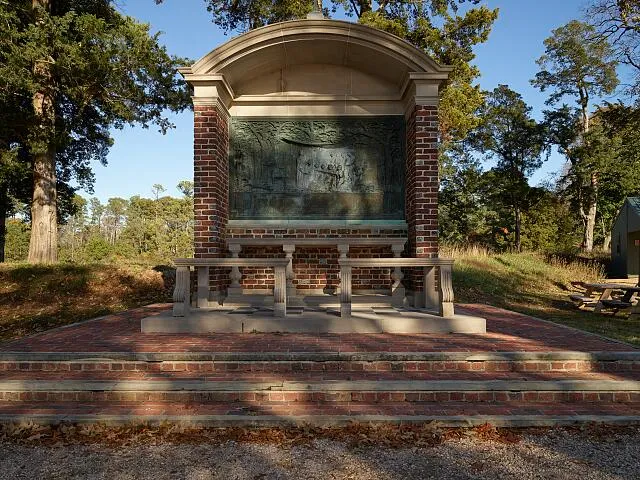
The Hunt Shrine honoring Robert Hunt, the first Anglican minister of the colony at Historic Jamestowne, a preservation and continuing excavation site at the location of the 1607 James Fort, near the later 17th-century (and present-day) city of Jamestown, Virginia Source: Library of Congress - Highsmith, Carol M.
The Jamestown Colony was the first permanent English settlement in America. It was founded in Virginia in 1607 by a group of men sent by the Virginia Company. The settlers hoped to find gold and become rich. They traveled across the Atlantic Ocean and landed near the James River. At first, the settlers built a small fort to protect themselves from danger.
The first years were very hard for the colonists. They did not have enough food. Many men did not know how to farm or hunt in the new land. The weather was hot and humid in the summer and freezing in the winter. Mosquitoes spread diseases like malaria. Because of poor water and little food, many people got sick. By the end of the first year, almost half the settlers had died.
In 1608, Captain John Smith became the leader of Jamestown. He made a rule: "He who does not work, will not eat." John Smith helped the colony survive. He worked with the Powhatan people, the Native Americans living nearby. Sometimes, the Powhatan gave the settlers corn and food. But there were also times of fighting and fear.
That winter, known as the "Starving Time," was the worst. The settlers ran out of food. Some ate roots, snakes, or even shoe leather to survive. Out of 500 settlers, only 60 survived by spring.
Later, the colony learned to grow tobacco. Tobacco became a very important crop. It helped Jamestown make money and attract more settlers from England. The colony slowly grew stronger. More families came, and houses and farms were built. Thanks to their hard work, Jamestown stayed, and it became the beginning of English America.
Interesting Fact: The first elected government in America, called the House of Burgesses, began in Jamestown in 1619.
When was Jamestown founded?
1607162014921776
Who became Jamestown's leader in 1608?
John SmithPowhatanGeorge WashingtonPocahontas
Where was Jamestown located?
VirginiaMassachusettsFloridaNew York
Why did many settlers die the first year?
Not enough foodToo much goldToo many shipsGood weather
How did tobacco help Jamestown?
It made moneyIt caused sicknessIt built housesIt made water
What was the "Starving Time"?
A time with no foodA time of goldA big partyA new ship's arrival
Jamestown had the first elected government. True or false?
TrueFalse
What does "colony" mean?
Place ruled by another countryA type of foodA riverA kind of animal
Perfect For:
👩🏫 Teachers
• Reading comprehension practice
• Auto-graded assessments
• Literacy skill development
👨👩👧👦 Parents
• Reading practice at home
• Comprehension improvement
• Educational reading time
🏠 Homeschoolers
• Reading curriculum support
• Independent reading practice
• Progress monitoring
Reading Features:
📖
Reading Passage
Engaging fiction or nonfiction text
❓
Comprehension Quiz
Auto-graded questions
📊
Instant Feedback
Immediate results and scoring
📄
Printable Version
Download for offline reading
🔊
Read Aloud
Voice-over with word highlighting
Reviews & Ratings
No reviews yet. Be the first to share your experience!
Related Content
Native American Tribes Across America
This engaging history reading passage introduces students to Native American tribes across America, focusing on their da...
D2.HIS.1.3-5D2.HIS.2.3-5RI.4.1RI.4.2
The Sioux: Warriors and Tribal Leaders
This history reading passage explores the Sioux Nation, focusing on their roles as warriors and tribal leaders. Students...
D2.HIS.1.3-5D2.HIS.2.3-5RI.4.1RI.4.3
Pocahontas and the Powhatan People
This engaging reading passage explores the life of Pocahontas and the Powhatan people and their important role in early ...
D2.HIS.1.3-5D2.HIS.2.3-5RI.4.1RI.4.3
Colonial Games and Entertainment
This engaging history reading passage explores the types of games and entertainment enjoyed by children and families in ...
D2.HIS.1.3-5RI.4.3RI.4.4
Colonial Towns and Village Life
This engaging history reading passage explores the daily life, work, and unity found in colonial towns and villages. Ali...
D2.HIS.1.3-5D2.HIS.2.3-5RI.4.3RI.4.4
George Washington Leads the Army
This engaging history reading passage explores how George Washington bravely led the Continental Army during the America...
D2.HIS.1.3-5D2.HIS.2.3-5RI.4.3RI.4.4
The Battle of Yorktown Ends War
This engaging U.S. history reading passage explores the Battle of Yorktown, a key event that ended the American Revoluti...
D2.HIS.1.3-5D2.HIS.2.3-5RI.4.1RI.4.3
Life as a Continental Soldier
This passage explores the daily life of a Continental Soldier during the American Revolutionary War, highlighting challe...
D2.HIS.1.3-5RI.4.1RI.4.3
Loyalists vs. Patriots: Divided Families
This engaging U.S. history reading passage explores the division between Loyalists and Patriots during the American Revo...
D2.HIS.1.3-5D2.HIS.2.3-5RI.4.3RI.4.4
Manifest Destiny: Coast to Coast
This engaging U.S. history reading passage explores Manifest Destiny and the westward expansion of the United States. St...
D2.HIS.1.3-5D2.HIS.2.3-5RI.4.3RI.4.4
Abraham Lincoln Becomes President
This engaging U.S. history reading passage introduces students to the story of Abraham Lincoln’s rise to the presidency....
D2.HIS.1.3-5D2.HIS.2.3-5RI.4.3RI.4.4
The Southern States Leave the Union
This engaging reading passage explores the key events leading up to the Southern states leaving the Union before the Civ...
D2.HIS.1.3-5D2.HIS.2.3-5RI.4.3RI.4.4
Lincoln Assassinated at Ford's Theatre
This history reading passage explores the events of President Abraham Lincoln's assassination at Ford's Theatre in 1865....
D2.HIS.1.3-5D2.HIS.2.3-5RI.4.3RI.4.4
Juan Cabrillo Explores California
This engaging U.S. history reading passage introduces students to Juan Cabrillo, the first European explorer to reach Ca...
D2.HIS.1.3-5D2.HIS.2.3-5D2.HIS.3.3-5RI.4.3
California's Early Spanish Settlements
This engaging U.S. history reading passage explores life during the early Spanish settlements in America, highlighting t...
D2.HIS.1.3-5D2.HIS.2.3-5D2.HIS.3.3-5RI.4.1
Discovery of Gold in 1848 by James Marshall
This engaging U.S. History passage introduces students to the discovery of gold in 1848 by James Marshall and the beginn...
D2.HIS.1.3-5D2.HIS.2.3-5D2.HIS.3.3-5RI.4.1
The Gold Rush Changes California Forever
This engaging U.S. History reading passage explores how the Gold Rush changed California forever. Students will learn ab...
D2.HIS.1.3-5D2.HIS.2.3-5D2.HIS.16.3-5RI.4.3
The Golden Spike: Connecting California to the Nation
This engaging U.S. history reading passage teaches students about the Golden Spike and how the first transcontinental ra...
D2.HIS.1.3-5D2.HIS.2.3-5D2.HIS.14.3-5RI.4.3
Farms, Factories, and Growing Cities
This engaging U.S. history reading passage explores the dramatic changes in America during the Progressive Era, focusing...