The Southern States Leave the Union — Reading Comprehension
Rate this
Premium Resource
Present
Present in classroom. No work saved
Assign
Classroom with student accounts, Track progress
Quick Play
No student accounts, assign with a link
Grades
3
4
5
Standards
D2.HIS.1.3-5
D2.HIS.2.3-5
RI.4.3
RI.4.4
PRINT+DIGITAL RESOURCE
This learning resource is available in interactive and printable formats. The interactive worksheet can be played online and assigned to students. The Printable PDF version can be downloaded and printed for completion by hand.
This engaging reading passage explores the key events leading up to the Southern states leaving the Union before the Civil War. Students will learn about Abraham Lincoln's election, the reasons for secession, and the creation of the Confederacy. The passage uses a simple cause-and-effect structure and grade-appropriate vocabulary to make the complex events accessible. Activities include a multiple-choice quiz, writing prompts, a timeline of important moments, and a glossary of key terms. This reading passage supports C3 Framework and Common Core standards for history and literacy. It also includes read aloud audio and a full Spanish translation, making it ideal for diverse classrooms and English language learners.
CONTENT PREVIEW
Expand content preview
Southern states seceded (1860-1861), creating the Confederacy and starting the Civil War.
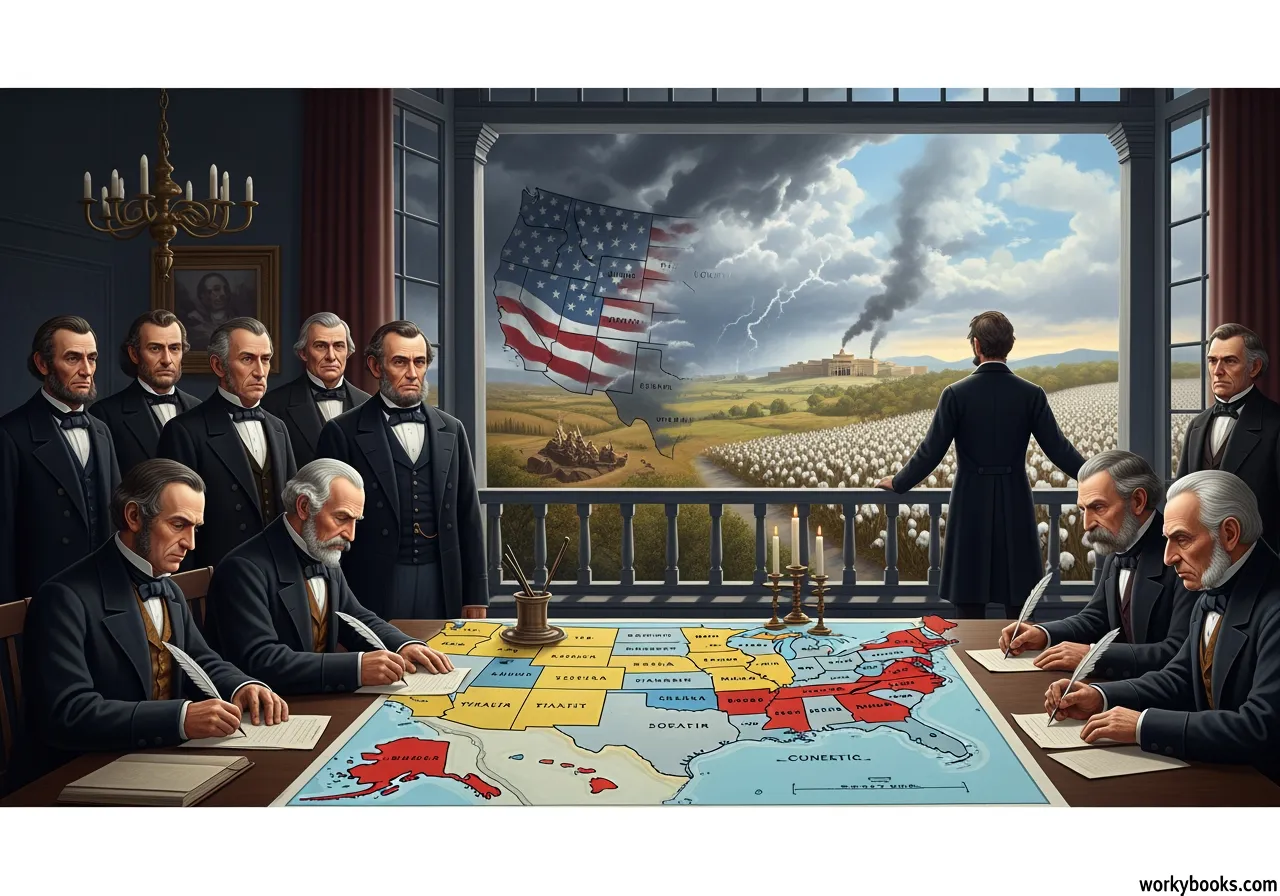
The Civil War began when eleven Southern states left the United States, or "the Union," after Abraham Lincoln was elected president in 1860. This act of leaving is called secession. The Southern states believed they had the right to form their own country. They created the Confederate States of America, also known as the Confederacy.
The country was deeply divided. People in the North and South had different ways of life. The North had more factories and big cities. The South had large farms called plantations and depended on enslaved people to work the land. Many people in the North wanted to end slavery, but people in the South wanted to keep it. This disagreement grew worse each year.
When Abraham Lincoln was elected president, many Southerners feared he would end slavery. They believed this would change their way of life. As a result, starting with South Carolina in December 1860, Southern states began to leave the Union, one after another.
The Southern states claimed that the United States government could not force them to stay. They said each state had the right to decide important issues for itself. This idea is called states' rights. The North, however, believed the Union should stay together. They did not think states could just leave the country whenever they wanted.
By February 1861, eleven states had joined the Confederacy. They made their own government, wrote a constitution, and chose Jefferson Davis as president. The Union, led by President Lincoln, did not accept that the Southern states could break away. This conflict led to the Civil War in April 1861.
The Civil War lasted four years. It was the deadliest war in American history. In the end, the Union won, and the country was brought back together. Slavery was also ended in the United States.
Interesting Fact: Abraham Lincoln was not even on the ballot in ten Southern states during the 1860 election.
Who was elected president in 1860?
Abraham LincolnJefferson DavisGeorge WashingtonAndrew Jackson
What is secession?
Leaving a countryMaking new lawsStarting a businessBuilding a city
Which state left the Union first?
South CarolinaTexasVirginiaGeorgia
Why did Southern states leave the Union?
To keep slaveryTo find goldTo build factoriesTo make new money
What is states' rights?
States make their own rulesStates build schoolsStates vote for presidentStates buy land
What happened after the Civil War?
Union won and slavery endedConfederacy wonNew president electedMore states left
The Civil War lasted four years. True or false?
TrueFalse
What is a plantation?
Large farmSmall storeSchoolFactory
Perfect For:
👩🏫 Teachers
• Reading comprehension practice
• Auto-graded assessments
• Literacy skill development
👨👩👧👦 Parents
• Reading practice at home
• Comprehension improvement
• Educational reading time
🏠 Homeschoolers
• Reading curriculum support
• Independent reading practice
• Progress monitoring
Reading Features:
📖
Reading Passage
Engaging fiction or nonfiction text
❓
Comprehension Quiz
Auto-graded questions
📊
Instant Feedback
Immediate results and scoring
📄
Printable Version
Download for offline reading
🔊
Read Aloud
Voice-over with word highlighting
Reviews & Ratings
No reviews yet. Be the first to share your experience!
Related Content
Native American Tribes Across America
This engaging history reading passage introduces students to Native American tribes across America, focusing on their da...
D2.HIS.1.3-5D2.HIS.2.3-5RI.4.1RI.4.2
The Sioux: Warriors and Tribal Leaders
This history reading passage explores the Sioux Nation, focusing on their roles as warriors and tribal leaders. Students...
D2.HIS.1.3-5D2.HIS.2.3-5RI.4.1RI.4.3
Jamestown: The First Permanent English Colony
This engaging history passage explores the founding of Jamestown, the first permanent English colony in America. Aligned...
D2.HIS.1.3-5D2.HIS.2.3-5RI.4.3RI.4.4
Pocahontas and the Powhatan People
This engaging reading passage explores the life of Pocahontas and the Powhatan people and their important role in early ...
D2.HIS.1.3-5D2.HIS.2.3-5RI.4.1RI.4.3
Colonial Games and Entertainment
This engaging history reading passage explores the types of games and entertainment enjoyed by children and families in ...
D2.HIS.1.3-5RI.4.3RI.4.4
Colonial Towns and Village Life
This engaging history reading passage explores the daily life, work, and unity found in colonial towns and villages. Ali...
D2.HIS.1.3-5D2.HIS.2.3-5RI.4.3RI.4.4
George Washington Leads the Army
This engaging history reading passage explores how George Washington bravely led the Continental Army during the America...
D2.HIS.1.3-5D2.HIS.2.3-5RI.4.3RI.4.4
The Battle of Yorktown Ends War
This engaging U.S. history reading passage explores the Battle of Yorktown, a key event that ended the American Revoluti...
D2.HIS.1.3-5D2.HIS.2.3-5RI.4.1RI.4.3
Life as a Continental Soldier
This passage explores the daily life of a Continental Soldier during the American Revolutionary War, highlighting challe...
D2.HIS.1.3-5RI.4.1RI.4.3
Loyalists vs. Patriots: Divided Families
This engaging U.S. history reading passage explores the division between Loyalists and Patriots during the American Revo...
D2.HIS.1.3-5D2.HIS.2.3-5RI.4.3RI.4.4
Manifest Destiny: Coast to Coast
This engaging U.S. history reading passage explores Manifest Destiny and the westward expansion of the United States. St...
D2.HIS.1.3-5D2.HIS.2.3-5RI.4.3RI.4.4
Abraham Lincoln Becomes President
This engaging U.S. history reading passage introduces students to the story of Abraham Lincoln’s rise to the presidency....
D2.HIS.1.3-5D2.HIS.2.3-5RI.4.3RI.4.4
Lincoln Assassinated at Ford's Theatre
This history reading passage explores the events of President Abraham Lincoln's assassination at Ford's Theatre in 1865....
D2.HIS.1.3-5D2.HIS.2.3-5RI.4.3RI.4.4
Juan Cabrillo Explores California
This engaging U.S. history reading passage introduces students to Juan Cabrillo, the first European explorer to reach Ca...
D2.HIS.1.3-5D2.HIS.2.3-5D2.HIS.3.3-5RI.4.3
California's Early Spanish Settlements
This engaging U.S. history reading passage explores life during the early Spanish settlements in America, highlighting t...
D2.HIS.1.3-5D2.HIS.2.3-5D2.HIS.3.3-5RI.4.1
Discovery of Gold in 1848 by James Marshall
This engaging U.S. History passage introduces students to the discovery of gold in 1848 by James Marshall and the beginn...
D2.HIS.1.3-5D2.HIS.2.3-5D2.HIS.3.3-5RI.4.1
The Gold Rush Changes California Forever
This engaging U.S. History reading passage explores how the Gold Rush changed California forever. Students will learn ab...
D2.HIS.1.3-5D2.HIS.2.3-5D2.HIS.16.3-5RI.4.3
The Golden Spike: Connecting California to the Nation
This engaging U.S. history reading passage teaches students about the Golden Spike and how the first transcontinental ra...
D2.HIS.1.3-5D2.HIS.2.3-5D2.HIS.14.3-5RI.4.3
Farms, Factories, and Growing Cities
This engaging U.S. history reading passage explores the dramatic changes in America during the Progressive Era, focusing...