Discovery of Fire
Interactive passage with audio narration, comprehension questions, and printable PDF.
By completing this purchase you agree to our Terms of Use and Privacy Policy. Your subscription renews automatically until you cancel. You can cancel anytime from your account settings. All sales are final and non-refundable. Digital content is available for download in your account immediately upon purchase.
What's included
Part of this bundle

Discovery of Fire preview and details
About this printable Discovery of Fire reading passage (Grades 6-8)
Sample passage and quiz from Discovery of Fire
Reading passage and comprehension quiz preview
Discovery of Fire
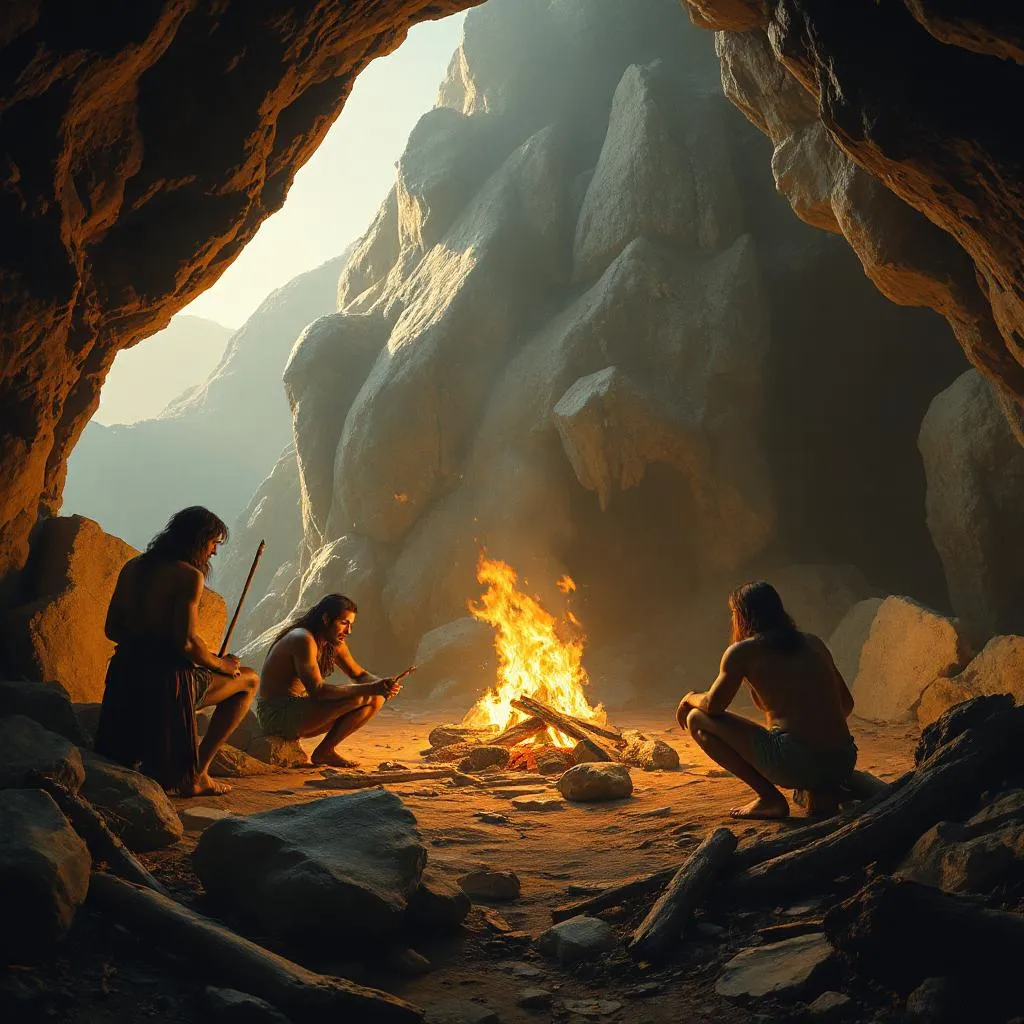
"Ancient humans at their cave at the fire" / Wikimedia Commons (Public domain).
The control of fire was one of the most important breakthroughs in human history. Archaeological evidence shows that early humans began to use fire over one million years ago. Sites like Wonderwerk Cave in South Africa, dated to about 1 million years ago, reveal ancient ash and burned bones. Fire allowed early humans to survive in many environments and changed how they lived together as communities.
Early humans, such as Homo erectus, learned to use fire for warmth, protection, and cooking. Before fire, people ate raw food, which was harder to digest. Cooking made food safer and easier to chew, providing more nutrients and energy. In places like Gesher Benot Ya'aqov in Israel, archaeologists found hearths, or ancient fireplaces, used around 790,000 years ago. These discoveries show that people gathered around fires, which encouraged cooperation and sharing.
Fire also offered protection from dangerous animals and insects. At night, flames kept wild predators away from camps. People could settle in new regions with colder climates because fire provided warmth and light. This adaptation helped humans spread from Africa to Europe and Asia over thousands of years. Fire let them make new tools by hardening wooden spears, and eventually, it became essential for making pottery and metalworking. The ability to control fire led to new technologies that shaped human progress.
Social life changed because of fire. People gathered around the hearth to cook, talk, and tell stories. This gathering place became the center of group life, increasing communication and cooperation. Sharing fire and food may have helped to form early social hierarchies, as some individuals were responsible for tending the fire or dividing cooked food. Over time, these social changes contributed to the development of more complex societies.
The control of fire is considered a turning point in ancient history because it allowed humans to adapt to different environments, invent new tools, and build stronger communities. Without fire, the progress of early humans would have been much slower. Understanding the use of fire helps historians see how a single innovation can transform life and lead to new possibilities.
Interesting Fact: The oldest known evidence of fire use by early humans was found in Wonderwerk Cave, South Africa, and is over one million years old!
This topic connects to broader themes in ancient history, such as how technological change shapes societies and the importance of adaptation in human survival.
Comprehension quiz (8 questions)
1. Where is Wonderwerk Cave located?
2. Which early human species used fire?
3. What was found at Gesher Benot Ya'aqov?
4. How did fire help early humans cooperate?
5. Why was cooking food important?
6. What effect did fire have on migration?
7. Fire allowed early humans to make pottery. (True/False)
8. What is a hearth?
Perfect for the way you teach
- Build comprehension skills
- Auto-graded quiz
- Differentiated reading
- Read together at home
- Improve fluency
- Quiet reading time
- Reading curriculum support
- Independent practice
- Track Lexile growth