Oldowan Tools
Interactive passage with audio narration, comprehension questions, and printable PDF.
By completing this purchase you agree to our Terms of Use and Privacy Policy. Your subscription renews automatically until you cancel. You can cancel anytime from your account settings. All sales are final and non-refundable. Digital content is available for download in your account immediately upon purchase.
What's included
Part of this bundle

Oldowan Tools preview and details
About this printable Oldowan Tools reading passage (Grades 6-8)
Sample passage and quiz from Oldowan Tools
Reading passage and comprehension quiz preview
Oldowan Tools
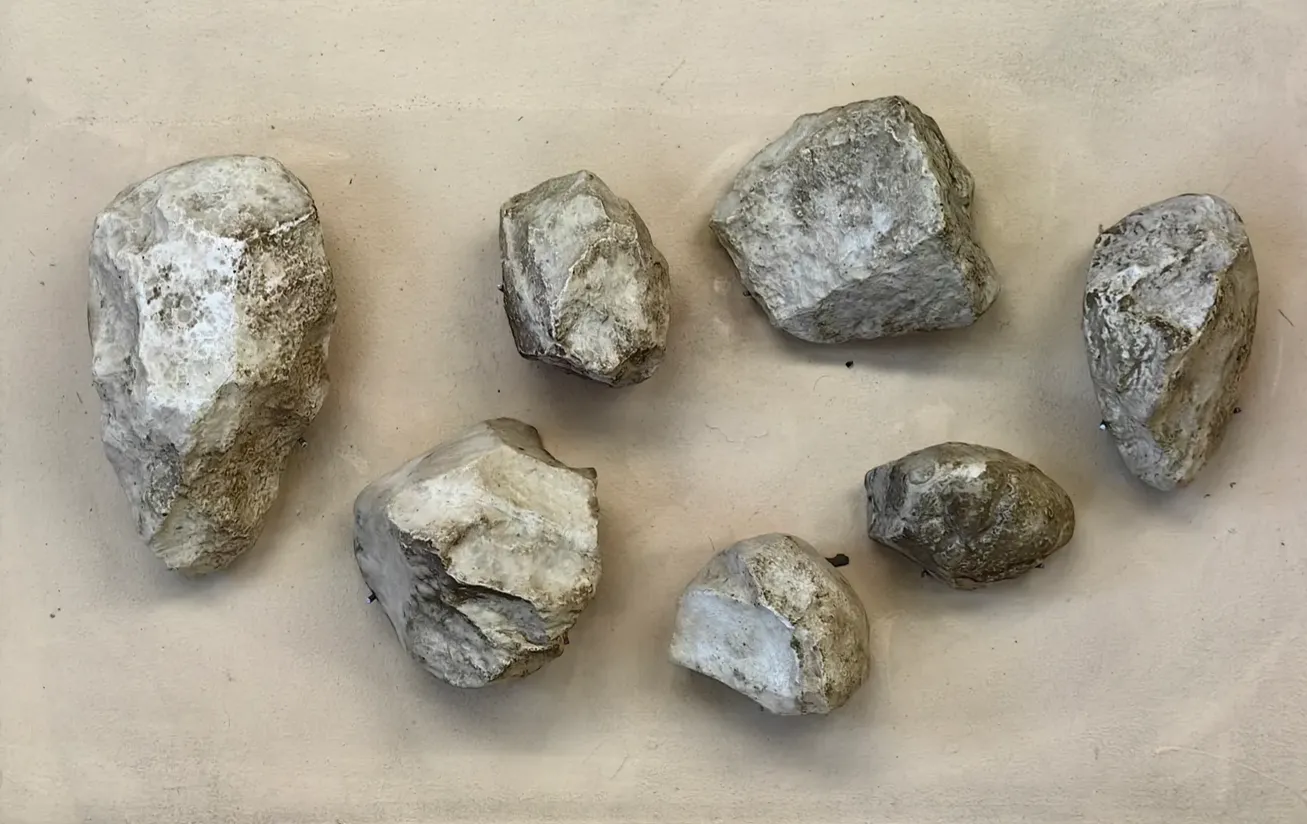
"Tools of Oldowan culture in the Timiryazev museum" by Александр Сигачёв / Wikimedia Commons
The earliest known stone tools were made by human ancestors over 2.5 million years ago in East Africa. These tools, called Oldowan tools, represent one of humanity’s greatest early achievements. Archaeologists have studied these artifacts to understand how early humans survived and adapted to their environment. The appearance of stone tools marks a major turning point in human history, showing the beginnings of technology and complex behaviors.
The Oldowan tools were simple, but effective. They were usually made by striking one rock against another to create a sharp edge. This process, called flaking, allowed early humans to cut meat, break bones, and process plants. The earliest examples were found at sites like Gona and Omo in Ethiopia, and Olduvai Gorge in Tanzania. Archaeologists have dated these tools to around 2.6 to 1.7 million years ago. The presence of animal bones with cut marks at these sites provides direct evidence that tools were used for butchering meat. This innovation helped early humans access more calories from their environment.
Oldowan toolmakers were likely Homo habilis, an early human species. They lived in small groups and moved across the African landscape, following herds of animals and searching for food. The ability to make and use tools may have led to other important changes. For example, it likely encouraged cooperation and communication, as groups shared tasks and knowledge. Tool use also shaped early humans’ brains and hands, leading to further evolution over time. Archaeological findings suggest that some groups specialized in certain types of tools, showing the beginnings of social organization and division of labor.
The spread of Oldowan tools shows both continuity and change. For nearly a million years, stone tools remained simple and similar across regions. However, over time, new types of tools and more advanced techniques appeared. The Oldowan tradition eventually gave way to the more complex Acheulean tools, marking another step in technological progress. Yet the basic idea of shaping stones for specific purposes continued to influence human societies for thousands of years. This development connected humans more deeply to their environment and increased their chances of survival.
The invention of stone tools is significant because it marks the start of human technology. It shows how early humans responded to their environment and solved problems creatively. By studying these ancient artifacts, historians and archaeologists can learn about the daily lives, challenges, and achievements of our earliest ancestors.
This study of early technology links directly to broader historical themes, such as the development of societies, adaptation to geography, and the role of innovation in human progress.
Interesting Fact: Some Oldowan tools show signs of being transported far from their original source, suggesting that early humans planned ahead and valued certain types of rock for tool-making.
Comprehension quiz (8 questions)
1. Where were Oldowan tools first found?
2. What process created sharp stone edges?
3. Which species likely made Oldowan tools?
4. Why did Oldowan tools matter?
5. What evidence shows tools were used for meat?
6. How did tool use affect early humans?
7. Oldowan tools are the oldest known tools.
8. What does 'innovation' mean in the passage?
Perfect for the way you teach
- Build comprehension skills
- Auto-graded quiz
- Differentiated reading
- Read together at home
- Improve fluency
- Quiet reading time
- Reading curriculum support
- Independent practice
- Track Lexile growth