This learning resource is available in interactive and printable formats. The interactive worksheet can be played online and assigned to students. The Printable PDF version can be downloaded and printed for completion by hand.
This engaging history reading passage explores Early Paleolithic Stone Tools, focusing on how early humans crafted sharp edges from rocks for hunting and gathering. It details the development of hand axes, the significance of tool-making, and its impact on daily life during the Paleolithic era. The passage is aligned with the CA HSS 6.1.1 and CCSS RH.6-8.2 standards, and supports students in analyzing historical evidence and understanding technological change over time. Included are a glossary, multiple-choice and writing activities, graphic organizers, and a timeline. The resource also provides a Spanish translation and read aloud audio, making it accessible to more learners. Key academic vocabulary is woven throughout to support literacy and content mastery. The material is ideal for ancient history units exploring human innovation and adaptation.
CONTENT PREVIEW
Expand content preview
"Paleolithic Stone Artifacts (9974634973)" by Gary Todd from Xinzheng, China / Wikimedia Commons
The earliest known use of stone tools began about 2.6 million years ago during the Paleolithic era. Early humans, known as hominins, learned to shape stones to create sharp edges for cutting, scraping, and hunting. These technological advances marked a significant turning point in human history, allowing hominins to adapt more effectively to their environments across Africa and beyond.
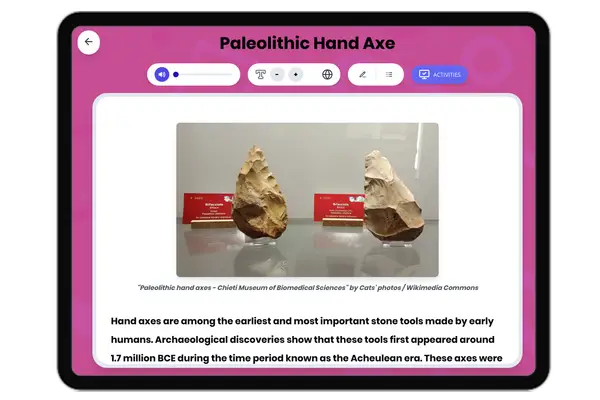
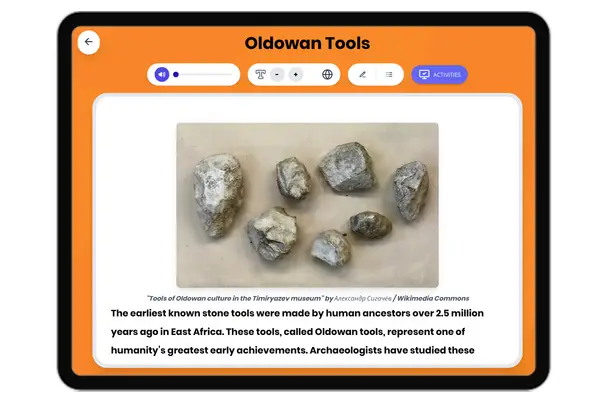
The oldest stone tools, found in sites like Olduvai Gorge in Tanzania, are called Oldowan tools. These were simple flakes and cores struck from rocks to produce razor-sharp edges. Archaeologists have identified evidence of tool use through cut marks on animal bones, indicating that early humans used these implements for butchering meat. Over time, around 1.7 million years ago, a new technology emerged: the Acheulean hand axe. These teardrop-shaped tools, discovered in Africa, Europe, and Asia, were carefully crafted by removing flakes from both sides of a large stone, resulting in a symmetrical, multi-purpose cutting tool.
The creation of stone tools required a deep understanding of materials and skillful technique. Early humans selected rocks like flint or quartzite for their durability and ability to hold a sharp edge. The process of knapping, or striking stones with precise blows, allowed them to shape tools for specific tasks. Archaeological findings, such as the 1.76-million-year-old hand axes from Kokiselei, Kenya, show that this knowledge was passed down through generations. The spread of similar tool types across continents suggests that early humans shared ideas and adapted their technology to new environments.
Stone tools had a profound impact on daily life and social organization. With reliable cutting tools, groups could hunt larger animals, process plants, and build shelters more effectively. The ability to hunt and gather more efficiently led to increased survival rates and population growth. Tool-making may have encouraged early forms of communication and teaching, as skills were shared within social groups. Despite changes in climate and landscape, the continuous use and improvement of stone tools demonstrates both adaptation and continuity in human history.
These early inventions laid the foundation for later technological advances and are a key reason why archaeologists study ancient tools to understand human evolution. The development of Paleolithic stone tools connects to broader themes of innovation, adaptation, and the shaping of human societies over time.
Interesting Fact: Some Acheulean hand axes are so well-made that scientists believe they may have been used for social display or as symbols of skill, not just as practical tools.
When did stone tool use begin?
2.6 million years ago10,000 years ago500 years ago5 million years ago
Where were Oldowan tools first found?
Olduvai Gorge, TanzaniaEgyptChinaAustralia
What rock types were often used?
Flint and quartziteGranite and marbleLimestone and chalkSandstone and slate
Why were hand axes important?
Helped cut and huntUsed as moneyFor making fireFor farming
What does 'knapping' mean?
Shaping stone by strikingBuilding firesPainting cavesHunting animals
How did tool-making change society?
Enabled larger groups, sharingStopped huntingNo effectMade people nomads
Acheulean hand axes appeared about 1.7 million years ago. (True/False)