This learning resource is available in interactive and printable formats. The interactive worksheet can be played online and assigned to students. The Printable PDF version can be downloaded and printed for completion by hand.
This engaging history reading passage explores how early humans developed language and complex ideas, transforming their societies and shaping the path of civilization. Students will learn about archaeological discoveries, the significance of cave art, and the role of communication in human advancement. The passage aligns with CA HSS 6.1 and CCSS RH.6-8.1, supporting deep inquiry into ancient history. Activities include a glossary, quiz, writing prompts, graphic organizers, a timeline, and Spanish translations. This resource is designed to help students analyze historical causation, use evidence, and connect past developments to broader world history themes, with read aloud audio for accessibility.
CONTENT PREVIEW
Expand content preview
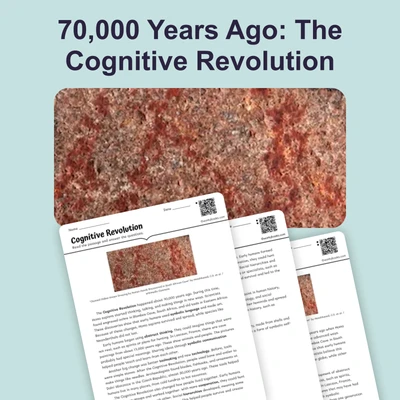
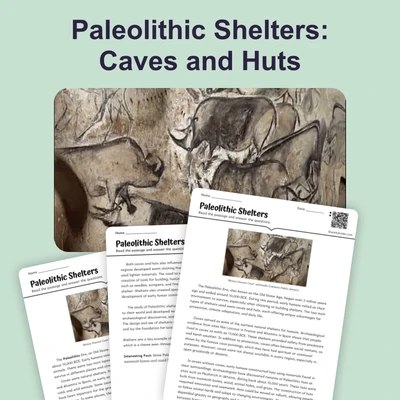
"Cave painting, Lascaux" by DaBler / Wikimedia Commons (Public domain).
Modern humans first appeared in Africa about 300,000 years ago. These early people are called Homo sapiens. Unlike earlier hominids, Homo sapiens developed advanced language and symbolic thinking. Archaeologists have found evidence of this in places like Blombos Cave in South Africa, where people carved geometric patterns into ochre stones about 75,000 years ago.
One of the earliest forms of communication was spoken language. Language allowed early humans to share ideas, teach skills, and plan hunts together. This ability to communicate complex thoughts set Homo sapiens apart from other species. Archaeological discoveries, such as engraved bones and tools, show that early humans began to express ideas and record information. In Europe, the discovery of cave paintings in sites like Lascaux, France (created over 17,000 years ago), provides evidence of early artistic expression. These images of animals and symbols may have been used for storytelling, rituals, or recording important events.
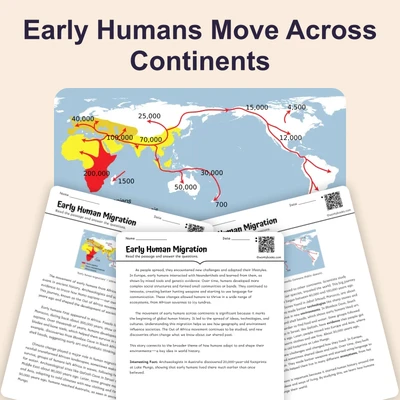
The development of language led to great changes in human society. With language, people could pass down knowledge to future generations. This helped groups survive and adapt to new environments. For example, early humans migrating out of Africa around 60,000 years ago used language to share information about animal behavior and weather, which improved their chances of survival. The ability to talk about things that were not present—such as distant places or past experiences—enabled humans to plan, cooperate, and form larger communities. Over time, these skills resulted in the rise of more complex social structures and the sharing of culture.
Language and symbolic thinking also influenced daily life and social hierarchy. People could share stories, create myths, and develop rules. These ideas helped early societies organize themselves and maintain order. Archaeological evidence, such as burial sites with grave goods, shows that early humans valued certain individuals and may have believed in an afterlife. This suggests that language contributed to the development of beliefs, traditions, and social roles.
The development of ideas and language marks a turning point in human history. These abilities allowed Homo sapiens to outlive and outcompete other hominids, such as Neanderthals. The spread of language and shared ideas laid the foundation for later inventions, including writing and civilization itself. Understanding how early humans thought and communicated connects us to the roots of all human societies and is a key theme in world history.
Interesting Fact: Some of the earliest musical instruments, like bone flutes, have been found in caves over 40,000 years old, showing that music was also an important part of early human culture.
Where did Homo sapiens first appear?
AfricaAsiaEuropeAustralia
How old are the Lascaux cave paintings?
Over 17,000 yearsAbout 5,000 years1,000 yearsAbout 200 years
What was found in Blombos Cave?
Geometric patterns on ochreClay potsBronze swordsStone pyramids
How did language help early humans?
Share knowledge and surviveHunt aloneGrow cropsBuild cars
Why are burial sites important evidence?
Show beliefs and social rolesShow technologyShow animal migrationShow trade routes
What set Homo sapiens apart?
Advanced language and thinkingRunning fastBig sizeBright colors
Early humans used language to plan hunts. True or false?
TrueFalse
What does 'hierarchy' mean?
Ranking people by statusBuilding sheltersHunting animalsDrawing on caves
Perfect For:
👩🏫 Teachers
• Reading comprehension practice
• Auto-graded assessments
• Literacy skill development
👨👩👧👦 Parents
• Reading practice at home
• Comprehension improvement
• Educational reading time
🏠 Homeschoolers
• Reading curriculum support
• Independent reading practice
• Progress monitoring
Reading Features:
📖
Reading Passage
Engaging fiction or nonfiction text
❓
Comprehension Quiz
Auto-graded questions
📊
Instant Feedback
Immediate results and scoring
📄
Printable Version
Download for offline reading
🔊
Read Aloud
Voice-over with word highlighting
Reviews & Ratings
No reviews yet. Be the first to share your experience!
Related Content
Early Humans Reach Australia
This reading passage explores the journey of early humans who reached Australia by crossing the ocean over 60,000 years ...
CA HSS 6.1CCSS RH.6-8.1CCSS RH.6-8.4CCSS RH.6-8.7
Early Humans in Europe and Asia
This passage explores the arrival of early humans in Europe and Asia around 40,000 BCE, highlighting their migration, ad...
CA HSS 6.1.1CCSS RH.6-8.1CCSS RH.6-8.2CCSS RH.6-8.4
Early Human Migration
This comprehensive history reading passage explores the Out of Africa movement and how early humans migrated across cont...
CA HSS 6.1.1CCSS RH.6-8.1RH.6-8.2RH.6-8.4
Ancient Humans Adapt to Different Climates
This engaging ancient history reading passage explores how early humans adapted to different climates, especially during...
First Humans
This engaging history reading passage explores the evolution of early humans, tracing the journey from the earliest homi...
CA HSS 6.1RH.6-8.1RH.6-8.2W.6.2
The Turkana Boy: A Nearly Complete Early Human Skeleton
This history reading passage explores the remarkable discovery of the Turkana Boy, a nearly complete Homo erectus skelet...
Early Stone Tools
This engaging history reading passage explores Early Paleolithic Stone Tools, focusing on how early humans crafted sharp...
Rise of Early Civilizations
This reading passage explores the critical transformation from early human hunter-gatherer societies to the development ...
CA HSS 6.1CCSS.RI.6.1CCSS.RI.6.3CCSS.RI.6.4
Neanderthals and Denisovans
This comprehensive history reading passage explores the fascinating story of Neanderthals, Denisovans, and other ancient...
CA HSS 6.1.1TEKS 6.2BCCSS.RH.6-8.1CCSS.RH.6-8.2
Paleolithic Migration by Land and Sea
This passage explores the migration of Paleolithic humans from Africa to the rest of the world, focusing on the routes t...
6.1RH.6-8.1RH.6-8.2RH.6-8.4
Introduction to the Paleolithic Age
This engaging passage explores the lives and achievements of ancient humans during the Paleolithic Age, focusing on thei...
CA HSS 6.1.1CCSS RH.6-8.1CCSS RH.6-8.2CCSS RH.6-8.4
Paleolithic Shelters
Explore how early humans in the Paleolithic Era built shelters such as caves and huts to survive harsh climates. This pa...
CA HSS 6.1CCSS.RI.6.3CCSS.RI.7.1CCSS.RI.8.2
Paleolithic Hand Axe
This engaging ancient history passage explores the development and significance of Acheulean hand axes, one of the earli...
CA HSS 6.1.1CCSS.RI.6.1CCSS.RI.6.4CCSS.W.6.2
How Paleolithic People Changed the Environment
This passage explores how Paleolithic people, or early humans, shaped their environment through the use of fire, hunting...
Discovery of Fire
This history reading passage explores the revolutionary impact of fire on early human societies. Students will learn how...
Oldowan Tools
This engaging history reading passage explores the emergence of the first stone tools, known as Oldowan tools, around 2....
Evidence in Ancient History
This engaging history reading passage investigates how archaeologists and historians discover clues about how ancient pe...
Nomads to Farmers
This engaging passage explores the two major ways of life practiced by early humans: nomadic hunter-gathering and settle...
CA HSS 6.1.1CCSS RH.6-8.2
Prehistoric Cave Art
This passage explores the significance of cave paintings and early symbolic art, examining how ancient humans used these...