The Turkana Boy: A Nearly Complete Early Human Skeleton
Interactive passage with audio narration, comprehension questions, and printable PDF.
By completing this purchase you agree to our Terms of Use and Privacy Policy. Your subscription renews automatically until you cancel. You can cancel anytime from your account settings. All sales are final and non-refundable. Digital content is available for download in your account immediately upon purchase.
What's included
Part of this bundle

The Turkana Boy: A Nearly Complete Early Human Skeleton preview and details
About this printable The Turkana Boy: A Nearly Complete Early Human Skeleton reading passage (Grades 5-8)
Sample passage and quiz from The Turkana Boy: A Nearly Complete Early Human Skeleton
Reading passage and comprehension quiz preview
The Turkana Boy: A Nearly Complete Early Human Skeleton
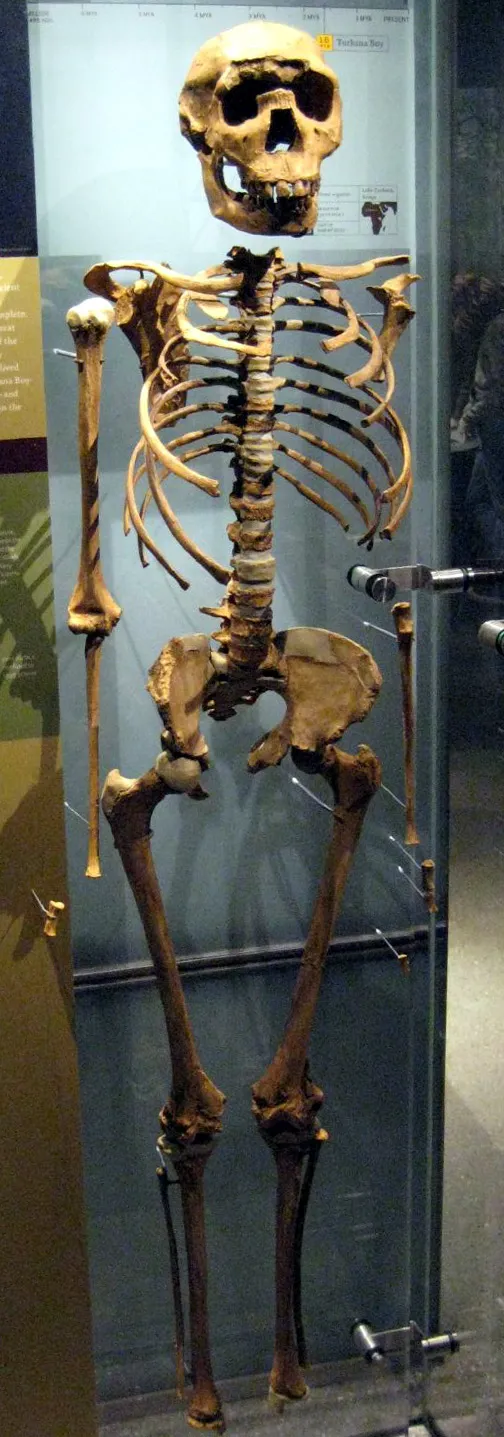
Source: Wikimedia Commons - Claire Houck from New York City, USA
The Turkana Boy is one of the most important archaeological discoveries related to early humans. In 1984, a team led by the Kenyan archaeologist Richard Leakey and Kamoya Kimeu found the nearly complete skeleton near Lake Turkana in northern Kenya. Scientists identified the remains as belonging to a young male of the species Homo erectus, who lived about 1.6 million years ago. This find was remarkable because most ancient human fossils are only fragments, but the Turkana Boy's skeleton was about 90% complete.
The skeleton gave researchers new insights into the physical characteristics and daily life of early humans. The Turkana Boy was about 8 to 12 years old when he died, based on his teeth and bones. He stood nearly 5 feet 3 inches tall, which shows that early Homo erectus children grew quickly, similar to modern humans. By examining the shape of his pelvis, skull, and limbs, scientists learned that Turkana Boy walked upright, had long legs, and could probably run well. These features suggest that Homo erectus was adapted to life on open grasslands rather than forests. This evidence fits with other archaeological finds from the region, such as stone tools and animal bones, which indicate that early humans hunted and gathered food along the shores of Lake Turkana.
The location where Turkana Boy was found is significant. Lake Turkana is in the Great Rift Valley, an area known as the "cradle of humankind" because so many important fossils have been discovered there. The region's shifting climate and volcanic activity preserved fossils in layers of sediment, making it possible for archaeologists to use stratigraphy—the study of rock layers—to date the remains. Scientists also use radiometric dating to estimate the age of the bones. These methods help build a timeline of how human ancestors evolved and spread across Africa.
The Turkana Boy discovery changed our understanding of human evolution. Before this find, scientists debated how similar early Homo erectus was to modern humans. The completeness of the skeleton allowed researchers to compare it directly with both earlier hominids, like Australopithecus, and with people today. For example, Turkana Boy's brain was larger than that of Australopithecus but smaller than modern humans, showing a clear development over time. The evidence also reveals that Homo erectus had a social structure and cared for their young, based on the wear on Turkana Boy's teeth and the location of the burial. However, some evidence is still debated, such as whether Turkana Boy died from disease or injury.
Today, the Turkana Boy remains one of the most complete early human skeletons ever found, helping scientists connect the past to the present. His discovery highlights the importance of archaeology in uncovering the story of human origins and the ways in which people and environments shape each other over time.
The story of Turkana Boy connects to broader themes in ancient history, such as migration, adaptation, and the development of technology.
Interesting Fact: The Turkana Boy's skeleton is so well preserved that scientists were able to study details like his tooth enamel and the structure of his ribs, providing unique clues about his health and nutrition.
Comprehension quiz (8 questions)
1. Where was Turkana Boy found?
2. What species was Turkana Boy?
3. How old was Turkana Boy when he died?
4. Why is the completeness of the skeleton important?
5. What did scientists learn from the bones?
6. What is stratigraphy used for?
7. Turkana Boy lived 1.6 million years ago.
8. What does 'fossil' mean?
Perfect for the way you teach
- Build comprehension skills
- Auto-graded quiz
- Differentiated reading
- Read together at home
- Improve fluency
- Quiet reading time
- Reading curriculum support
- Independent practice
- Track Lexile growth