This learning resource is available in interactive and printable formats. The interactive worksheet can be played online and assigned to students. The Printable PDF version can be downloaded and printed for completion by hand.
This passage explores the significance of cave paintings and early symbolic art, examining how ancient humans used these forms of expression to communicate ideas, beliefs, and experiences. Students will learn about archaeological discoveries such as the Lascaux and Altamira caves, the techniques and materials used, and how geography and migration influenced the spread of symbolic art. The text highlights the impact of these artworks on our understanding of early human societies, linking them to broader historical themes of communication, cultural development, and adaptation. Glossary terms are provided to support academic vocabulary, and the passage is available in both English and Spanish. The accompanying activities, such as reading comprehension questions, writing prompts, and graphic organizers, are aligned with CA HSS 6.1.1, 6.1.2, 6.1.3, and CCSS.RI.6.1, RI.6.4, W.6.2. A read aloud audio version and Spanish translation are included for accessibility.
CONTENT PREVIEW
Expand content preview
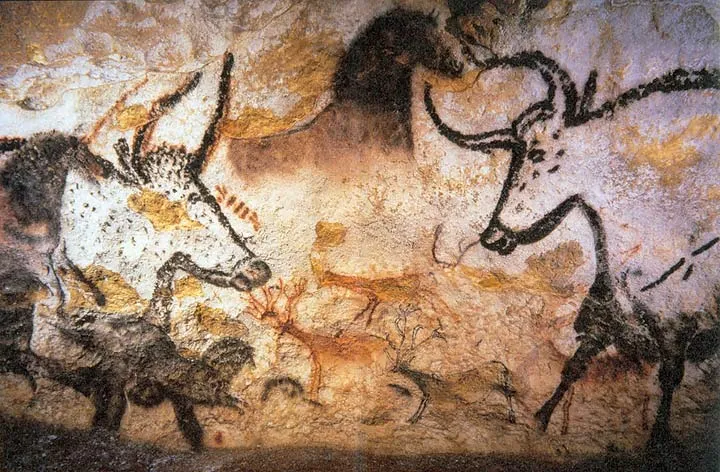
"Lascaux painting" by EU/ Wikimedia Commons (Public domain).
Archaeologists have discovered that some of the earliest known forms of human expression are found in cave paintings and early symbolic art. These artworks, created by ancient humans during the Paleolithic era (around 40,000 to 10,000 BCE), provide evidence of our ancestors’ creativity and ability to communicate ideas through images.
The oldest examples of cave art have been found in locations such as Chauvet Cave in France, which contains paintings dating back over 30,000 years, and the El Castillo Cave in Spain, where a red disk may be more than 40,000 years old. The famous Lascaux Caves, discovered in 1940 in southwestern France, feature over 600 painted and drawn animals, including horses, deer, and bison. In Altamira, Spain, artists used natural pigments to create vibrant images of bison on the cave ceiling. These sites show that early humans developed advanced artistic techniques, such as mixing minerals, charcoal, and animal fats to produce different colors and textures.
Cave paintings often show animals, human handprints, and mysterious symbols. The reasons for creating this art are still debated by experts. Some archaeologists believe the paintings had a spiritual or religious meaning, possibly related to hunting rituals or beliefs about nature. Others think these images helped early people share information or tell stories. The careful placement of art deep within caves suggests these sites had special significance and were not just decorated for decoration’s sake. For example, in Chauvet Cave, lions and rhinos are painted in areas that were difficult to reach, highlighting the importance of these images to the community.
The creation and spread of symbolic art were influenced by the migration of early humans across Africa, Europe, and Asia. As people moved into new regions, they adapted their artistic methods to fit local environments and available materials. The persistence of cave paintings for thousands of years shows both change and continuity in human culture. Even as societies evolved, the desire to communicate through art remained strong. This early art provides crucial evidence about how people understood their world, organized society, and expressed ideas before the invention of writing.
Cave paintings and symbolic art are significant because they mark a major step in the development of human culture. They reveal the beginnings of complex thought, creativity, and social organization. By studying these ancient artworks, historians and archaeologists gain insight into daily life, beliefs, and the social structure of early human groups.
The study of early symbolic art connects to larger themes in ancient history, such as migration, adaptation, and the development of communication.
Interesting Fact: The famous handprints found in many caves were created by blowing pigment over a hand pressed against the wall, leaving behind a stencil that has survived for tens of thousands of years.
Where is Lascaux Cave located?
FranceSpainItalyGreece
What animal is commonly painted in Altamira Cave?
BisonElephantBearCamel
When were the Lascaux caves discovered?
1940184014921980
Why did early humans create cave art?
Religious or ritual reasonsTo farm animalsFor trade onlyTo build houses
How did migration affect cave art?
Spread art to new placesStopped people from paintingMade art disappearOnly used in Africa
What is one way cave art shows change and continuity?
Art styles changed but art continuedArt was never made againPaintings only showed handprintsArt was not important
Cave paintings were made only for decoration. True or false?
TrueFalse
What does 'Paleolithic' mean?
Early Stone AgeModern TimesBronze AgeAncient Egypt
Perfect For:
👩🏫 Teachers
• Reading comprehension practice
• Auto-graded assessments
• Literacy skill development
👨👩👧👦 Parents
• Reading practice at home
• Comprehension improvement
• Educational reading time
🏠 Homeschoolers
• Reading curriculum support
• Independent reading practice
• Progress monitoring
Reading Features:
📖
Reading Passage
Engaging fiction or nonfiction text
❓
Comprehension Quiz
Auto-graded questions
📊
Instant Feedback
Immediate results and scoring
📄
Printable Version
Download for offline reading
🔊
Read Aloud
Voice-over with word highlighting
Reviews & Ratings
No reviews yet. Be the first to share your experience!
Related Content
Types of Plate Boundaries
This science passage explores how geologists use rock formations, fossil distributions, and seafloor structures to ident...
MS-ESS2-3RI.6.1RI.7.4RI.8.2
How Are Metamorphic Rocks Formed?
This science passage explains how metamorphic rocks form through metamorphism, detailing the effects of heat (150°C-1,00...
MS-ESS2-3RI.6.1RI.7.4RI.8.2
How Are Igneous Rocks Formed?
This science passage explains the complete formation process of igneous rocks, covering both intrusive (granite) and ext...
MS-ESS2-3RI.6.1RI.7.4RI.8.2
Intrusive Igneous Rocks: Formation and Features
This passage explains the formation of intrusive igneous rocks through slow cooling of magma beneath Earth's surface. It...
MS-ESS2-3RI.6.1RI.7.4RI.8.2
Type of Mountain Ranges Formed at Convergent Plate Boundaries
This passage explains how Earth's tallest mountain ranges form at convergent plate boundaries. It details two main forma...
MS-ESS2-3RI.6.1RI.7.4RI.8.2
Battle of the Alamo 1836
This rigorous history reading passage examines the Battle of the Alamo (1836) within the broader context of the Texas Re...
D2.HIS.2.3-5D2.HIS.3.3-5RI.6.3RI.6.4
Kansas-Nebraska Act 1854
This engaging history reading passage examines the Kansas-Nebraska Act of 1854, a pivotal moment in American history tha...
D2.HIS.2.3-5D2.HIS.3.3-5RI.6.3RI.6.4
Andrew Carnegie's Empire
This engaging U.S. History reading passage examines Andrew Carnegie's rise in the steel industry and his influential phi...
D2.HIS.2.3-5D2.HIS.3.3-5RI.6.3RI.6.4
American Federation of Labor
This engaging U.S. history reading passage explores the origins, strategies, and impact of the American Federation of La...
D2.HIS.2.6-8D2.HIS.3.6-8RI.6.3RI.6.4
Triangle Shirtwaist Factory Fire 1911: Worker Safety
This engaging U.S. history reading passage examines the Triangle Shirtwaist Factory Fire of 1911, one of the most signif...
D2.HIS.2.3-5D2.HIS.3.3-5RI.6.3RI.6.4
Tenement Life
This history reading passage examines the difficult realities of tenement life and urban poverty in America during the l...
D2.HIS.2.3-5D2.HIS.3.3-5RI.6.3RI.6.4
Ida Tarbell and Standard Oil Monopoly
This history reading passage explores the significant role of Ida Tarbell in exposing the Standard Oil monopoly and shap...
D2.HIS.2.3-5D2.HIS.3.3-5RI.6.3RI.6.4
Angel Island
This reading passage examines Angel Island, the main immigration processing center for Asians entering the United States...
D2.HIS.2.6-8D2.HIS.3.6-8RI.6.3RI.6.4
Temperance Movement: Push for Prohibition
This passage explores the Temperance Movement and the push for Prohibition in the United States. Students will learn abo...
D2.HIS.2.3-5D2.HIS.3.3-5RI.6.3RI.6.4
Lend-Lease Act 1941: Supporting Britain
This rigorous history reading passage explores the Lend-Lease Act of 1941, focusing on the causes, motivations, and cons...
D2.HIS.2.3-5D2.HIS.3.3-5RI.6.3RI.6.4
World War II Home Front
This rigorous U.S. history reading passage explores the complexities and challenges of the World War II Home Front, focu...
D2.HIS.2.3-5D2.HIS.3.3-5RI.6.3RI.6.4
Tuskegee Airmen
This engaging history reading passage explores the story of the Tuskegee Airmen, the first Black fighter pilots in the U...
D2.HIS.2.3-5D2.HIS.3.3-5RI.6.3RI.6.4
GI Bill Benefits 1944
This reading passage explores the GI Bill of 1944 and its transformative impact on World War II veterans and American so...
D2.HIS.2.3-5D2.HIS.3.3-5RI.6.3RI.6.4
Letter from Birmingham Jail 1963
This passage explores Martin Luther King Jr.'s historic 'Letter from Birmingham Jail' from 1963, a turning point in the ...
D2.HIS.2.3-5D2.HIS.3.3-5RI.6.3RI.6.4
Voting Rights Act 1965
This engaging passage examines the Voting Rights Act of 1965 and its impact on voting rights in the United States. Stude...