Diseases of the Columbian Exchange
Interactive passage with audio narration, comprehension questions, and printable PDF.
By completing this purchase you agree to our Terms of Use and Privacy Policy. Your subscription renews automatically until you cancel. You can cancel anytime from your account settings. All sales are final and non-refundable. Digital content is available for download in your account immediately upon purchase.
What's included
Diseases of the Columbian Exchange preview and details
About this printable Diseases of the Columbian Exchange reading passage (Grades 3-5)
Sample passage and quiz from Diseases of the Columbian Exchange
Reading passage and comprehension quiz preview
Diseases of the Columbian Exchange
The Columbian Exchange brought many changes to the Americas. When Europeans arrived, they brought new plants, animals, and technology. But they also brought something deadly—new diseases. These invisible germs would change America forever.
Before the Europeans came, Native Americans had their own ways of life. Their bodies had never faced illnesses like smallpox, measles, and typhus. When these diseases arrived, Native Americans had no way to fight them. Their immune systems could not protect them.
At first, people did not know how these diseases spread. One person might get sick and then pass it to many others. Smallpox was especially dangerous. It caused high fevers and painful sores. Measles and typhus also spread quickly, making whole villages sick. Unlike battles, these epidemics did not need armies. Germs traveled on the breath, skin, and even clothes of the new settlers.
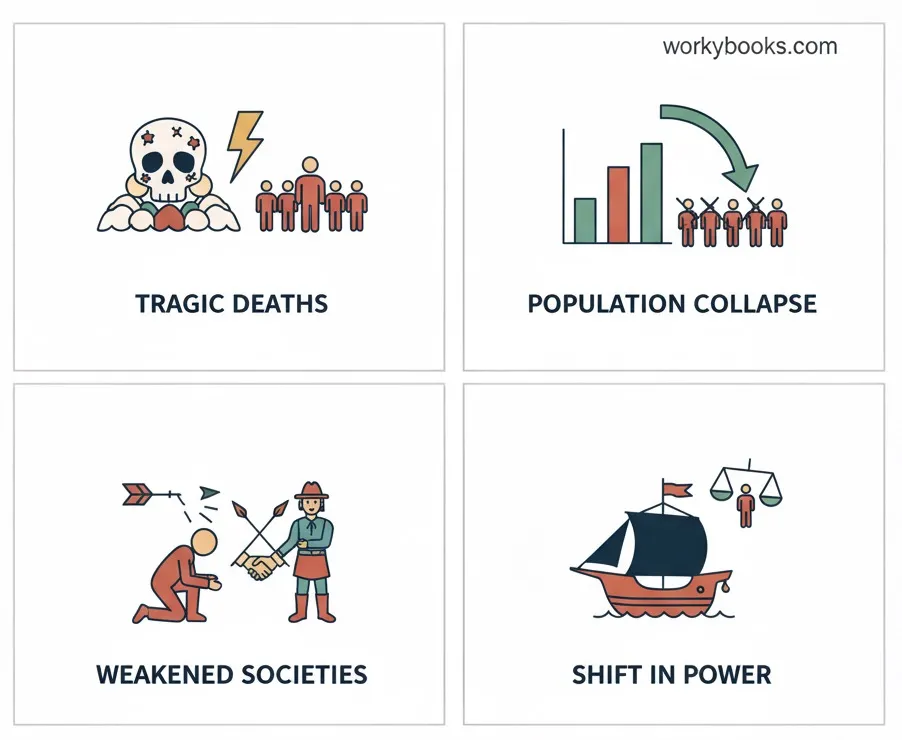
The effects were tragic. In just a few years, millions of Native Americans died. Some villages lost everyone. In some places, up to 90% of the population disappeared. This is called a population collapse. It changed the way people lived, worked, and even the land itself.
These losses made it easier for Europeans to take land. With fewer people to resist, colonies grew quickly. But Native communities lost leaders, traditions, and families. The Columbian Exchange did not only bring new foods and animals. It brought great sadness, too.
Over time, people learned more about germs and disease. Today, we know how to prevent and treat many illnesses. We remember this history to honor those who were lost and to keep learning how to protect each other.
Interesting Fact: The smallpox virus was so deadly that, in some places, it wiped out entire communities in just a few months.
Comprehension quiz (8 questions)
1. What was the Columbian Exchange?
2. Which disease killed many Native Americans?
3. What happened to many Native villages?
4. Why did diseases spread so quickly?
5. How did the epidemics help Europeans?
6. What is a population collapse?
7. Smallpox wiped out whole villages. True or false?
8. What does epidemic mean?
Common Core standards for Diseases of the Columbian Exchange
Determine the main idea of a text and explain how it is supported by key details; summarize the text.
Perfect for the way you teach
- Build comprehension skills
- Auto-graded quiz
- Differentiated reading
- Read together at home
- Improve fluency
- Quiet reading time
- Reading curriculum support
- Independent practice
- Track Lexile growth