This learning resource is available in interactive and printable formats. The interactive worksheet can be played online and assigned to students. The Printable PDF version can be downloaded and printed for completion by hand.
This passage explores the history and impact of Indian Boarding Schools during U.S. Westward Expansion. Students will analyze the causes and consequences of government policies that forced Native American children to attend these schools, focusing on assimilation and the deliberate destruction of native cultures. The reading integrates primary sources and multiple perspectives, challenging students to think critically about historical evidence and point of view. Activities include a glossary, timeline, multiple-choice and writing assessments, and graphic organizers to support deep understanding. Spanish translations and differentiated, simplified versions are provided for accessibility. This U.S. history reading passage aligns with CA HSS 8.8, 8.9 and TEKS 8.9B, 8.23B, as well as Common Core standards RI.6.3, RI.6.6, W.6.2, making it ideal for classrooms seeking rigorous, standards-based historical inquiry with support for English and Spanish speakers.
CONTENT PREVIEW
Expand content preview
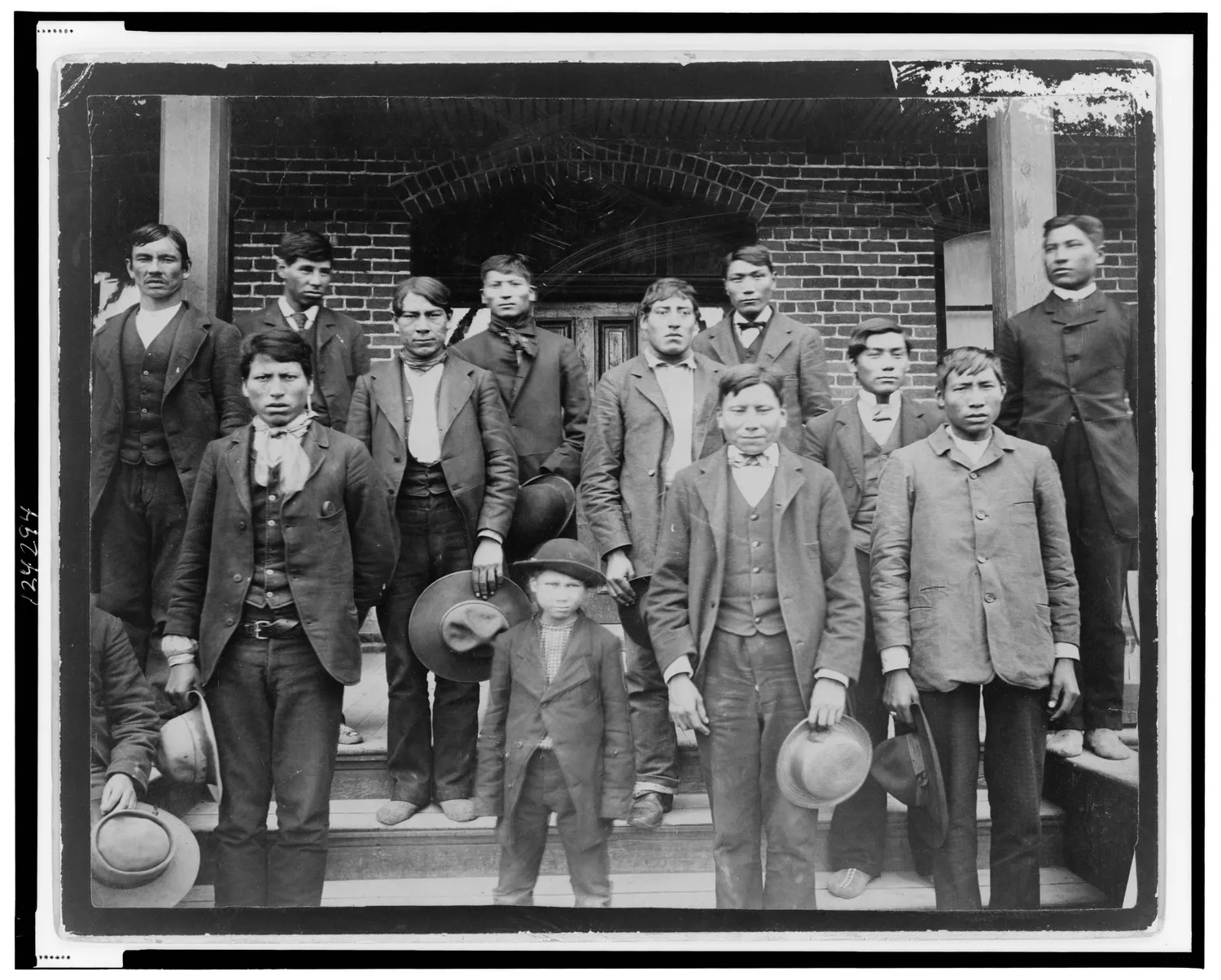
"Native American men and a boy posed outside of Carlisle Indian School LCCN99471846" by Miscellaneous Items in High Demand, PPOC, Source: Library of Congress / Wikimedia Commons (Public domain).
The establishment of boarding schools for Native American children was a major part of U.S. government policy during Westward Expansion. The primary aim of these schools was assimilation, which meant encouraging Native children to adopt English, Christianity, and American customs, while discouraging their traditional languages and practices. These schools were often located far from Native communities, making it difficult for families to visit their children.
Government leaders believed that changing Native cultures would help Native Americans fit into American society. They thought that education was the key to this process. However, this approach ignored Native beliefs and did not respect their ways of life. Many children were separated from their families for years, which led to feelings of loss and isolation. The policy resulted in deep disruption of Native communities and damaged family relationships.
Life at an Indian boarding school was highly structured and strict. Children followed a daily schedule that included English lessons, religious instruction, and manual labor. Students were often required to cut their hair, wear uniforms, and take English names. Speaking their own languages or practicing cultural traditions could lead to punishment. The schools promoted discipline and hard work, but at the cost of erasing Native identity.
Some former students remembered learning useful skills, such as reading, writing, and trades like carpentry or sewing. However, many also described harsh conditions, such as overcrowding, strict discipline, and homesickness. Many children experienced emotional trauma due to their forced separation from family and culture. Over time, the effects of these experiences spread throughout Native communities, causing lasting pain and challenges.
There was also resistance to boarding schools. Some Native families hid their children or refused to send them away. Others tried to keep their traditions alive by teaching language and customs at home. In later years, Native leaders and activists spoke out against the policy, arguing that it was unfair and harmful. Eventually, the U.S. government recognized the negative effects of boarding schools and changed its approach to Native education.
Today, many Native communities are working to revitalize their languages and traditions that were threatened by assimilation policies. Learning about the history of Indian boarding schools helps students understand the challenges Native peoples have faced and continue to overcome. Reflecting on this history encourages respect for different cultures and the importance of preserving cultural identity.
Interesting Fact: The famous phrase "Kill the Indian, save the man" was used by some school leaders to describe the goal of assimilation at Indian boarding schools.
What was the main goal of boarding schools?
AssimilationPunishmentCelebrationExploration
What did schools discourage?
Traditional languagesEnglishMath skillsSports
When did the first major school open?
1879177619001970
Why were families upset?
Children removed from homeMore homeworkFewer teachersShorter school days
What was a result of the policy?
Lost Native identityMore Native traditionsLess disciplineNew holidays
How did some families resist?
Hid childrenBuilt new schoolsMoved citiesStarted businesses
Boarding schools helped preserve Native languages. True or false?
TrueFalse
What does 'assimilation' mean?
Adopting another group's customsLearning to farmBuilding housesCreating new food
Perfect For:
👩🏫 Teachers
• Reading comprehension practice
• Auto-graded assessments
• Literacy skill development
👨👩👧👦 Parents
• Reading practice at home
• Comprehension improvement
• Educational reading time
🏠 Homeschoolers
• Reading curriculum support
• Independent reading practice
• Progress monitoring
Reading Features:
📖
Reading Passage
Engaging fiction or nonfiction text
❓
Comprehension Quiz
Auto-graded questions
📊
Instant Feedback
Immediate results and scoring
📄
Printable Version
Download for offline reading
🔊
Read Aloud
Voice-over with word highlighting
Reviews & Ratings
No reviews yet. Be the first to share your experience!
Related Content
Manifest Destiny: American Expansion
This engaging U.S. history reading passage explores the concept of Manifest Destiny and its impact on American expansion...
D2.HIS.2.3-5D2.HIS.3.3-5RI.4.3RI.4.4
The Bear Flag Revolt
This engaging U.S. History reading passage explores the Bear Flag Revolt, an important event during the time of Westward...
D2.HIS.1.4-5D2.HIS.2.4-5D2.HIS.3.4-5RI.4.3
When Mexico Took Over California
This engaging U.S. history reading passage explores the period when Mexico took over California during the era of Westwa...
D2.HIS.2.3-5D2.HIS.3.3-5D2.HIS.14.3-5RI.4.3
Oregon Trail Challenges
This engaging history reading passage examines the challenges and complexities of westward migration along the Oregon Tr...
D2.HIS.2.3-5D2.HIS.3.3-5RI.4.3RI.4.4
Americans Move West: The Oregon Trail
This engaging history passage explores the Oregon Trail and the westward movement of Americans in the 1800s. Students wi...
D2.HIS.1-4.3-5RI.4.3RI.4.4RI.5.3
The 31st State: California Joins the Union
This engaging U.S. history reading passage explores California's journey to becoming the 31st state in 1850. Students le...
D2.HIS.3.3-5D2.HIS.14.3-5RI.4.3RI.4.4
Exodusters
This passage explores the migration of Exodusters—African Americans who left the South in the 1870s to escape discrimina...
HSS 8.12.1RI.6-8.1RI.6-8.2
The Gold Rush Changes California Forever
This engaging U.S. History reading passage explores how the Gold Rush changed California forever. Students will learn ab...
D2.HIS.1.3-5D2.HIS.2.3-5D2.HIS.16.3-5RI.4.3
California Gold Rush Merchants
This engaging U.S. history reading passage explores the impact of merchants like Levi Strauss during the Gold Rush era i...
D2.HIS.2.3-5D2.HIS.3.3-5RI.4.3RI.4.4
Californios Culture
This history reading passage explores the story of the Californios—Spanish and Mexican settlers who shaped California be...
D2.HIS.2.3-5D2.HIS.3.3-5D2.HIS.14.3-5RI.4.3
Routes to the Gold Fields
This engaging history reading passage explores the three main routes people took to reach the California gold fields dur...
D2.HIS.2.3-5D2.HIS.14.3-5RI.4.3RI.4.4
Environmental impact of hydraulic mining.
This reading passage explores the environmental impact of hydraulic mining during the California Gold Rush era, an impor...
D2.HIS.2.3-5D2.HIS.4.3-5RI.4.3RI.4.4
Manifest Destiny: Coast to Coast
This engaging U.S. history reading passage explores Manifest Destiny and the westward expansion of the United States. St...
D2.HIS.1.3-5D2.HIS.2.3-5RI.4.3RI.4.4
Life in a California Mining Camp
This engaging reading passage explores daily life in a California mining camp during the Gold Rush era of the late 1840s...
D2.HIS.2.3-5D2.HIS.3.3-5D2.HIS.16.3-5RI.4.3
California Spanish Missions
This engaging U.S. history passage explores daily life at the California missions during the Mission and Rancho Eras. St...
D2.HIS.2.3-5D2.HIS.3.3-5RI.4.3RI.4.4
San Francisco Growth
This engaging U.S. History reading passage guides students through the dramatic transformation of San Francisco during t...
D2.HIS.2.3-5D2.HIS.3.3-5RI.4.3RI.4.4
Buffalo Slaughter Impact
This passage examines the systematic slaughter of buffalo in the 19th century and its devastating impact on Native Ameri...
D2.HIS.2.3-5D2.HIS.3.3-5RI.4.3RI.4.4
Discovery of Gold in 1848 by James Marshall
This engaging U.S. History passage introduces students to the discovery of gold in 1848 by James Marshall and the beginn...
D2.HIS.1.3-5D2.HIS.2.3-5D2.HIS.3.3-5RI.4.1
Homestead Act 1862
This informative U.S. history reading passage examines the Homestead Act of 1862, a pivotal law that transformed the Ame...