Buffalo Slaughter Impact
Interactive passage with audio narration, comprehension questions, and printable PDF.
By completing this purchase you agree to our Terms of Use and Privacy Policy. Your subscription renews automatically until you cancel. You can cancel anytime from your account settings. All sales are final and non-refundable. Digital content is available for download in your account immediately upon purchase.
What's included
Buffalo Slaughter Impact preview and details
About this printable Buffalo Slaughter Impact reading passage (Grades 6-8)
Sample passage and quiz from Buffalo Slaughter Impact
Reading passage and comprehension quiz preview
Buffalo Slaughter Impact
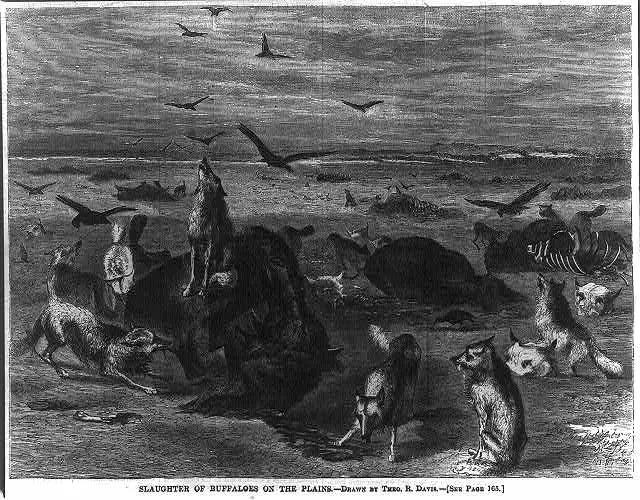
Source: Library of Congress
The slaughter of millions of buffalo in the late 1800s dramatically changed life on the Great Plains. Before this period, vast herds of buffalo roamed freely, forming the foundation of Plains Indian subsistence. Tribes such as the Lakota, Cheyenne, and Comanche depended on buffalo for food, clothing, shelter, and even tools. Each part of the animal was used, reflecting a deep respect for the natural world.
However, the arrival of white settlers and railroad construction during Westward Expansion brought new pressures. Commercial hunters, motivated by profit and encouraged by the government, began killing buffalo at an unprecedented rate. The hides were valuable for industrial uses, and sport hunters often killed animals only for trophies. By the 1870s, the population of buffalo was in rapid decline. Estimates suggest that within a few decades, over 30 million buffalo were reduced to just a few hundred.
This extinction-level event had devastating consequences for the Plains Indian nations. Without access to buffalo, Native Americans lost their primary source of food and materials. Starvation became common, and tribal economies collapsed. Many were forced onto reservations, where they struggled to adapt to farming and government rations. The loss of buffalo also meant the loss of cultural traditions tied to hunting, community, and spiritual ceremonies.
The U.S. government saw the buffalo slaughter as a way to weaken Native resistance. Government policies sometimes supported hunters or failed to protect the herds. This strategy contributed to the displacement of Native peoples and the expansion of white settlements. As the railroad spread across the plains, it became easier for hunters to access remote herds and transport hides to distant markets.
The impact of the buffalo slaughter went beyond immediate survival. It led to environmental changes, as grasslands were overgrazed by cattle and transformed by farming. The disappearance of the buffalo also disrupted the balance of the ecosystem, affecting other species and plant life. Today, efforts to restore buffalo populations are underway, but only a small fraction of their former range remains.
The story of the buffalo slaughter is a powerful example of how economic interests, government policy, and technological change can shape the fate of both people and nature. It reminds us to consider the long-term effects of human actions on communities and the environment.
Interesting Fact: At one point in the late 1800s, professional hunters could earn more money from buffalo tongues alone than from the entire hide, as tongues were considered a delicacy in eastern cities.
Comprehension quiz (8 questions)
1. Which animal was vital to Plains Indians?
2. What caused the buffalo population to drop?
3. By the late 1800s, how many buffalo remained?
4. Why did the U.S. government allow buffalo slaughter?
5. What was one effect on Plains Indians?
6. Which group profited from buffalo hides?
7. Buffalo slaughter led to environmental changes. True or false?
8. What does "subsistence" mean?
Common Core standards for Buffalo Slaughter Impact
Explain events, procedures, ideas, or concepts in a historical, scientific, or technical text, including what happened and why, based on specific information in the text.
Determine the meaning of general academic and domain-specific words or phrases in a text relevant to a grade 4 topic or subject area.
Write informative/explanatory texts to examine a topic and convey ideas and information clearly.
Perfect for the way you teach
- Build comprehension skills
- Auto-graded quiz
- Differentiated reading
- Read together at home
- Improve fluency
- Quiet reading time
- Reading curriculum support
- Independent practice
- Track Lexile growth