Manifest Destiny: American Expansion — Reading Comprehension
Rate this
Premium Resource
Present
Present in classroom. No work saved
Assign
Classroom with student accounts, Track progress
Quick Play
No student accounts, assign with a link
Grades
6
7
8
Standards
D2.HIS.2.3-5
D2.HIS.3.3-5
RI.4.3
RI.4.4
W.4.2
PRINT+DIGITAL RESOURCE
This learning resource is available in interactive and printable formats. The interactive worksheet can be played online and assigned to students. The Printable PDF version can be downloaded and printed for completion by hand.
This engaging U.S. history reading passage explores the concept of Manifest Destiny and its impact on American expansion during the 19th century. Students will analyze the causes, motivations, and consequences of westward expansion, including diverse perspectives from settlers, government leaders, and Native Americans. The passage is structured for critical thinking, incorporates a primary source quote, and highlights academic vocabulary. Activities include a multiple-choice quiz, writing prompts requiring explanatory responses, and a graphic organizer for comparative analysis. The content is designed to build historical reasoning and aligns with D2.His.2.3-5, D2.His.3.3-5, RI.4.3, RI.4.4, and W.4.2 standards. This resource features a glossary, a timeline, read aloud audio, and a full Spanish translation, making it accessible for all learners. Ideal for understanding the complexities of American expansion and fostering historical inquiry.
CONTENT PREVIEW
Expand content preview
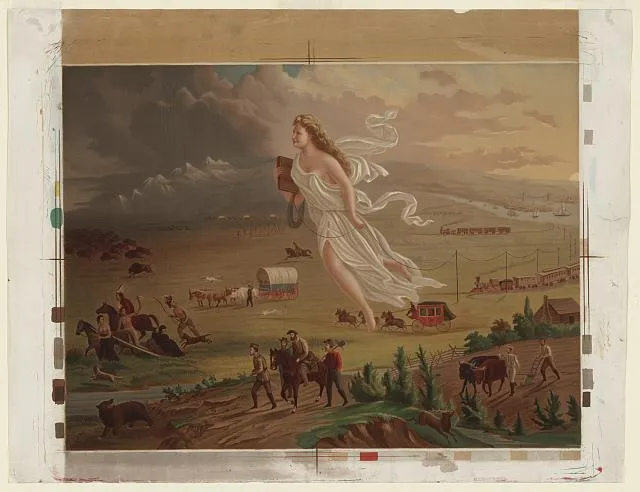
American progress Source: Library of Congress - Crofutt, George A.
The concept of Manifest Destiny was a powerful force in 19th-century America. Many Americans believed it was the nation’s duty and right to expand westward across the North American continent. This belief was not just about gaining land, but about spreading American values, democracy, and progress. However, Manifest Destiny also led to serious conflicts with Native American nations, Mexico, and others who lived on these lands.
In the early 1800s, the United States was mostly settled along the Atlantic coast. With the Louisiana Purchase in 1803, the country doubled in size, adding vast new territory west of the Mississippi River. This encouraged people to move west. The government passed laws like the Homestead Act in 1862, making it easier for families to claim and settle land on the frontier. As a result, towns, farms, and new states began to appear in areas that had once been home to Native Americans and wildlife.
Despite the promise of opportunity, westward expansion was filled with challenges. Settlers faced harsh weather, difficult journeys, and conflicts with Native peoples who resisted losing their ancestral lands. The Indian Removal Act of 1830 forced thousands of Native Americans off their homelands, leading to tragedies like the Trail of Tears. Meanwhile, the belief in Manifest Destiny justified wars, such as the Mexican-American War (1846–1848), through which the United States gained vast southwestern lands, including California and Texas.
The consequences of expansion were complex. On one hand, it created economic growth, new opportunities, and helped build the United States into a continental power. On the other hand, it caused displacement and suffering for Native Americans and led to disputes over slavery in new territories. These tensions contributed to the outbreak of the Civil War. The idea of Manifest Destiny continues to shape American identity and debates about the nation’s role in the world.
Historians today encourage us to look at Manifest Destiny from multiple perspectives. While it helped create the modern United States, it also involved difficult choices, losses, and moral dilemmas. Studying this period teaches us about the power of beliefs in shaping history and the importance of considering all voices and experiences.
Interesting Fact: The phrase "Manifest Destiny" was first used by newspaper editor John L. O'Sullivan in 1845 to promote the annexation of Texas and expansion to the Pacific Ocean.
What was Manifest Destiny?
Belief in U.S. westward expansionA law about farmingA Native American traditionA gold rush event
What did the Louisiana Purchase do?
Doubled U.S. sizeEnded the Civil WarFreed enslaved peopleBegan the Gold Rush
Who was forced to move by the Indian Removal Act?
Native AmericansSettlersFrench tradersGold miners
Why did settlers move west?
Seek land and opportunityEscape gold rushAvoid the Civil WarFind Native Americans
What was one result of expansion?
Native displacementLess farmingNo new statesPeaceful relations
What conflict did Manifest Destiny justify?
Mexican-American WarCivil WarRevolutionary WarSpanish-American War
Manifest Destiny only helped Native Americans. True or false?
TrueFalse
What does 'frontier' mean?
Edge of settled landA type of wagonA law about farmingA river in the East
Perfect For:
👩🏫 Teachers
• Reading comprehension practice
• Auto-graded assessments
• Literacy skill development
👨👩👧👦 Parents
• Reading practice at home
• Comprehension improvement
• Educational reading time
🏠 Homeschoolers
• Reading curriculum support
• Independent reading practice
• Progress monitoring
Reading Features:
📖
Reading Passage
Engaging fiction or nonfiction text
❓
Comprehension Quiz
Auto-graded questions
📊
Instant Feedback
Immediate results and scoring
📄
Printable Version
Download for offline reading
🔊
Read Aloud
Voice-over with word highlighting
Reviews & Ratings
No reviews yet. Be the first to share your experience!
Related Content
Native American Tribes Across America
This engaging history reading passage introduces students to Native American tribes across America, focusing on their da...
D2.HIS.1.3-5D2.HIS.2.3-5RI.4.1RI.4.2
Teepees: Homes on the Great Plains
This engaging history reading passage introduces students to teepees, the unique homes of Native American tribes on the ...
D2.HIS.2.3-5D2.HIS.14.3-5RI.4.1RI.4.2RI.4.4
Traditional Native American Clothing
This engaging history passage explores traditional Native American clothing and how it reflected the environment, values...
D2.HIS.2.3-5D2.HIS.3.3-5RI.4.3RI.4.4
The Iroquois Confederacy: A System of Peace
This engaging U.S. History reading passage introduces students to the Iroquois Confederacy, a powerful alliance of Nativ...
D2.HIS.2.3-5D2.HIS.3.3-5RI.4.3RI.4.4
The Cherokee Nation: History and Culture
This reading passage explores the rich history and culture of the Cherokee Nation, one of the largest Native American tr...
D2.HIS.2.3-5D2.HIS.14.3-5RI.4.3RI.4.4RI.4.10
The Sioux: Warriors and Tribal Leaders
This history reading passage explores the Sioux Nation, focusing on their roles as warriors and tribal leaders. Students...
D2.HIS.1.3-5D2.HIS.2.3-5RI.4.1RI.4.3
Native American Respect for Nature
This engaging history reading passage explores Native American respect for nature, emphasizing the close relationship be...
D2.HIS.2.3-5D2.HIS.3.3-5RI.4.3RI.4.4
Jamestown: The First Permanent English Colony
This engaging history passage explores the founding of Jamestown, the first permanent English colony in America. Aligned...
D2.HIS.1.3-5D2.HIS.2.3-5RI.4.3RI.4.4
Pocahontas and the Powhatan People
This engaging reading passage explores the life of Pocahontas and the Powhatan people and their important role in early ...
D2.HIS.1.3-5D2.HIS.2.3-5RI.4.1RI.4.3
Colonial Children: School and Chores
This reading passage explores the daily lives of colonial children, focusing on their experiences at school and their ma...
D2.HIS.2.3-5D2.HIS.3.3-5RI.4.1RI.4.2RI.4.4
Colonial Clothing and Homemade Goods
This engaging U.S. history passage explores the daily life of early American colonists with a focus on colonial clothing...
D2.HIS.2.3-5RI.4.3RI.4.4
Colonial Jobs: Blacksmiths, Bakers, and Craftsmen
This engaging history reading passage explores the vital roles of blacksmiths, bakers, and craftsmen in colonial America...
D2.HIS.2.3-5D2.HIS.3.3-5RI.4.3RI.4.4
Colonial Towns and Village Life
This engaging history reading passage explores the daily life, work, and unity found in colonial towns and villages. Ali...
D2.HIS.1.3-5D2.HIS.2.3-5RI.4.3RI.4.4
Colonial Trade with England and Africa
This history reading passage explores colonial trade between the American colonies, England, and Africa, focusing on the...
D2.HIS.2.3-5D2.HIS.14.3-5RI.4.3RI.4.4
Benjamin Franklin: Printer, Inventor, and Leader
This history reading passage explores the life and achievements of Benjamin Franklin, one of America's most important ea...
D2.HIS.2.3-5D2.HIS.3.3-5RI.4.1RI.4.3
George Washington Leads the Army
This engaging history reading passage explores how George Washington bravely led the Continental Army during the America...
D2.HIS.1.3-5D2.HIS.2.3-5RI.4.3RI.4.4
Women and Children During the Revolutionary War
This reading passage explores the important roles women and children played during the Revolutionary War. Students will ...
D2.HIS.2.3-5RI.4.3RI.5.3
African Americans Fight for Freedom
This educational passage explores the brave and inspiring story of how African Americans fought for freedom in the Unite...
D2.HIS.2.3-5D2.HIS.3.3-5RI.4.3RI.4.4
The Battle of Yorktown Ends War
This engaging U.S. history reading passage explores the Battle of Yorktown, a key event that ended the American Revoluti...
D2.HIS.1.3-5D2.HIS.2.3-5RI.4.1RI.4.3
Loyalists vs. Patriots: Divided Families
This engaging U.S. history reading passage explores the division between Loyalists and Patriots during the American Revo...