This learning resource is available in interactive and printable formats. The interactive worksheet can be played online and assigned to students. The Printable PDF version can be downloaded and printed for completion by hand.
This science reading passage, titled "The Amazing Axolotl," introduces young learners to one of Earth's most fascinating creatures. Aligned with Life Science NGSS standards, this easy-to-read text explains what an axolotl is—a unique type of salamander that lives entirely in water, primarily in lakes near Mexico City. The passage highlights their distinctive physical features, such as their external feathery gills, which they use to breathe underwater, and their extraordinary ability to regrow lost body parts, a superpower that makes them incredibly important to scientific research for understanding regeneration. The reading comprehension focus helps students grasp why axolotls are currently endangered, pointing to habitat loss and pollution as key threats to their survival in the wild. It gently emphasizes the importance of protecting these vulnerable animals and their aquatic environments for the sake of biodiversity. This resource is perfect for fostering curiosity about unique species, building basic science vocabulary, and introducing concepts of endangered animals and conservation within the broader context of NGSS Life Science standards, encouraging students to consider their role in protecting Earth's diverse living world.
CONTENT PREVIEW
Expand content preview
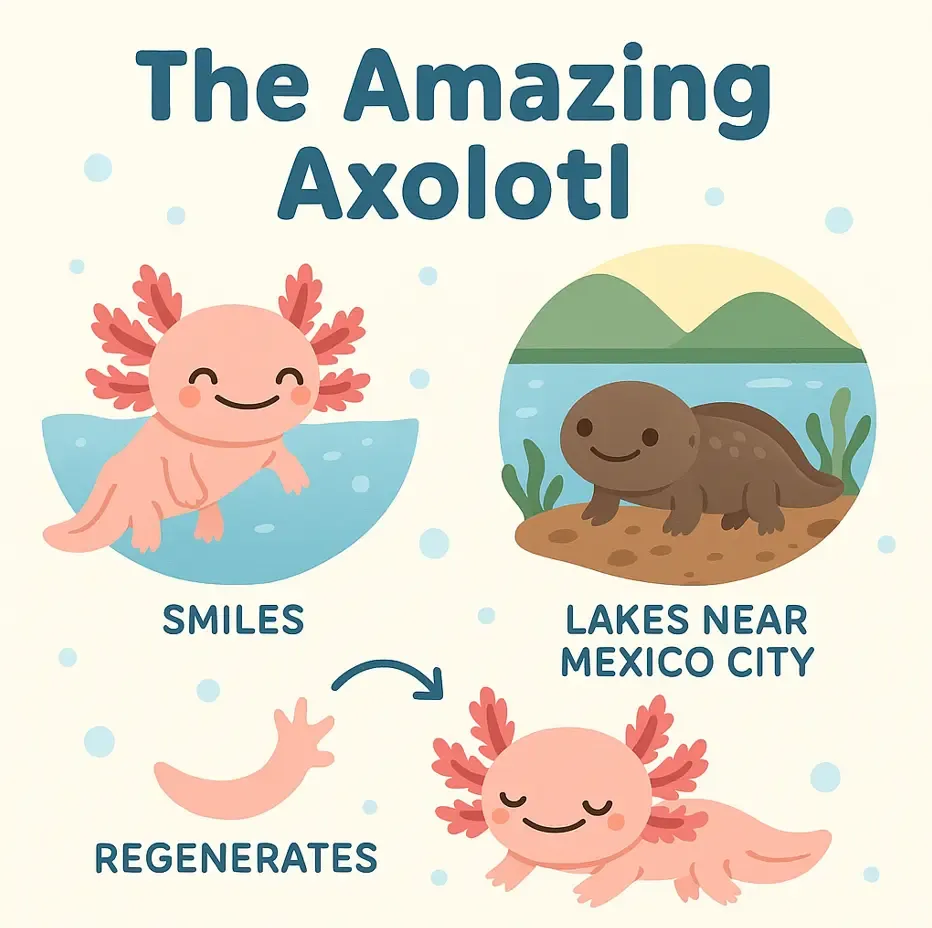
Have you ever seen an animal that looks like it's always smiling? Meet the Axolotl! This special creature is a type of salamander, but it's very unique. Most salamanders grow up and move onto land, but the axolotl loves water so much that it stays in the water its whole life!
Axolotls mostly live in lakes near Mexico City. They are often pink or white, but can also be black or brown. Look closely at their heads – they have fluffy, feathery things sticking out like branches. These are their gills, and they use them to breathe underwater!
What makes axolotls truly amazing is their superpower: they can grow back almost any part of their body! If an axolotl loses a leg, a tail, or even parts of its brain or heart, it can grow it back perfectly. Scientists are very interested in axolotls to learn how they do this. Their special healing ability could help us understand how to heal humans better.
Sadly, axolotls are in big trouble. There are not many left in the wild because their homes (the lakes) are getting polluted or disappearing. This means they are endangered, which means there are very few of them left, and they could disappear forever if we don't help.
We need to protect these incredible animals and their habitats. By learning about axolotls, we can understand why it's important to keep our planet's waters clean and safe for all the unique living things that call it home.
Fun Fact: Axolotls are sometimes called "walking fish" because of their funny feet, even though they are actually salamanders and don't walk like fish
What kind of animal is an Axolotl?
A fishA birdA salamanderAn insect
Where do Axolotls mostly live in the wild?
DesertsMountainsLakes in MexicoDeep oceans
What do Axolotls use their feathery gills for?
To eat foodTo breathe underwaterTo walk on landTo change colors
What amazing superpower do Axolotls have?
They can fly. They can turn invisible.They can grow back body parts.They can talk to humans.
Why are there not many Axolotls left in the wild?
They are too shy.Their homes are disappearing. They eat too much.Scientists take them all.
Why are scientists interested in Axolotls' healing power?
To make them stronger.To help humans heal.To change their colors.To make them smile more.
What is the main message about Axolotls in this passage?
They are colorful animals.They are amazing but need help.They only live in Mexico.Scientists only study their gills.
If a lake where Axolotls live becomes very dirty, what could happen?
Axolotls might grow more gills.Axolotls might become healthier.Axolotls might get sick or die.Axolotls might move to land.
Perfect For:
👩🏫 Teachers
• Reading comprehension practice
• Auto-graded assessments
• Literacy skill development
👨👩👧👦 Parents
• Reading practice at home
• Comprehension improvement
• Educational reading time
🏠 Homeschoolers
• Reading curriculum support
• Independent reading practice
• Progress monitoring
Reading Features:
📖
Reading Passage
Engaging fiction or nonfiction text
❓
Comprehension Quiz
Auto-graded questions
📊
Instant Feedback
Immediate results and scoring
📄
Printable Version
Download for offline reading
🔊
Read Aloud
Voice-over with word highlighting
Reviews & Ratings
No reviews yet. Be the first to share your experience!
Related Content
The Tiny Seed
This reading passage, 'The Sun, the Rain, and the Tiny Seed', is designed to illustrate the core concepts of NGSS LS2.A:...
2-LS2-1
Where Does My Food Come From?
This reading passage, 'Where Does My Food Come From?', aligns with NGSS LS2.A: Interdependent Relationships in Ecosystem...
2-LS2-1
Meadow Ecosystem
This reading passage, 'Life in the Meadow', is designed for elementary students to understand NGSS LS2.A: Interdependent...
2-LS2-1
What do Tadpoles Eat?
This reading passage, 'The Pond's Busy Life', vividly describes a pond ecosystem to illustrate NGSS LS2.A: Interdependen...
2-LS2-1
What do Plants Need to Thrive?
This science passage, 'Growing Green!', is designed for second-grade students and aligns with the NGSS standard 2-LS2-1....
2-LS2-1
The Bean Plant
This reading passage, 'The Mystery of the Green Bean Plant', is designed for second-grade students to understand cause a...
2-LS2-1
Robin's Nest
This NGSS passage, 'The Mystery of the Chirping Robin', is designed for second-grade students to explore cause and effec...
2-LS2-1
Butterfly Food
This science passage, 'The Butterfly's Busy Day', is crafted for second-grade students to understand cause and effect re...
2-LS2-1
The Beaver Creek
This science reading passage, 'The Beaver's Big Build', explores cause and effect relationships in animal behavior for s...
2-LS2-1
Seed Germination Experiment
This reading passage, 'The Sleepy Seed's Big Surprise', targets second-grade students and reinforces NGSS 2-LS2-1 by foc...
2-LS2-1
Squirrel Nuts
This science passage, 'Why Did the Squirrel Bury the Nut?', introduces second-grade students to cause and effect relatio...