Robin's Nest
Interactive passage with audio narration, comprehension questions, and printable PDF.
By completing this purchase you agree to our Terms of Use and Privacy Policy. Your subscription renews automatically until you cancel. You can cancel anytime from your account settings. All sales are final and non-refundable. Digital content is available for download in your account immediately upon purchase.
What's included
Robin's Nest preview and details
About this printable Robin's Nest science reading passage, NGSS-aligned (Grades 1-3)
Sample passage and quiz from Robin's Nest
Reading passage and comprehension quiz preview
Robin's Nest
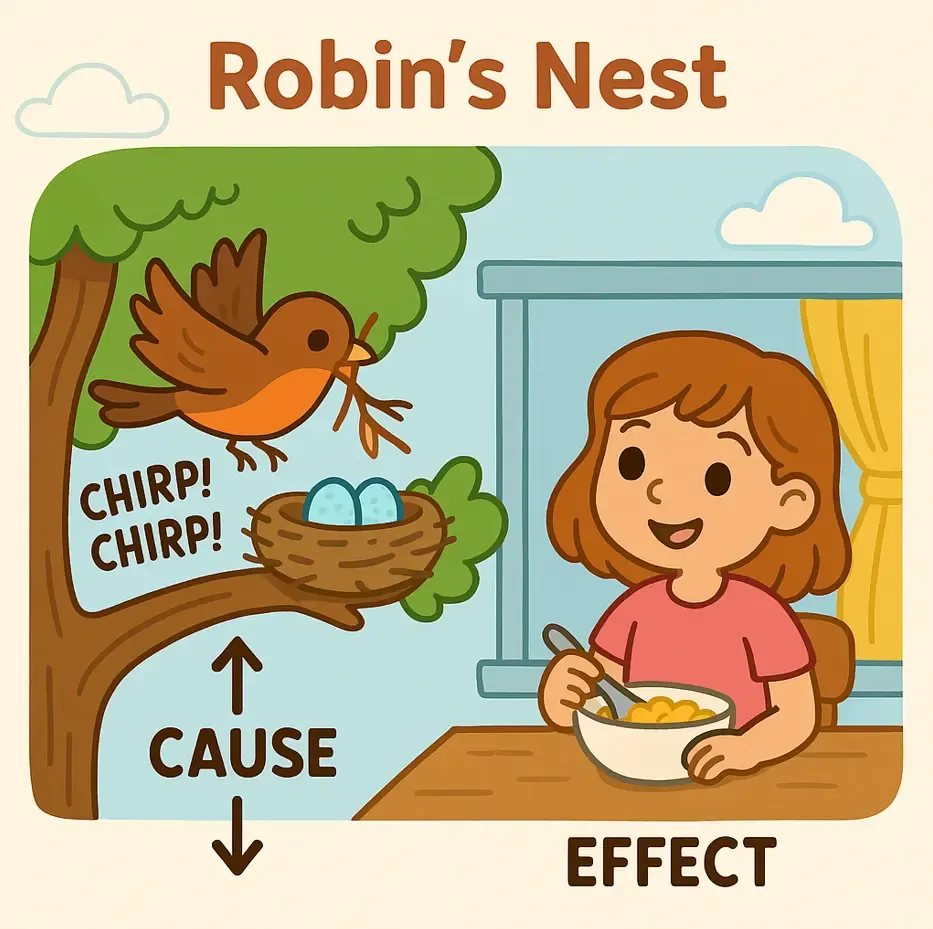
Lily was eating her breakfast one spring morning when she heard a loud "Chirp! Chirp! Chirp!" outside her window. She saw a small robin flying back and forth from a big tree to the ground. It kept putting things into a messy-looking pile of twigs and mud up in a branch.
"What's that robin doing?" Lily asked her mom.
Her mom smiled. "That robin is very busy! Animals do many things for a reason. There's a cause for their actions, and those actions (the effects) often make observable patterns that help us understand them."
They watched the robin together.
- Observable Pattern 1: The robin kept carrying little twigs, bits of string, and mud to the tree branch.
- Cause: The robin needs a safe place to lay its eggs and raise its babies.
- Effect: It is building a nest.
- Observable Pattern 2: After a few days, the robin stayed mostly inside the nest.
- Cause: The robin has laid its eggs.
- Effect: It is sitting on them to keep them warm until they hatch.
- Observable Pattern 3: A few weeks later, Lily heard tiny "Peep! Peep! Peep!" sounds from the nest, and the parent robin flew back and forth with worms in its beak.
- Cause: The eggs have hatched, and baby birds are hungry.
- Effect: The parent robin is bringing food to its babies.
Lily realized that the robin's busy work wasn't just random flying. Every action had a clear reason! She loved observing the patterns and understanding the causes behind them.
Comprehension quiz (8 questions)
1. What sound did Lily hear outside her window?
2. What kind of bird was Lily watching?
3. What was the robin putting into the pile on the branch?
4. What is the cause for the robin carrying twigs and mud to the tree branch?
5. What was the effect of the robin staying mostly inside the nest for a few days?
6. What is the main idea of this passage?
7. If a spider starts spinning a big web, what is a likely cause?
8. Which of these is an example of an observable pattern from the story?
Perfect for the way you teach
- Build comprehension skills
- Auto-graded quiz
- Differentiated reading
- Read together at home
- Improve fluency
- Quiet reading time
- Reading curriculum support
- Independent practice
- Track Lexile growth