Reading PassagePremium

The Beaver Creek

Interactive passage with audio narration, comprehension questions, and printable PDF.

No ratings yet|
1
Grades 1–3ReadingElaScienceEnglish · SpanishInteractive · Printable
Aligned to2-LS2-1
Just this resource
$1.50
One-time purchase
Best value
Unlock everything
$49.99$29.99/yr
40% off until Aug 1 — 10,000+ resources
Renews at $49.99/year.
Unlock above to use these actions

What's included

Reading passage
Audio narration
Comprehension quiz
Writing activity
Glossary & flashcards
Differentiated version
Spanish translation

The Beaver Creek preview and details

About this printable The Beaver Creek science reading passage, NGSS-aligned (Grades 1-3)

This science reading passage, 'The Beaver's Big Build', explores cause and effect relationships in animal behavior for second-grade students, aligning with NGSS 2-LS2-1. It details the observable patterns of a beaver's work, such as chewing trees and building dams and lodges, directly linking these actions (effects) to the beaver's needs (causes) for shelter and protection. The narrative vividly illustrates how one animal can significantly alter its environment, emphasizing that events have causes that generate observable patterns. This resource enhances reading comprehension and fosters an understanding of how living things interact with and change their surroundings.
Written by Workybooks TeamPublished by Workybooks
Preview

Sample passage and quiz from The Beaver Creek

Reading passage and comprehension quiz preview

Beaver Creek
QZ.2-LS2-1-7


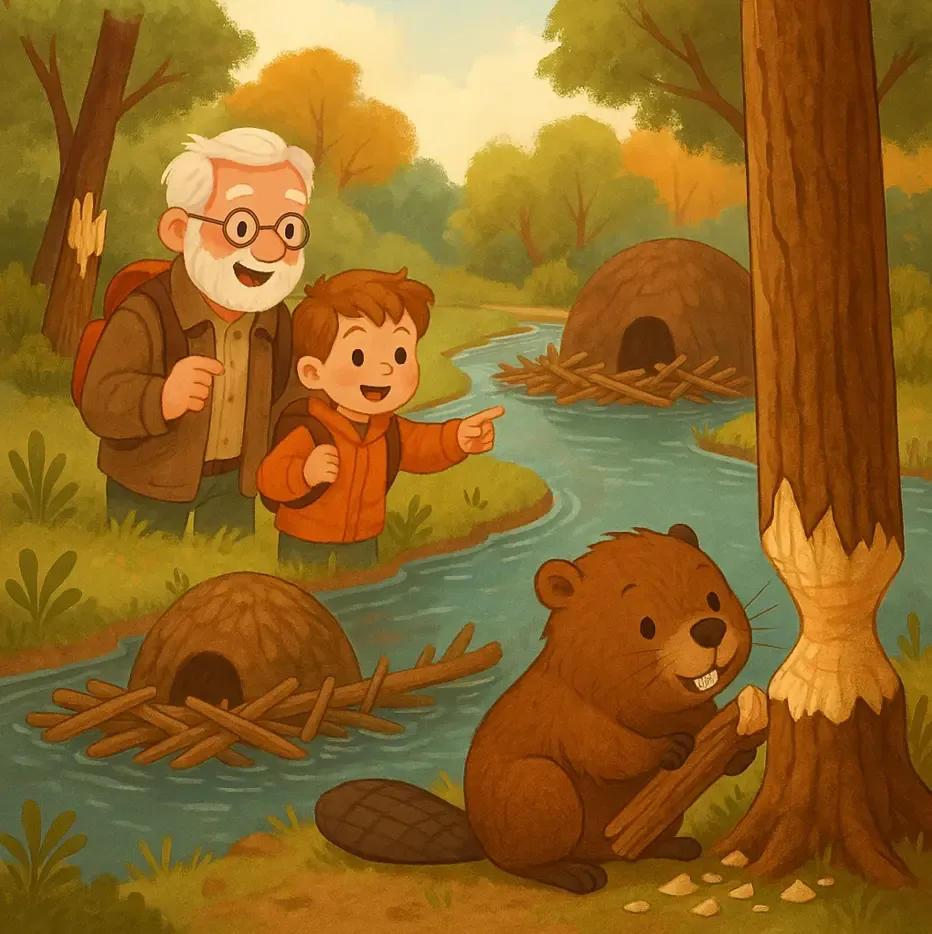
Far back in the woods, where a small river flowed, lived a very busy beaver. One day, Leo and his grandpa were hiking when they saw something amazing! A tall tree near the river had been chewed almost all the way through, and the water in the river looked a little deeper and wider than usual.


"Wow, look at that!" Leo exclaimed. "What happened here?"


Grandpa smiled. "That's the work of a beaver, Leo. In nature, when an animal does something (that's the cause), it creates a change (that's the effect). If we watch closely, we can see some very clear observable patterns."

They looked around the riverbank.


  • Observable Pattern 1: Many trees along the river had been chewed by strong teeth, and some had fallen down.
    • Cause: The beaver needs wood to build its home and to block the river.
    • Effect: The beaver chews down trees.
    •  
  • Observable Pattern 2: Sticks, mud, and small logs were piled up across the river, slowing down the water.
    • Cause: The beaver needs a still, deep pond to protect its home from predators and to store food underwater.
    • Effect: The beaver builds a dam to make the river wider and deeper.
    •  
  • Observable Pattern 3: A sturdy, dome-shaped house made of sticks and mud sat in the middle of the new, wider pond.
    • Cause: The beaver needs a safe place to live, raise its babies, and store food away from danger.
    • Effect: The beaver builds a lodge in the pond.
    •  

Leo couldn't believe it! The beaver wasn't just chewing trees for fun. Its strong instincts (the causes) made it do all this amazing building (the effects), creating a whole new environment! He saw clearly how one busy animal could cause so many big, observable changes.


Comprehension quiz (8 questions)

1. What do stars look like in the night sky?

Big, round moons
Tiny, sparkling lights
Bright, warm suns
Dark clouds

2. When can we usually see the stars?

In the morning
During the day
On a clear night
When it is raining

3. Why can't we see stars during the day?

They go away.
The moon hides them.
The sun is too bright.
They are too small.

4. What are stars actually made of?

Little diamonds
Cold ice
Hot gas
Tiny rocks

5. What happens to the stars during the day?

They hide.
They go to sleep.
They are hidden by sun's light.
They move very fast.

6. How is seeing stars at night a "predictable pattern"?

It happens only sometimes.
It is a surprise.
We know it will happen every clear night.
It changes often.

7. What is the main idea of this passage?

How the sun sets.
What stars are and when we see them.
Why the moon changes shape.
Where birds sleep.

8. If you are in a very dark place far from city lights, what might you see more of?

Bright sun
Many stars
Daytime clouds
Only moon
Who it's for

Perfect for the way you teach

Teachers
  • Build comprehension skills
  • Auto-graded quiz
  • Differentiated reading
Parents
  • Read together at home
  • Improve fluency
  • Quiet reading time
Homeschoolers
  • Reading curriculum support
  • Independent practice
  • Track Lexile growth
Topics

Reviews & Ratings

No reviews yet. Be the first to share your experience!

More reading you might love

11 more
Passage
The Tiny Seed - reading educational content
Grades 1–3

The Tiny Seed

science · 2-LS2-1

$1.50
Passage
Where Does My Food Come From? - reading educational content
Grades 1–3

Where Does My Food Come From?

science · 2-LS2-1

$1.50
Passage
Meadow Ecosystem - reading educational content
Grades 1–3

Meadow Ecosystem

life science · 2-LS2-1

$1.50
Passage
What do Tadpoles Eat? - reading educational content
Grades 1–3

What do Tadpoles Eat?

life science · 2-LS2-1

$1.50
Passage
What do Plants Need to Thrive? - reading educational content
Grades 1–3

What do Plants Need to Thrive?

life science · 2-LS2-1

$1.50
Passage
The Bean Plant - reading educational content
Grades 1–3

The Bean Plant

science · 2-LS2-1

$1.50
Passage
Robin's Nest - reading educational content
Grades 1–3

Robin's Nest

science · 2-LS2-1

$1.50
Passage
Butterfly Food - reading educational content
Grades 1–3

Butterfly Food

science · 2-LS2-1

$1.50
Passage
The Amazing Axolotl - reading educational content
Grades 1–3

The Amazing Axolotl

life science · 2-LS2-1

$1.50
Passage
Seed Germination Experiment - reading educational content
Grades 1–3

Seed Germination Experiment

life science · 2-LS2-1

$1.50
Passage
Squirrel Nuts - reading educational content
Grades 1–3

Squirrel Nuts

science · 2-LS2-1

$1.50
Copyright © 2026 Workybooks. Made with ♥ in California.