What do Plants Need to Thrive? — Reading Comprehension
Rate this
Premium Resource
Present
Present in classroom. No work saved
Assign
Classroom with student accounts, Track progress
Quick Play
No student accounts, assign with a link
Grades
1
2
3
Standards
2-LS2-1
PRINT+DIGITAL RESOURCE
This learning resource is available in interactive and printable formats. The interactive worksheet can be played online and assigned to students. The Printable PDF version can be downloaded and printed for completion by hand.
This science passage, 'Growing Green!', is designed for second-grade students and aligns with the NGSS standard 2-LS2-1. It introduces the concept of planning and conducting a simple investigation to determine if plants need sunlight and water to grow. The passage uses an engaging story about Lily and her class to illustrate the scientific process, including the importance of controlling variables. It supports reading comprehension by providing clear, accessible language and encourages critical thinking about cause and effect relationships in science. Students will learn about the fundamental requirements for plant growth, fostering an understanding of life science concepts and scientific inquiry skills at an elementary level.
CONTENT PREVIEW
Expand content preview
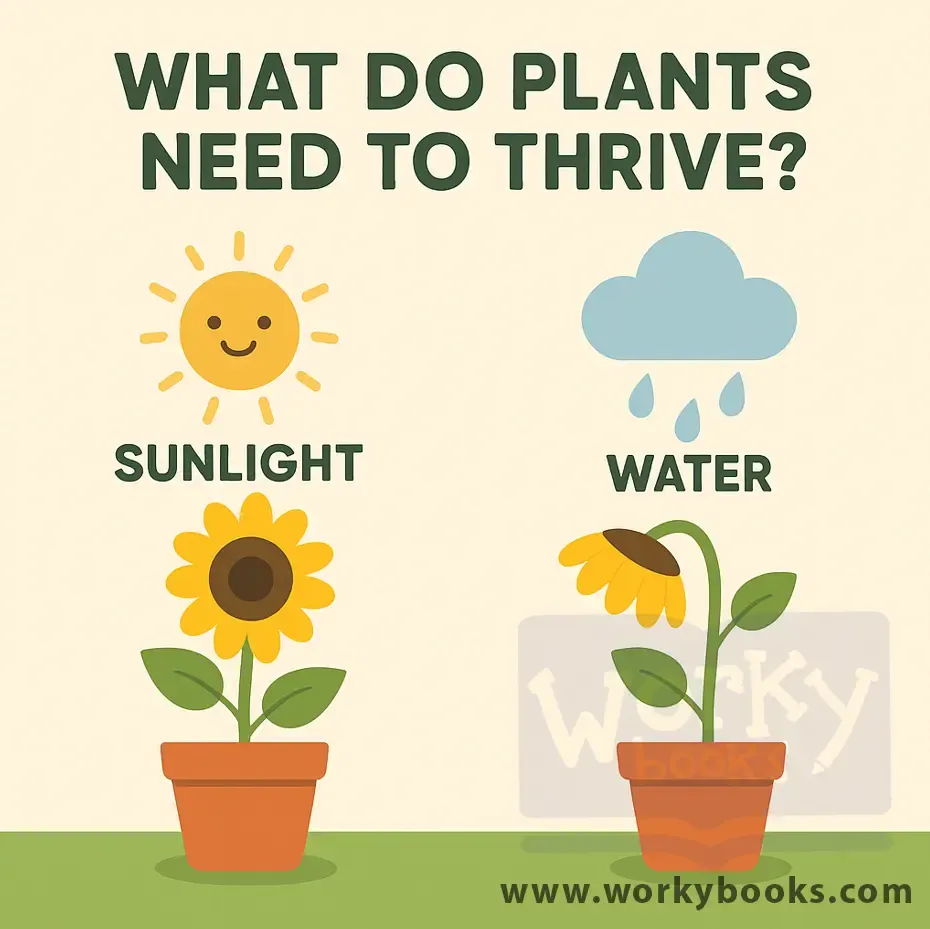
Lily loved her little sunflower plant. It sat on her windowsill, reaching for the sun, and she remembered to give it a little water every morning. One day, her teacher, Ms. Anya, asked the class a question: "What do plants need to grow big and strong?"
"Sunlight!" shouted one student. "Water!" called out another.
Ms. Anya smiled. "You're both right! But how can we prove it? How can we be sure that plants really need both sunlight and water?"
Lily thought for a moment. "We could do an experiment!" she said.
Ms. Anya clapped her hands. "Excellent idea, Lily! Let's plan one together. We want to find out if plants need sunlight to grow, and if they need water to grow. To do this, we need to be careful. When we test something, we only change one thing at a time. That way, we know exactly what made the difference."
So, they decided to get three small bean plants, all about the same size.
Plant A would get sunlight and water. This plant would be their "control" – what usually happens.
Plant B would get water, but no sunlight. They would put it in a dark cupboard.
Plant C would get sunlight, but no water.
"Every day," Ms. Anya explained, "we will look at each plant very carefully. We'll draw pictures of them and write down what we see. Are they getting taller? Are their leaves green? What happens to the plant that doesn't get sunlight? What happens to the plant that doesn't get water?"
Lily was so excited! She knew that by carefully watching and recording, they would discover the amazing truth about what plants need to thrive.
What type of plant did Lily have on her windowsill?
Bean plantSunflower plantRose plantTomato plant
What did Ms. Anya ask the class about plants?
Where they come fromHow tall they growWhat they need to growWhat color they are
How many bean plants did they use for the experiment?
OneTwoThreeFour
What did Plant A get in the experiment?
Only sunlightNo waterSunlight and waterNo sunlight
Why did they only change one thing at a time in the experiment?
To save timeTo know what workedTo make it harderTo use less water
What is the main idea of this passage?
How to water plantsThe importance of sunflowersPlanning a plant experimentAnya's class
If you wanted to test if plants need soil to grow, what would you do?
Give a plant no water. Put a plant in sand instead of soil.Give a plant extra sunlight.Put a plant in a dark room.
Which plant was the "control" in the experiment?
Plant APlant BPlant CPlant B and C
Perfect For:
👩🏫 Teachers
• Reading comprehension practice
• Auto-graded assessments
• Literacy skill development
👨👩👧👦 Parents
• Reading practice at home
• Comprehension improvement
• Educational reading time
🏠 Homeschoolers
• Reading curriculum support
• Independent reading practice
• Progress monitoring
Reading Features:
📖
Reading Passage
Engaging fiction or nonfiction text
❓
Comprehension Quiz
Auto-graded questions
📊
Instant Feedback
Immediate results and scoring
📄
Printable Version
Download for offline reading
🔊
Read Aloud
Voice-over with word highlighting
Reviews & Ratings
No reviews yet. Be the first to share your experience!
Related Content
The Tiny Seed
This reading passage, 'The Sun, the Rain, and the Tiny Seed', is designed to illustrate the core concepts of NGSS LS2.A:...
2-LS2-1
Where Does My Food Come From?
This reading passage, 'Where Does My Food Come From?', aligns with NGSS LS2.A: Interdependent Relationships in Ecosystem...
2-LS2-1
Meadow Ecosystem
This reading passage, 'Life in the Meadow', is designed for elementary students to understand NGSS LS2.A: Interdependent...
2-LS2-1
What do Tadpoles Eat?
This reading passage, 'The Pond's Busy Life', vividly describes a pond ecosystem to illustrate NGSS LS2.A: Interdependen...
2-LS2-1
The Bean Plant
This reading passage, 'The Mystery of the Green Bean Plant', is designed for second-grade students to understand cause a...
2-LS2-1
Robin's Nest
This NGSS passage, 'The Mystery of the Chirping Robin', is designed for second-grade students to explore cause and effec...
2-LS2-1
Butterfly Food
This science passage, 'The Butterfly's Busy Day', is crafted for second-grade students to understand cause and effect re...
2-LS2-1
The Amazing Axolotl
This science reading passage, titled "The Amazing Axolotl," introduces young learners to one of Earth's most fascinating...
2-LS2-1
The Beaver Creek
This science reading passage, 'The Beaver's Big Build', explores cause and effect relationships in animal behavior for s...
2-LS2-1
Seed Germination Experiment
This reading passage, 'The Sleepy Seed's Big Surprise', targets second-grade students and reinforces NGSS 2-LS2-1 by foc...
2-LS2-1
Squirrel Nuts
This science passage, 'Why Did the Squirrel Bury the Nut?', introduces second-grade students to cause and effect relatio...