This reading passage explores the fascinating interactions between Homo sapiens and Neanderthals in ancient Europe, focusing on archaeological discoveries, cultural exchanges, and the lasting impact of their encounters. Students will analyze evidence, compare cultures, and understand cause-and-effect relationships in early human history. The passage aligns with CA HSS 6.1 and CCSS.ELA-LITERACY.RI.6.3 standards, providing rigorous content alongside multiple-choice questions, explanatory writing prompts, graphic organizers, and a timeline. Spanish translations are included for accessibility, and students have the option to listen to the passage. Key vocabulary is highlighted and defined in the glossary to support academic language development. This resource is ideal for building critical historical thinking skills and understanding the importance of ancient human migrations and interactions in shaping the world today.
Written by Workybooks TeamPublished by Workybooks
Preview
Sample passage and quiz content
CONTENT PREVIEW
Expand content preview
"Neanderthals-gb338100f2 1280" by athree23 / Wikimedia Commons
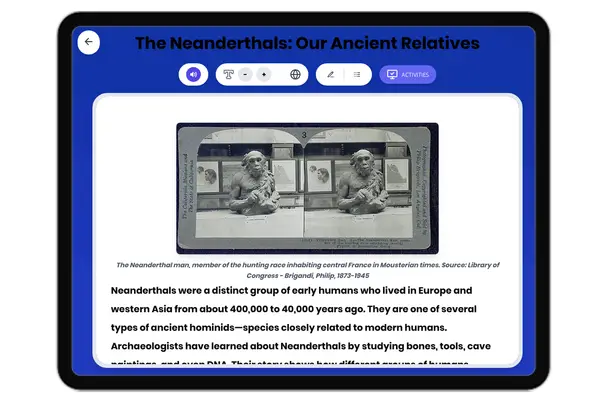
Homo sapiens and Neanderthals are two distinct human species that coexisted in parts of Europe and western Asia more than 40,000 years ago. Archaeologists have uncovered important evidence showing that these two groups interacted, sometimes peacefully and sometimes in competition. These encounters shaped the development of modern humans and left lasting marks on our history and even our DNA.
The earliest known meeting between Homo sapiens and Neanderthals took place in Europe, where Neanderthals had lived for hundreds of thousands of years. Fossil discoveries in places like the El Sidrón cave in Spain and the Vindija cave in Croatia reveal that both groups shared similar environments. Archaeologists found artifacts such as stone tools and ornaments, indicating that both species had advanced skills. In some sites, layers of tools show Neanderthals and Homo sapiens living in the same region within a few thousand years of each other. Some genetic evidence even suggests they exchanged ideas and technologies, and that interbreeding occurred. Today, scientists estimate that about 1-2% of the DNA in many non-African people comes from Neanderthals.
Despite similarities, there were important differences in daily life and culture. Neanderthals were skilled hunters who adapted to cold Ice Age conditions. Their strong bodies helped them survive harsh climates. Homo sapiens, meanwhile, showed greater innovation in tools, art, and social organization. For example, in the French cave of Châtelperron, archaeologists discovered decorated bone tools and pierced animal teeth, showing symbolic thinking. Some researchers believe contact with Homo sapiens may have influenced Neanderthal culture, as new styles of tools and ornaments appeared after the two groups met. However, the nature of these exchanges is still debated among experts.
Over time, Homo sapiens became more widespread, while Neanderthal populations declined. By about 40,000 years ago, Neanderthals had disappeared from most regions. The reasons for their extinction are complex. It may have involved climate changes, competition for resources, diseases, or being outnumbered by Homo sapiens. What is clear is that the meeting of these two species changed human history forever. Modern humans inherited both physical traits and knowledge from Neanderthals, showing how ancient connections continue to shape us today.
The story of Homo sapiens and Neanderthals connects to broader themes of migration, adaptation, and cultural exchange in world history. By studying their encounters, historians and scientists learn how humans have always adapted, learned, and changed through contact with others.
Interesting Fact: The oldest known cave paintings in Europe, found in Spain, may have been created by Neanderthals, not Homo sapiens!
Where did Neanderthals mainly live?
Europe and western AsiaAfrica and South AmericaAustralia and North AmericaAntarctica and India
What artifact was found in Châtelperron?
Decorated bone toolsMetal swordsClay potsBronze statues
How much Neanderthal DNA do many non-Africans have?
1-2%10-15%20-25%None
What helped Homo sapiens outlast Neanderthals?
Innovation and social structureStronger bodiesColder climateBetter eyesight
Why did Neanderthals disappear?
Complex reasons like climate, diseasesMeteor impact onlyLack of food onlyNever disappeared
How did Neanderthals adapt to their environment?
Skilled hunting and strong bodiesLarge citiesFarmingSailing
Neanderthals influenced modern human DNA.
TrueFalse
What does the word 'artifact' mean?
An object made by humansA kind of animalA type of caveA natural rock
Who it's for
Perfect for the way you teach
Teachers
Build comprehension skills
Auto-graded quiz
Differentiated reading
Parents
Read together at home
Improve fluency
Quiet reading time
Homeschoolers
Reading curriculum support
Independent practice
Track Lexile growth
Topics
Homo sapiensNeanderthalsearly humansancient historyhuman evolutionmigrationarchaeologyinteraction
Reviews & Ratings
No reviews yet. Be the first to share your experience!
More reading you might love
18 more
First Humans
This engaging history reading passage explores the evolution of early humans, tracing the journey from the earliest homi...
CA HSS 6.1RH.6-8.1RH.6-8.2W.6.2
Who Were the Neanderthals
This engaging history reading passage explores the fascinating world of the Neanderthals, our ancient relatives who live...
CA HSS 6.1TEKS 6.2RI.6.1RI.6.4
The Birth of Human Thinkin
This engaging reading passage explores the Cognitive Revolution, a major turning point in human history that occurred ar...
CA HSS 6.1CCSS.RI.6.1CCSS.RI.6.2CCSS.RI.6.4
Did Early Humans Cause Extinctions
This passage explores how Paleolithic people, or early humans, shaped their environment through the use of fire, hunting...
CA HSS 6.1CCSS RH.6-8.2CCSS RI.6.4
Paleolithic Cultures Worldwide
This passage explores Paleolithic cultures around the world, focusing on the regional differences in tools, food, clothi...
CA HSS 6.1CCSS RH.6-8.1CCSS RH.6-8.2CCSS RH.6-8.4
Paleolithic Shelters
Explore how early humans in the Paleolithic Era built shelters such as caves and huts to survive harsh climates. This pa...
CA HSS 6.1CCSS.RI.6.3CCSS.RI.7.1CCSS.RI.8.2
How Early Humans Survived Climate
This passage explores how Paleolithic people adapted to a variety of landscapes, including coastal regions, mountains, p...
CA HSS 6.1CCSS RH.6-8.1CCSS RH.6-8.2CCSS RH.6-8.4
Life in the Neolithic Age
This engaging passage explores what life was like during a typical day in the Neolithic Age, a pivotal era in ancient hi...
CA HSS 6.1CCSS RH.6-8.2CCSS RH.6-8.4
How Artifacts Are Restored
This engaging passage explores how scientists, especially archaeologists and conservators, protect and restore artifacts...
CA HSS 6.1RI.6.1RH.6-8.2
What Was the Neolithic Revolution
This comprehensive history reading passage explores the Neolithic Revolution, focusing on how early humans transitioned ...
CA HSS 6.1CCSS RH.6-8.2CCSS RH.6-8.4CCSS RH.6-8.7
Early Humans Reach Australia
This reading passage explores the journey of early humans who reached Australia by crossing the ocean over 60,000 years ...
CA HSS 6.1CCSS RH.6-8.1CCSS RH.6-8.4CCSS RH.6-8.7
First Americans
This comprehensive history reading passage explores how the first humans migrated to the Americas over 12,000 years ago,...
CA HSS 6.1CCSS RH.6-8.1CCSS RH.6-8.2CCSS RH.6-8.4
Paleolithic Clothing
This passage explores the fascinating world of Paleolithic clothing, focusing on how early humans used animal skins and ...
CA HSS 6.1CCSS.ELA-LITERACY.RH.6-8.1CCSS.ELA-LITERACY.RH.6-8.4
Rise of Early Civilizations
This reading passage explores the critical transformation from early human hunter-gatherer societies to the development ...
CA HSS 6.1CCSS.RI.6.1CCSS.RI.6.3CCSS.RI.6.4
Climate and Archaeology
This detailed history passage explores the impact of climate change on ancient archaeological sites around the world. St...
CA HSS 6.16.2RH.6-8.1RH.6-8.2
Climate and Early Civilizations
This passage explores how climate influenced the development, location, and success of ancient human settlements. Studen...
CA HSS 6.1CCSS.ELA-LITERACY.RI.6.1CCSS.ELA-LITERACY.RI.6.2CCSS.ELA-LITERACY.W.6.2
Herodotus
This engaging history reading passage introduces students to Herodotus, known as the 'Father of History,' and his major ...
CA HSS 6.4CCSS.RI.6.3CCSS.RI.6.4
Stone Tool Archaeology
This engaging passage explores the significance of ancient stone tools and their role in understanding early human histo...