This engaging reading passage explores the Cognitive Revolution, a major turning point in human history that occurred around 70,000 years ago. Students will learn how early Homo sapiens developed advanced symbolic language, complex tools, and new forms of social organization, setting the stage for modern civilization. The passage is aligned with CA HSS 6.1 and CCSS RI.6-8 standards and provides multiple examples from archaeological and primary sources. It is accompanied by a glossary, multiple-choice quiz, writing activity, graphic organizers, a timeline, and both English and Spanish versions. Students can listen to the read-aloud audio and access a Spanish translation to support diverse learners. This resource is ideal for building reading comprehension, critical analysis, and content knowledge in ancient history.
Written by Workybooks TeamPublished by Workybooks
Preview
Sample passage and quiz content

CONTENT PREVIEW
Expand content preview
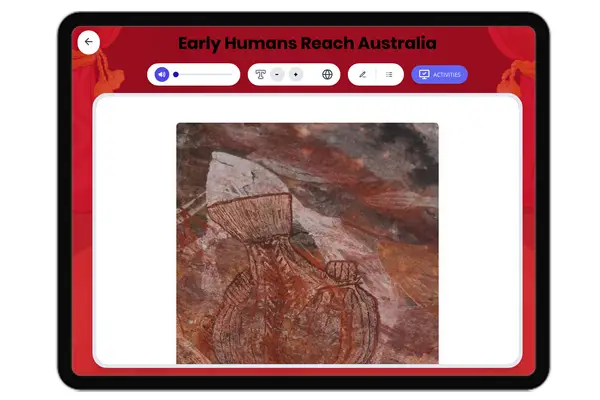
"Claimed Oldest Known Drawing by Human Hands Discovered in South African Cave" by Henshilwood, C.S. et al. / Wikimedia Commons
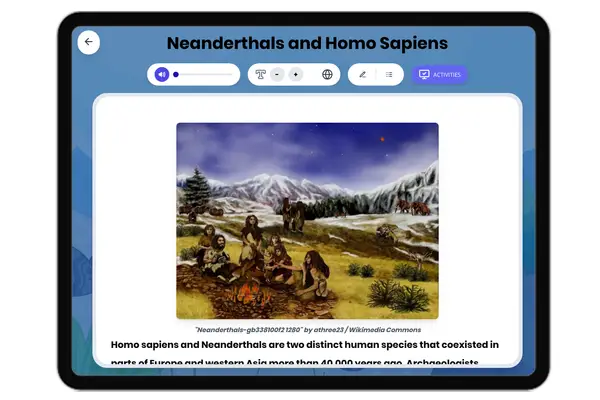
The Cognitive Revolution refers to a period about 70,000 years ago when Homo sapiens began to think, communicate, and create in new, more advanced ways. Archaeological discoveries, such as engraved ochre from Blombos Cave in South Africa and ancient tools from Eastern Africa, provide evidence that early humans started to use symbolic language and make complex art. Scientists believe this revolution helped Homo sapiens survive and spread across the globe, while other human species, like Neanderthals, eventually disappeared.
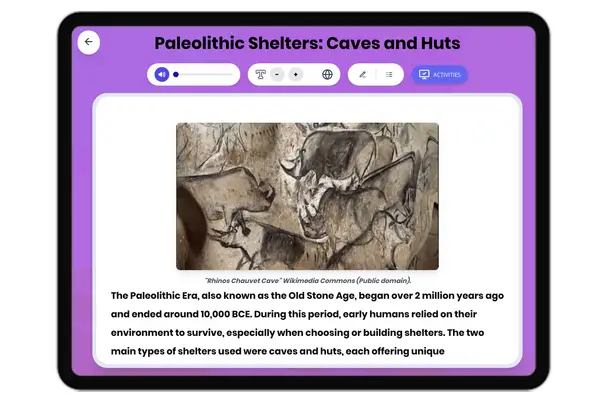
One key feature of the Cognitive Revolution was the development of abstract thinking. Early humans began to imagine things that did not exist, such as spirits, myths, or strategies for hunting. For example, cave paintings in Lascaux, France, created about 17,000 years ago, show animals and human figures that may have had spiritual or social meanings. The ability to share ideas through symbolic communication allowed groups to pass knowledge and traditions from one generation to the next.
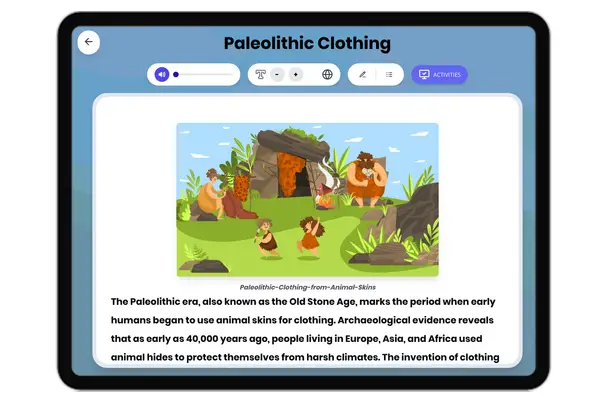
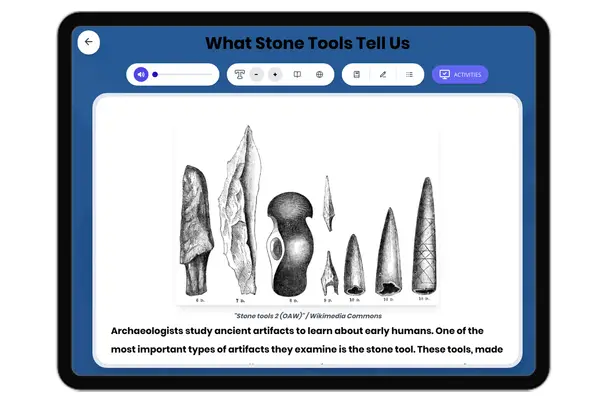
Another important change was the improvement of toolmaking and technology. Before the Cognitive Revolution, tools were simple and mostly made from stone. Afterward, Homo sapiens began making tools with bone, antler, and even creating needles for sewing clothes. Archaeologists have found blades, fishhooks, and ornaments at sites like Dolní Věstonice in the Czech Republic, dating back nearly 30,000 years. These advances show that early humans were learning to adapt to different environments, from icy tundras to hot savannas.
The Cognitive Revolution also changed social organization. Early humans formed larger and more complex social groups. With improved cooperation, they could hunt big animals, defend against predators, and share resources. Social hierarchies and roles developed, allowing some individuals to become leaders or specialists, such as skilled toolmakers or storytellers. This organization supported survival and led to the development of diverse cultures.
In conclusion, the Cognitive Revolution marked a turning point in human history, enabling Homo sapiens to develop advanced language, technology, and social structures. These changes helped our species outcompete other hominids and spread across continents. This period connects to broader themes in history, such as adaptation, innovation, and the evolution of societies.
Interesting Fact: Archaeologists believe that the first jewelry, made from shells and animal teeth, was created during the Cognitive Revolution as a form of symbolic self-expression.
When did the Cognitive Revolution begin?
About 70,000 years agoAbout 10,000 years agoAbout 100,000 years agoAbout 2,000 years ago
Where was engraved ochre found?
Blombos Cave, South AfricaLascaux, FranceDolní VěstoniceEastern Asia
What did Homo sapiens use for new tools?
Bone and antlerIron and steelClay and glassPlastic
Why was symbolic language important?
It helped share knowledgeIt built housesIt tamed animalsIt grew crops
How did cooperation help early humans?
Hunt big animals togetherInvent the wheelWrite booksControl fire
What did cave paintings show?
Animals and human figuresOnly plantsMaps of citiesMachines
The Cognitive Revolution led to new technology.
TrueFalse
What does 'hierarchies' mean?
Levels of power in societyMaking fireHunting animalsDrawing pictures