Newton's Cradle
Interactive passage with audio narration, comprehension questions, and printable PDF.
By completing this purchase you agree to our Terms of Use and Privacy Policy. Your subscription renews automatically until you cancel. You can cancel anytime from your account settings. All sales are final and non-refundable. Digital content is available for download in your account immediately upon purchase.
What's included
Newton's Cradle preview and details
About this printable Newton's Cradle science reading passage, NGSS-aligned (Grades 3-6)
Sample passage and quiz from Newton's Cradle
Reading passage and comprehension quiz preview
Newton's Cradle
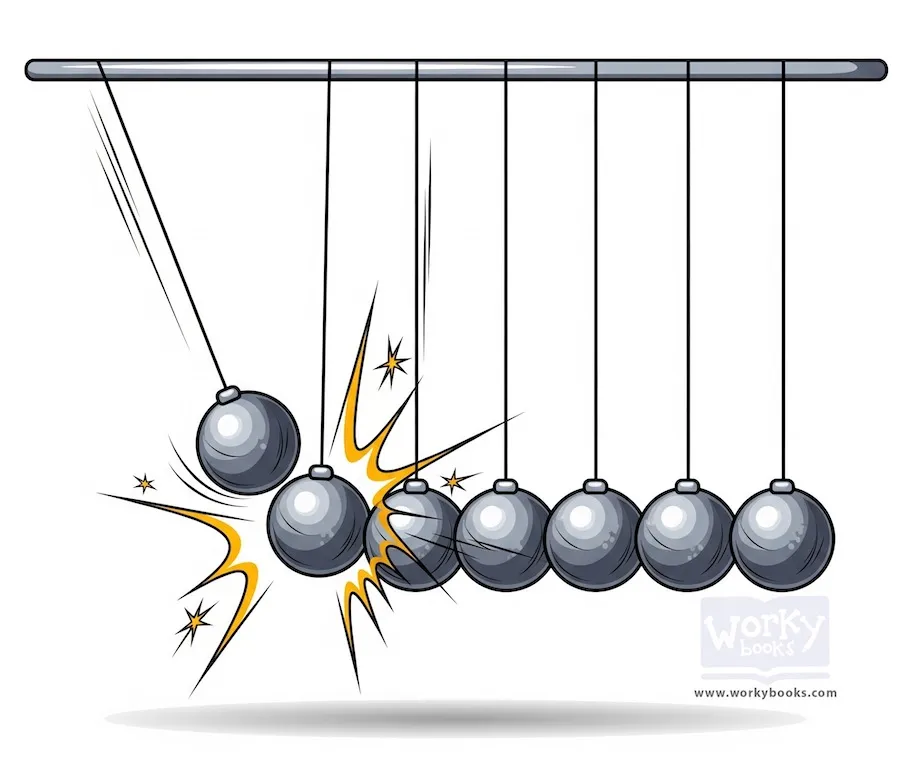
Newton's Cradle is a famous science toy that shows how energy and motion can move from one object to another. It has a row of metal balls hanging in a line, each touching the next. When you pull back one ball and let it go, you start a chain reaction!
The first ball you pull back has potential energy. This means energy is stored and ready to move. When you let the ball go, it swings down and gains speed. Now, it has kinetic energy, which is energy of motion.
When the first ball hits the row of still balls, a collision happens. But something amazing occurs—the balls in the middle barely move! Instead, the energy and momentum (how much motion something has, found by multiplying its mass and speed) pass through them very quickly, like a secret message. The ball on the opposite end swings out with almost the same speed as the first ball!
This is because energy and momentum must be conserved, or kept. They can't disappear, so they travel through the line of balls. If you pull back two balls, two balls swing out on the other end. If you pull back three, three swing out. The middle balls just pass the energy along, almost like playing telephone with energy.
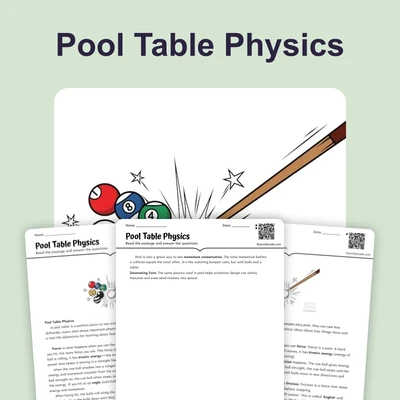
Newton's Cradle helps us see how energy transfers during collisions. We see this in real life, too. When pool balls hit each other, or when cars crash, energy moves from one object to another. Even on the playground, when you bump into a friend on a swing, you are transferring energy!
You can make a simple Newton's Cradle at home using marbles or coins lined up in a row. Try it out and see how energy travels!
Interesting Fact: Some Newton's Cradles can swing for several minutes before stopping, showing how energy moves back and forth until it is used up by friction.
Comprehension quiz (8 questions)
1. What does Newton's Cradle show?
2. What is potential energy?
3. What happens when two balls are released?
4. Why do the middle balls barely move?
5. What real-life example uses energy transfer?
6. What must be conserved in Newton's Cradle?
7. Newton's Cradle is a science toy.
8. What is a collision?
Perfect for the way you teach
- Build comprehension skills
- Auto-graded quiz
- Differentiated reading
- Read together at home
- Improve fluency
- Quiet reading time
- Reading curriculum support
- Independent practice
- Track Lexile growth