What Is Gravitational Energy? — Reading Comprehension
Rate this|
2
Present
Present in classroom. No work saved
Assign
Classroom with student accounts, Track progress
Quick Play
No student accounts, assign with a link
Grades
5
6
7
8
Standards
MS-PS3-4
4-PS3-3
4-PS3-2
PRINT+DIGITAL RESOURCE
This learning resource is available in interactive and printable formats. The interactive worksheet can be played online and assigned to students. The Printable PDF version can be downloaded and printed for completion by hand.
This engaging science passage for middle school students explores the concept of gravitational energy, a form of potential energy described in NGSS standard MS-PS3-4. The text explains how gravitational energy is stored based on an object’s height and mass, and how it converts into kinetic energy as the object falls. Real-world examples like waterfalls, swinging on a swing, and standing on a diving board help students connect theory with practice. The passage supports reading comprehension, introduces key science vocabulary, and includes 8 multiple-choice questions that cover factual recall, application, and main idea. This resource is ideal for science teachers seeking standards-aligned content to reinforce energy concepts in a classroom or remote learning environment. It's also perfect for students preparing for assessments or practicing informational text analysis in line with Common Core and NGSS literacy in science goals.
CONTENT PREVIEW
Expand content preview
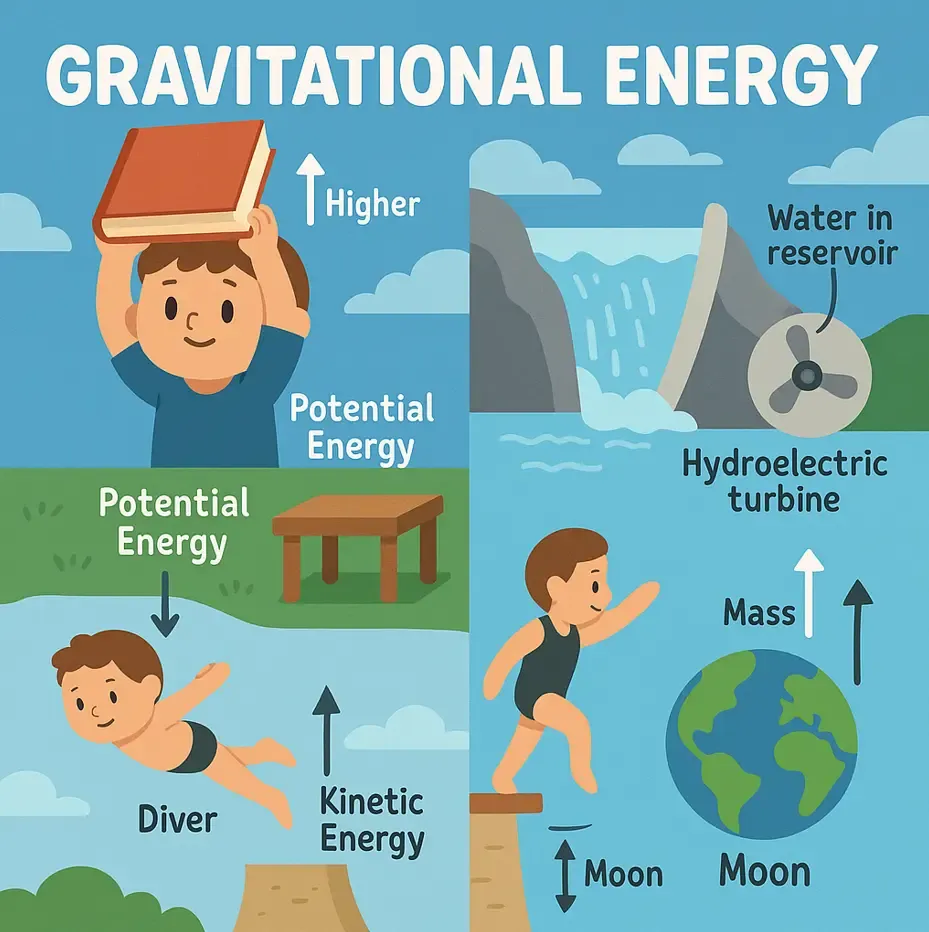
Gravitational energy is a type of potential energy. It is the energy stored in an object because of its position above the ground. The higher an object is, the more gravitational energy it has. This is because gravity is always pulling things down toward Earth.
For example, when you hold a book above your head, it has more gravitational energy than when it’s on a table. If you drop it, the energy changes from potential to kinetic energy as it falls. The heavier the object and the higher it's lifted, the more gravitational energy it stores.
Gravitational energy is all around us. Water in a mountain reservoir has gravitational energy. When released, the water flows downhill, turning turbines to produce electricity. This is how many hydroelectric dams work—they turn gravitational energy into electrical energy.
Even sports use gravitational energy. Think of a diver standing on a high platform. The diver has stored energy because of height. As the diver jumps, that energy becomes motion.
Gravitational energy depends on mass, height, and gravity. On the Moon, where gravity is weaker, the same object would have less gravitational energy than on Earth.
Understanding gravitational energy helps engineers design roller coasters, elevators, and even rescue equipment. It's a powerful force that plays a major role in our everyday lives.
Fun Fact: Did you know that astronauts bounce higher on the Moon because the Moon’s gravity is only one-sixth as strong as Earth’s? That also means objects have much less gravitational energy up there!
What type of energy is gravitational energy?
Kinetic energyThermal energyPotential energyChemical energy
What causes gravitational energy?
FrictionElectricityHeight and gravitySound
Which situation has the most gravitational energy?
A ball on the floorA book lying on a deskA rock on a hilltopA paperclip on a chair
What happens when an object falls from a height?
Gravitational energy disappearsGravitational energy turns into kinetic energyGravity stops workingThe object floats
How do hydroelectric dams use gravitational energy?
They burn it for fuelThey store it as soundThey turn falling water into electricityThey freeze the water
What does gravitational energy depend on?
Color, weight, and shapeGravity, mass, and heightTemperature, speed, and timePressure, size, and age
What is an example of gravitational energy in sports?
A soccer player dribblingA runner tying their shoesA diver jumping from a platformA swimmer floating in a pool
Why do objects have less gravitational energy on the Moon?
The Moon has more airThe Moon spins fasterThe Moon has weaker gravityThe Moon has no weather
Perfect For:
👩🏫 Teachers
• Reading comprehension practice
• Auto-graded assessments
• Literacy skill development
👨👩👧👦 Parents
• Reading practice at home
• Comprehension improvement
• Educational reading time
🏠 Homeschoolers
• Reading curriculum support
• Independent reading practice
• Progress monitoring
Reading Features:
📖
Reading Passage
Engaging fiction or nonfiction text
❓
Comprehension Quiz
Auto-graded questions
📊
Instant Feedback
Immediate results and scoring
📄
Printable Version
Download for offline reading
🔊
Read Aloud
Voice-over with word highlighting
Reviews & Ratings
No reviews yet. Be the first to share your experience!
Related Content
Energy Sources—Recall Relevant Information
4-PS3-2W.4.8PS3.A
Exploring Energy—Gathering Relevant Information
4-PS3-2W.4.8PS3.A
Types of Energy
4-PS3-2W.4.8PS3.A
What Is an Endothermic Reaction?
This engaging science passage introduces middle school readers to the concept of endothermic reactions, aligned with NGS...
MS-PS3-44-PS3-34-PS3-2
What Is an Exothermic Reaction?
This science passage introduces students to the idea of exothermic reactions—chemical changes that release heat or light...
MS-PS3-44-PS3-34-PS3-2
Is Freezing Endothermic or Exothermic?
This clear and accessible passage helps students understand why freezing is an exothermic process, even though frozen ob...
MS-PS3-44-PS3-34-PS3-2
What Is Thermal Contraction?
This middle school science passage introduces the concept of thermal contraction, aligned with NGSS standard MS-PS1-4. I...
MS-PS3-44-PS3-34-PS3-2
What Is Kinetic Energy?
This NGSS-aligned reading passage introduces 6th–8th grade students to the concept of kinetic energy—energy that an obje...
MS-PS3-44-PS3-34-PS3-2
Understanding Mechanical Energy
This science passage is crafted for 6th–8th grade students and focuses on mechanical energy—specifically the combination...
MS-PS3-44-PS3-34-PS3-2
Chemical Energy
This informational science passage on chemical energy is designed for middle school students and aligns with the NGSS st...
MS-PS3-44-PS3-34-PS3-2
Sublimation: The Solid-to-Gas Magic
This engaging NGSS-aligned reading passage explores the science of sublimation, a unique phase change where a solid turn...
MS-PS3-44-PS3-34-PS3-2
Scientific Theories
This reading passage for grades 6-8 introduces students to the concept of scientific theories, emphasizing that these ar...
MS-PS1-1MS-PS1-4MS-PS3-4SCIENCE AND ENGINEERING PRACTICES
Heat and Temperature
This comprehensive passage for grades 6-8 explores the important differences between heat and temperature, emphasizing t...
MS-PS3-3MS-PS3-4
Heat and Changes of State
This grade 6-8 science passage explores the relationship between heat and changes of state, aligning with NGSS standard ...
MS-PS3-4
Specific Heat
This comprehensive middle school science passage explores the concept of specific heat, the amount of energy required to...
MS-PS3-4
Thermal Energy
This comprehensive passage explores the concept of thermal energy, aligning with NGSS standards MS-PS3-3 and MS-PS3-4. S...
MS-PS3-3MS-PS3-4
Renewable vs. Nonrenewable Energy
This engaging passage, aligned with NGSS standards MS-PS3-4, MS-ESS3-3, and MS-ESS3-4, helps middle school students diff...
MS-PS3-4MS-ESS3-3MS-ESS3-4
Fossil Fuels: Coal
This middle school science reading passage explores the science behind coal, a major fossil fuel. Students will learn ho...
MS-PS3-4MS-ESS3-3MS-ESS3-4
Solar Energy
This engaging passage for grades 6-8 explores the science of solar energy, focusing on how sunlight is converted into el...