This learning resource is available in interactive and printable formats. The interactive worksheet can be played online and assigned to students. The Printable PDF version can be downloaded and printed for completion by hand.
The Roller Coaster Physics reading passage is a fascinating resource for fourth-grade students, designed to explain the key scientific principles behind a thrilling roller coaster ride. Aligned with the Next Generation Science Standards (NGSS) Disciplinary Core Concept PS3.B: Conservation of Energy and Energy Transfer, the passage uses the relatable example of a roller coaster to illustrate how potential energy is converted into kinetic energy. It explains how a car gains potential energy as it is pulled up a hill and then converts that stored energy into motion as it races down. The text also touches on how some energy is lost to sound and heat, which is why the first hill must be the tallest. The included assessment, with multiple-choice questions at three different Depth of Knowledge (DOK) levels, ensures that students not only recall key terms but also apply their understanding to new scenarios.
CONTENT PREVIEW
Expand content preview
Roller Coaster Physics
Roller coasters are thrilling examples of science at work. When you ride a roller coaster, you are experiencing the exciting journey of energy transformation. This means energy changes from one form to another—from potential energy to kinetic energy and back again.
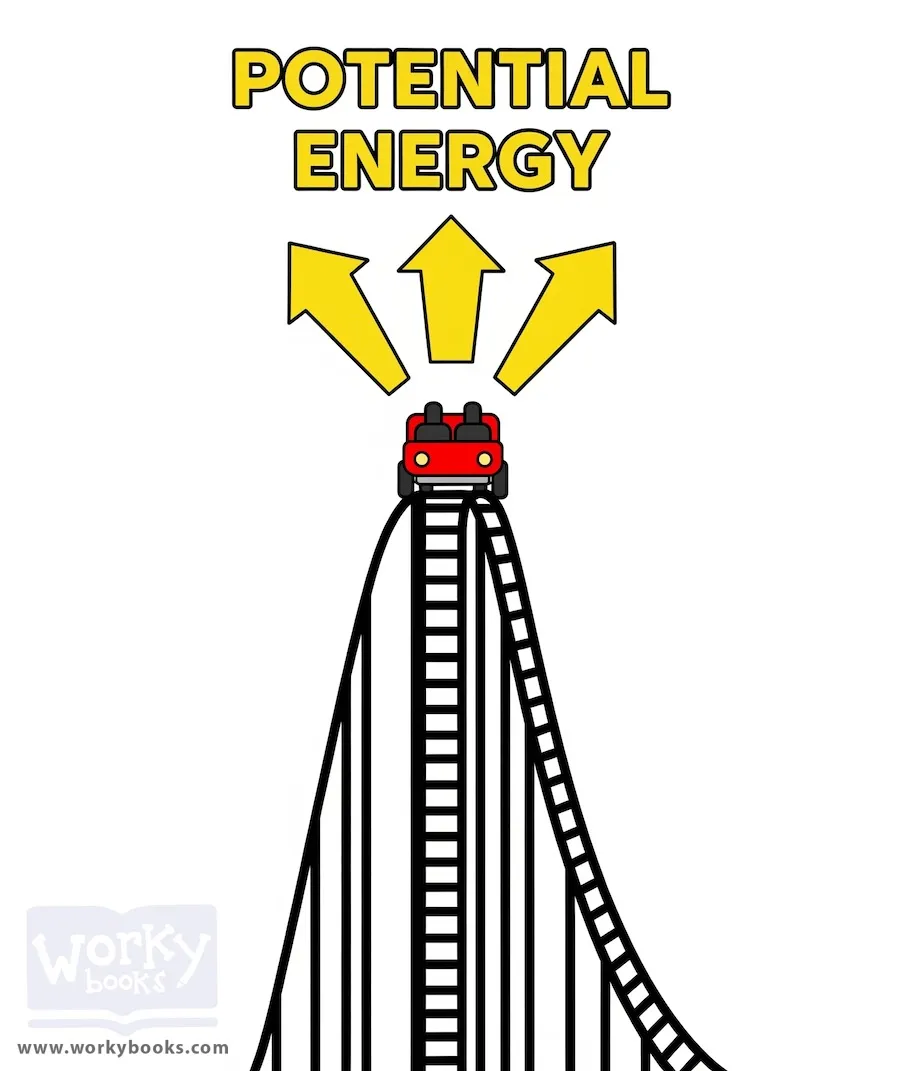
The ride begins when a chain lift or motor pulls the cars up the first big hill. The higher you go, the more potential energy the cars gain. Potential energy is stored energy, like money saved in a piggy bank. At the very top, the cars have the most potential energy and are ready to spend it all!
As the cars race down the hill, the stored energy changes into kinetic energy, which is the energy of motion. The cars move fastest at the bottom of the first hill because all that stored energy has become motion. When the cars go up the next hill, some kinetic energy turns back into potential energy, so the cars slow down.
This back-and-forth exchange of energy continues as the coaster goes over hills and through twists. The first hill is always the tallest. That’s because the chain lift only gives energy at the start. The rest of the ride relies on gravity and momentum to keep going, but some energy is lost to friction between the wheels and track, and to the air. That’s why each hill after the first is a little smaller!
Other forces help make the ride exciting. Gravity pulls the cars down. Inertia keeps the cars moving, and centripetal force keeps riders safely in loops and turns. When you feel heavy at the bottom of a hill or light at the top, you are feeling G-forces.
Engineers plan every part of a roller coaster, calculating how much energy is needed for every twist and turn. Safety bars and careful design protect riders throughout the ride.
A roller coaster is like a giant energy piggy bank—you fill it up on the first hill and spend it bit by bit on each exciting drop!
Interesting Fact: The world’s fastest roller coaster can go over 149 miles per hour—almost as fast as a race car!
What gives cars potential energy?
Chain lift or motorFrictionLoopsAir
What is kinetic energy?
Stored energySlowing forceMoving energySafety bar
Why are hills smaller after the first?
Less energy from frictionEngineers want it shortCars are lighterGravity is stronger
What force keeps you in loops?
FrictionCentripetal forceMomentumPotential energy
What happens at the top of the first hill?
Maximum potential energyMaximum kinetic energyNo gravityNo energy
Why do you feel heavier at the bottom?
Friction increasesG-forces changeSlower speedLess energy
A roller coaster gets energy from the chain lift only at the start. True or false?
TrueFalse
Which word means 'stored energy'?
Kinetic energyPotential energyFrictionCentripetal force
Perfect For:
👩🏫 Teachers
• Reading comprehension practice
• Auto-graded assessments
• Literacy skill development
👨👩👧👦 Parents
• Reading practice at home
• Comprehension improvement
• Educational reading time
🏠 Homeschoolers
• Reading curriculum support
• Independent reading practice
• Progress monitoring
Reading Features:
📖
Reading Passage
Engaging fiction or nonfiction text
❓
Comprehension Quiz
Auto-graded questions
📊
Instant Feedback
Immediate results and scoring
📄
Printable Version
Download for offline reading
🔊
Read Aloud
Voice-over with word highlighting
Reviews & Ratings
No reviews yet. Be the first to share your experience!
Related Content
How Speed Affects Energy
This Grade 4 physical science reading passage introduces students to the relationship between speed and kinetic energy, ...
NGSS 4-PS3-2
Science Vocabulary
This worksheet on domain-specific words will help students learn some science vocabulary. Students will be asked to matc...
L.3.6L.3.4.A
What Is Potential Energy
This 250-word reading passage introduces fourth-grade students to the fundamental concept of potential energy aligned wi...
NGSS 4-PS3-1
What Is Energy
This engaging 250-word reading passage introduces fourth-grade students to the fundamental concept of energy as outlined...
NGSS 4-PS3-1
Work and Energy
This science reading passage for grades 6-8 introduces students to the concepts of work and energy, aligned with NGSS st...
MS-PS3-1
Simple Machines Science Report
This science writing task requires students to clearly explain how three simple machines work using precise domain-speci...
W.5.4
Motion Energy
This NGSS-aligned science passage for 4th graders focuses on the disciplinary core concept of Motion Energy (PS1.A). It'...
Energy Transformation
This middle school science passage aligned to NGSS standard MS-PS3-5 explains the concept of energy transformation—the p...
MS-PS3-5
Thermal Energy
This comprehensive passage explores the concept of thermal energy, aligning with NGSS standards MS-PS3-3 and MS-PS3-4. S...
MS-PS3-3MS-PS3-4
Beach Day Science
This passage addresses NGSS K-PS3-1 by comparing temperature differences in materials exposed to sunlight versus shade. ...
K-PS3-1RL.1.1
Sound Energy
This engaging science passage, titled "What is Sound Energy?", is designed for 4th-grade students and aligns with the NG...
What Happens When Cars Collide
This 250-word reading passage introduces fourth-grade students to the concept of energy transfer and transformation duri...
NGSS 4-PS3-3
Pool Table Physics
The Pool Table Physics reading passage is a highly engaging educational resource designed for fourth-grade science stude...
Energy Transformations
This engaging middle school science passage explores the concept of energy transformations, aligning with NGSS standards...
MS-PS3-1MS-PS3-2MS-PS3-5
What Are Physical Changes?
This engaging Grade 4-5 science passage introduces students to the concept of physical changes in matter, aligning with ...
Energy Transfer
This NGSS-aligned science passage introduces middle school students to the concept of energy transfer, aligned to standa...
MS-PS3-5
The Future of Energy
This engaging science passage for grades 6-8, aligned with NGSS standards MS-PS3-4, MS-ESS3-3, and MS-ESS3-4, introduces...
MS-PS3-4MS-ESS3-3MS-ESS3-4
Mechanical Energy
This comprehensive passage introduces middle school students to the concept of mechanical energy, defined as the sum of ...
MS-PS3-1MS-PS3-2
How Does a Slingshot Work
This 250-word reading passage introduces fourth-grade students to the concept of energy transformation using a slingshot...
NGSS 4-PS3-1
Forms of Energy
Energy Is Everywhere is an engaging science reading passage aligned with NGSS standard 4-PS3-1, designed for Grade 4-5 s...