This learning resource is available in interactive and printable formats. The interactive worksheet can be played online and assigned to students. The Printable PDF version can be downloaded and printed for completion by hand.
This NGSS-aligned science passage for 4th graders focuses on the disciplinary core concept of Motion Energy (PS1.A). It's designed to build reading comprehension skills while explaining fundamental scientific principles in an accessible way. The passage defines motion energy and explores how mass and speed affect its quantity. Students will learn about the transfer of energy through real-world examples, and the accompanying multiple-choice questions align with Webb's Depth of Knowledge levels to assess recall, inference, and application. This resource is perfect for teaching fundamental physics concepts at the elementary level, making science engaging and understandable for young learners. This educational tool effectively links science content with reading comprehension, providing a comprehensive learning experience aligned with national educational standards. It's a great way to introduce elementary students to the physics of force and motion.
CONTENT PREVIEW
Expand content preview
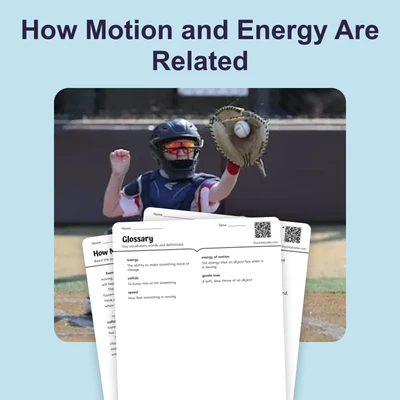
What Is Motion Energy? Motion energy, also called kinetic energy, is the energy that all moving things have. If something is moving, it has motion energy. When something stops, its motion energy becomes zero.
How Do Weight and Speed Affect Motion Energy? The amount of motion energy depends on two things: how heavy the object is (its mass) and how fast it is moving (its speed). The faster something goes, the more motion energy it has. If you double the speed, the motion energy actually becomes four times bigger! Heavier things also have more motion energy at the same speed. For example, a truck driving at the same speed as a bicycle has much more motion energy because it is much heavier.
Everyday Examples of Motion Energy Motion energy is everywhere. When you roll a ball slowly, it has a little motion energy. If you roll it fast, it has a lot more. When you walk, you have motion energy, but you have even more when you run. Moving air, called wind, has motion energy too. Wind turbines use the motion energy of the air to make electricity. Flowing water in rivers also carries motion energy.
Energy Transfer and Collisions When two moving objects hit each other, they can transfer motion energy. This is called a collision. For example, when a bowling ball hits the pins, it transfers motion energy to the pins and knocks them over. When a baseball bat hits a baseball, energy moves from the bat to the ball.
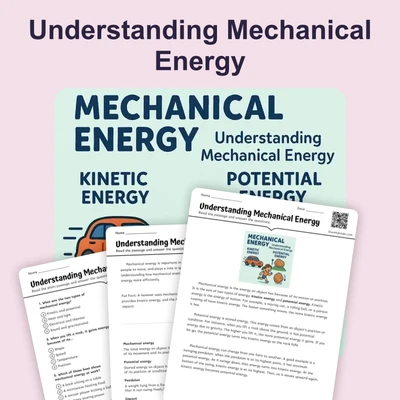
Kinetic and Potential Energy On a playground swing, when you are at the highest point, you have mostly potential energy. As you swing down, that energy turns into motion energy. At the bottom, you have the most motion energy. The swing keeps changing energy back and forth!
Why Motion Energy Matters for Safety Understanding motion energy helps us stay safe. Fast, heavy cars have a lot of motion energy, which is why we wear seatbelts and helmets. They help protect us by absorbing some of that energy if we stop suddenly.
Interesting Fact: Motion energy is like a moving savings account—the faster and heavier something is, the more energy it carries with it!
What is another name for motion energy?
Kinetic energyPotential energyWind energyThermal energy
What happens to motion energy when something stops?
It becomes zeroIt doublesIt increasesIt becomes wind
What has more motion energy at the same speed?
A heavy truckA bicycleA featherA leaf
Why do we wear helmets and seatbelts?
To protect from motion energyTo go fasterTo carry more massTo make cars lighter
What happens in a collision?
Motion energy is transferredObjects disappearNothing changesObjects slow down
What is true about speed and motion energy?
Faster objects have more energySpeed doesn't matterSlower is more energySpeed equals mass
Stopped objects have motion energy. True or false?
TrueFalse
What does 'mass' mean?
How heavy something isHow fast it movesHow much energy it hasHow big it looks
Perfect For:
👩🏫 Teachers
• Reading comprehension practice
• Auto-graded assessments
• Literacy skill development
👨👩👧👦 Parents
• Reading practice at home
• Comprehension improvement
• Educational reading time
🏠 Homeschoolers
• Reading curriculum support
• Independent reading practice
• Progress monitoring
Reading Features:
📖
Reading Passage
Engaging fiction or nonfiction text
❓
Comprehension Quiz
Auto-graded questions
📊
Instant Feedback
Immediate results and scoring
📄
Printable Version
Download for offline reading
🔊
Read Aloud
Voice-over with word highlighting
Reviews & Ratings
No reviews yet. Be the first to share your experience!
Related Content
How Speed Affects Energy
This Grade 4 physical science reading passage introduces students to the relationship between speed and kinetic energy, ...
NGSS 4-PS3-2
Science Vocabulary
This worksheet on domain-specific words will help students learn some science vocabulary. Students will be asked to matc...
L.3.6L.3.4.A
What Is Potential Energy
This 250-word reading passage introduces fourth-grade students to the fundamental concept of potential energy aligned wi...
NGSS 4-PS3-1
What Is Energy
This engaging 250-word reading passage introduces fourth-grade students to the fundamental concept of energy as outlined...
NGSS 4-PS3-1
Simple Machines Science Report
This science writing task requires students to clearly explain how three simple machines work using precise domain-speci...
W.5.4
Work and Energy
This science reading passage for grades 6-8 introduces students to the concepts of work and energy, aligned with NGSS st...
MS-PS3-1
Energy Transformation
This middle school science passage aligned to NGSS standard MS-PS3-5 explains the concept of energy transformation—the p...
MS-PS3-5
Thermal Energy
This comprehensive passage explores the concept of thermal energy, aligning with NGSS standards MS-PS3-3 and MS-PS3-4. S...
MS-PS3-3MS-PS3-4
How Circuits Convert Energy
This 250-word reading passage introduces Grade 4 students to the concept of energy conversion in electric circuits, alig...
NGSS 4-PS3-2
Beach Day Science
This passage addresses NGSS K-PS3-1 by comparing temperature differences in materials exposed to sunlight versus shade. ...
K-PS3-1RL.1.1
Sound Energy
This engaging science passage, titled "What is Sound Energy?", is designed for 4th-grade students and aligns with the NG...
What Happens When Cars Collide
This 250-word reading passage introduces fourth-grade students to the concept of energy transfer and transformation duri...
NGSS 4-PS3-3
Pool Table Physics
The Pool Table Physics reading passage is a highly engaging educational resource designed for fourth-grade science stude...
Energy Transformations
This engaging middle school science passage explores the concept of energy transformations, aligning with NGSS standards...
MS-PS3-1MS-PS3-2MS-PS3-5
Energy Transfer
This NGSS-aligned science passage introduces middle school students to the concept of energy transfer, aligned to standa...
MS-PS3-5
What Are Physical Changes?
This engaging Grade 4-5 science passage introduces students to the concept of physical changes in matter, aligning with ...
The Future of Energy
This engaging science passage for grades 6-8, aligned with NGSS standards MS-PS3-4, MS-ESS3-3, and MS-ESS3-4, introduces...
MS-PS3-4MS-ESS3-3MS-ESS3-4
Mechanical Energy
This comprehensive passage introduces middle school students to the concept of mechanical energy, defined as the sum of ...
MS-PS3-1MS-PS3-2
How Does a Slingshot Work
This 250-word reading passage introduces fourth-grade students to the concept of energy transformation using a slingshot...