This learning resource is available in interactive and printable formats. The interactive worksheet can be played online and assigned to students. The Printable PDF version can be downloaded and printed for completion by hand.
The Pool Table Physics reading passage is a highly engaging educational resource designed for fourth-grade science students. It aligns with the Next Generation Science Standards (NGSS) Disciplinary Core Concept PS3.B: Conservation of Energy and Energy Transfer. The passage uses the familiar example of a game of pool to illustrate complex scientific principles. Students will learn about how a player's arm transfers kinetic energy to a cue stick, which then transfers it to a cue ball, and finally to the other balls on the table. The text also explains how some of this energy is converted into sound and heat, which is why the balls eventually stop moving. The assessment, with multiple-choice questions at DOK Levels 1, 2, and 3, helps teachers evaluate students' comprehension and application of the concepts. This material is an excellent tool for hands-on and conceptual learning.
CONTENT PREVIEW
Expand content preview
Pool Table Physics
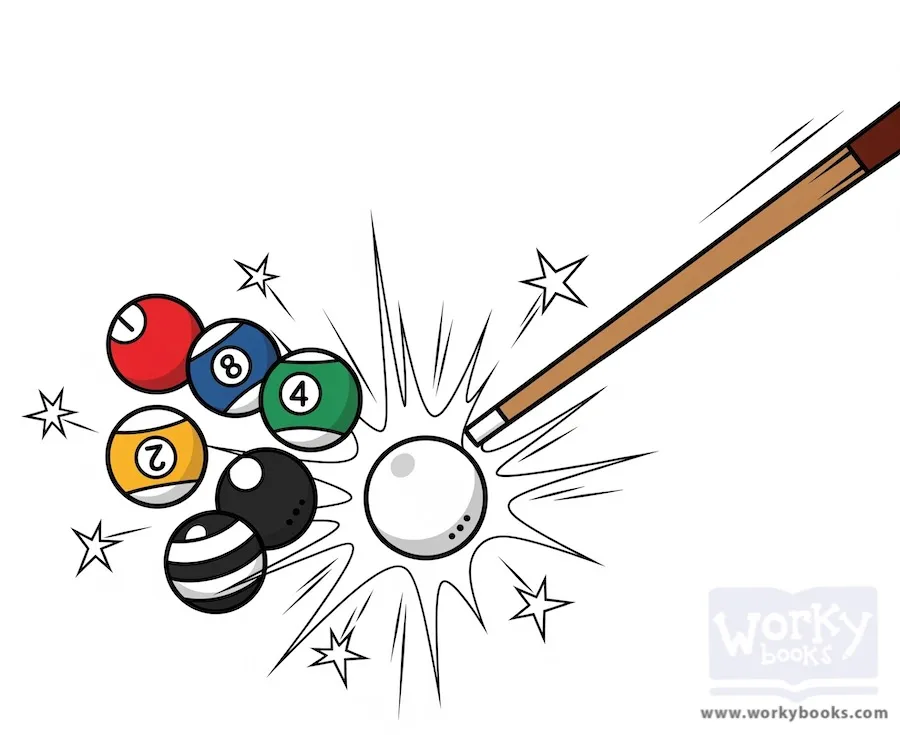
A pool table is a perfect place to see science in action. When someone plays pool (billiards), every shot shows important physics ideas. Pool is more than just a game—it’s a real-life laboratory for learning about how things move and interact!
Force is what happens when you use the cue stick to push the cue ball. The harder you hit, the more force you use. This force makes the cue ball start moving. Once the cue ball is rolling, it has kinetic energy—the energy of motion—and momentum, which is the power that keeps it moving in a straight line.
When the cue ball crashes into a target ball, a collision happens. In this collision, energy and momentum transfer from the cue ball to the target ball. If you hit the target ball straight on, the cue ball often stops, and the target ball speeds away, taking most of the energy. If you hit at an angle, both balls move off in different directions, sharing the energy and momentum.
After being hit, the balls roll along the green felt. The felt creates friction, a force that slowly slows the balls down until they stop. Pool tables are softer than wood floors, so balls roll farther before friction stops them.
Pool players can make advanced shots by hitting the cue ball off-center. This gives the ball spin, called ‘English’. Spin changes the direction the cue ball goes after hitting another ball, making the game more challenging. In bank shots, balls bounce off the cushions just like light reflects off a mirror. The angle the ball hits the cushion is the same as the angle it bounces away—this is called reflection!
Pool is also a great way to see momentum conservation. The total momentum before a collision equals the total after. It’s like watching bumper cars, but with balls and a table!
Interesting Fact: The same physics used in pool helps scientists design car safety features and even send rockets into space!
What does the cue stick do?
Pushes the cue ballStops the ballsMakes frictionChanges table color
What is kinetic energy?
Energy of movingEnergy of stoppingEnergy from lightEnergy of sound
What slows the balls down?
FrictionAnglesMomentumReflection
What happens in a collision?
Balls transfer energyBalls become lighterBalls change colorBalls disappear
If cue ball is hit at an angle, what happens?
Both balls move awayBalls stop instantlyBalls bounce highBalls stick together
How does 'English' affect a shot?
Changes directionMakes ball heavierRemoves frictionTurns cue ball red
A pool table has no friction. True or false?
TrueFalse
What is 'momentum'?
Power to keep movingType of cushionColor of the tableKind of shot
Perfect For:
👩🏫 Teachers
• Reading comprehension practice
• Auto-graded assessments
• Literacy skill development
👨👩👧👦 Parents
• Reading practice at home
• Comprehension improvement
• Educational reading time
🏠 Homeschoolers
• Reading curriculum support
• Independent reading practice
• Progress monitoring
Reading Features:
📖
Reading Passage
Engaging fiction or nonfiction text
❓
Comprehension Quiz
Auto-graded questions
📊
Instant Feedback
Immediate results and scoring
📄
Printable Version
Download for offline reading
🔊
Read Aloud
Voice-over with word highlighting
Reviews & Ratings
No reviews yet. Be the first to share your experience!
Related Content
How Speed Affects Energy
This Grade 4 physical science reading passage introduces students to the relationship between speed and kinetic energy, ...
NGSS 4-PS3-2
Science Vocabulary
This worksheet on domain-specific words will help students learn some science vocabulary. Students will be asked to matc...
L.3.6L.3.4.A
What Is Potential Energy
This 250-word reading passage introduces fourth-grade students to the fundamental concept of potential energy aligned wi...
NGSS 4-PS3-1
What Is Energy
This engaging 250-word reading passage introduces fourth-grade students to the fundamental concept of energy as outlined...
NGSS 4-PS3-1
Work and Energy
This science reading passage for grades 6-8 introduces students to the concepts of work and energy, aligned with NGSS st...
MS-PS3-1
Simple Machines Science Report
This science writing task requires students to clearly explain how three simple machines work using precise domain-speci...
W.5.4
Motion Energy
This NGSS-aligned science passage for 4th graders focuses on the disciplinary core concept of Motion Energy (PS1.A). It'...
Energy Transformation
This middle school science passage aligned to NGSS standard MS-PS3-5 explains the concept of energy transformation—the p...
MS-PS3-5
Thermal Energy
This comprehensive passage explores the concept of thermal energy, aligning with NGSS standards MS-PS3-3 and MS-PS3-4. S...
MS-PS3-3MS-PS3-4
Beach Day Science
This passage addresses NGSS K-PS3-1 by comparing temperature differences in materials exposed to sunlight versus shade. ...
K-PS3-1RL.1.1
Sound Energy
This engaging science passage, titled "What is Sound Energy?", is designed for 4th-grade students and aligns with the NG...
What Happens When Cars Collide
This 250-word reading passage introduces fourth-grade students to the concept of energy transfer and transformation duri...
NGSS 4-PS3-3
Energy Transformations
This engaging middle school science passage explores the concept of energy transformations, aligning with NGSS standards...
MS-PS3-1MS-PS3-2MS-PS3-5
What Are Physical Changes?
This engaging Grade 4-5 science passage introduces students to the concept of physical changes in matter, aligning with ...
Energy Transfer
This NGSS-aligned science passage introduces middle school students to the concept of energy transfer, aligned to standa...
MS-PS3-5
The Future of Energy
This engaging science passage for grades 6-8, aligned with NGSS standards MS-PS3-4, MS-ESS3-3, and MS-ESS3-4, introduces...
MS-PS3-4MS-ESS3-3MS-ESS3-4
Mechanical Energy
This comprehensive passage introduces middle school students to the concept of mechanical energy, defined as the sum of ...
MS-PS3-1MS-PS3-2
How Does a Slingshot Work
This 250-word reading passage introduces fourth-grade students to the concept of energy transformation using a slingshot...
NGSS 4-PS3-1
Forms of Energy
Energy Is Everywhere is an engaging science reading passage aligned with NGSS standard 4-PS3-1, designed for Grade 4-5 s...