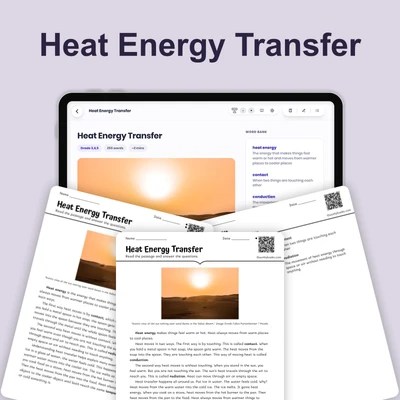
This learning resource is available in interactive and printable formats. The interactive worksheet can be played online and assigned to students. The Printable PDF version can be downloaded and printed for completion by hand.
This 4th-grade science passage explores the concept of heat energy, a key topic in the NGSS standards. Students will learn that heat is a form of energy related to the motion of tiny particles and can be transferred in various ways. The passage provides a simple definition of energy and explains heat transfer through relatable examples, such as rubbing hands together and a spoon in hot chocolate. This resource is designed to improve reading comprehension skills while teaching foundational science concepts. It aligns with the NGSS standard PS3.A, focusing on the definition of energy and its transfer.
CONTENT PREVIEW
Expand content preview
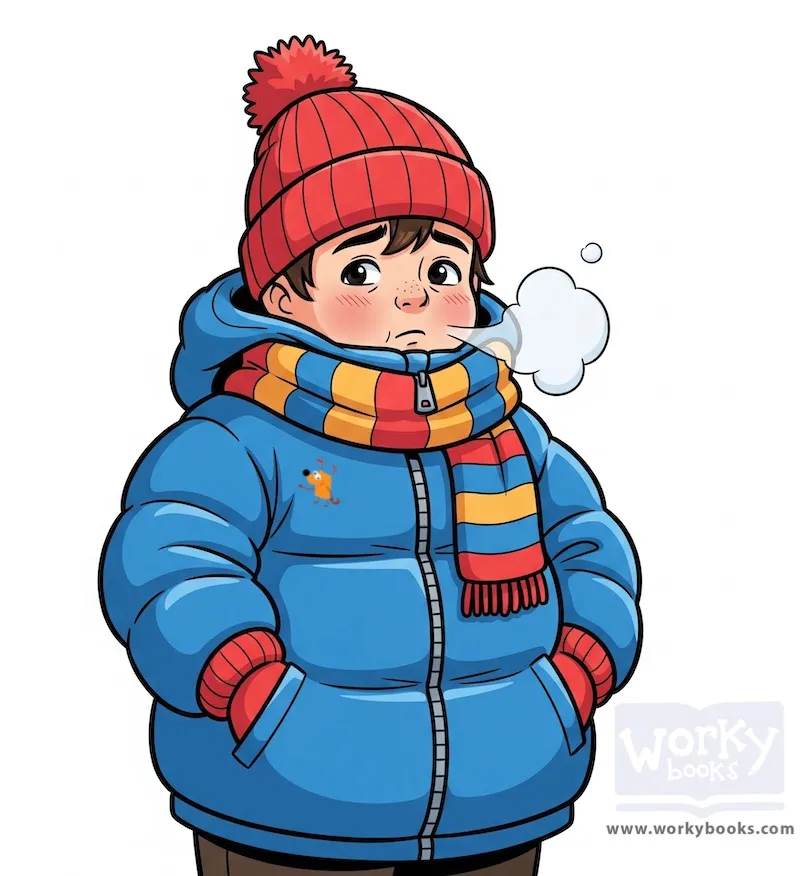
Have you ever rubbed your hands together when you're cold? They get warmer, right? That feeling of warmth is called heat energy. Everything in the world is made of tiny, tiny pieces that are always moving. When those pieces move faster, they create more heat energy, and the object gets warmer. When the pieces slow down, the object gets cooler.
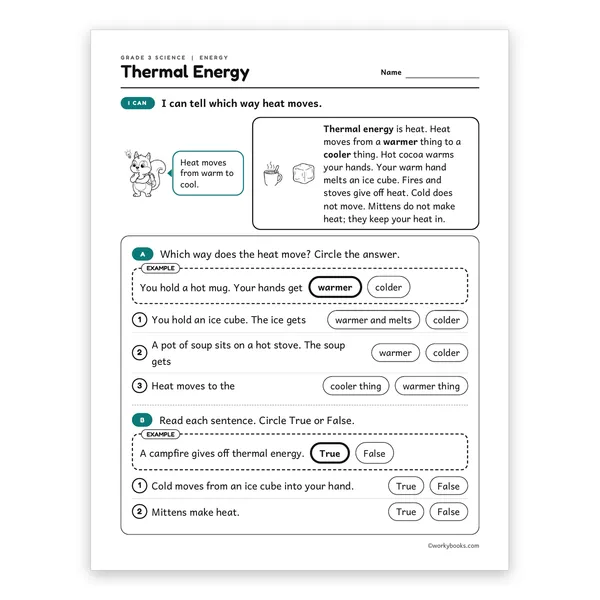
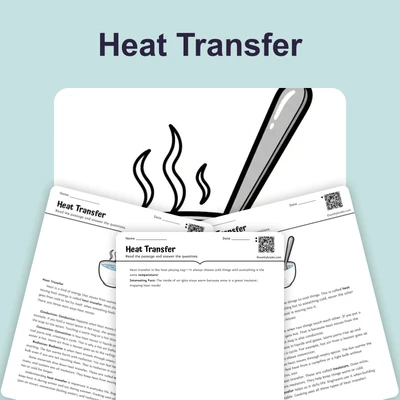
Energy is the ability to do work or cause change. Heat is one kind of energy. Heat energy can move from one place to another. This is called heat transfer. Think about a cup of hot chocolate. The steam rising from the cup is a form of heat transfer. The heat from the hot chocolate moves into the air, making the air around it warmer.
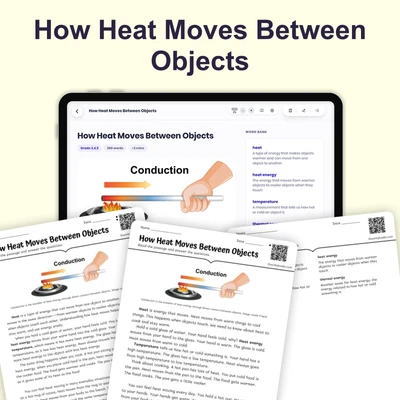
There are three main ways that heat can be transferred. First, there's when things touch. If you put a cold metal spoon into your hot chocolate, the heat from the liquid will move directly into the spoon, making the spoon's handle warm. This is why you shouldn't touch a hot stove!
Second, heat can move through a liquid or gas. When you boil water, the water at the bottom of the pot gets hot first. It rises, and cooler water sinks down to take its place. This creates a circle of moving hot and cool water, transferring heat throughout the pot.
Third, heat can travel through waves, like light. The sun sends heat to the Earth. Even though the sun is millions of miles away, you can feel its warmth on your skin. That's because the sun's energy travels to you in waves. Fire also gives off heat in this way.
So, heat energy is all around us! It makes our food cook, keeps us warm, and even helps power machines. Remember that heat always moves from a warmer object to a colder object, trying to even things out.
Fun Fact: A lightning bolt is hotter than the surface of the sun! That's why it's so dangerous to be near one.
What happens when the tiny pieces inside an object move faster?
What is the main example given in the passage to show how to create heat energy?
Putting a spoon in hot chocolate.Touching a stove.Rubbing your hands together.Standing in the sun.
If you leave a metal spoon in a bowl of hot soup, why does the handle get warm?
The handle is a good insulator.The heat moves through the spoon.The soup is a type of gas.The air around the spoon is hot.
Based on the passage, what can we infer about why we wear thick jackets on a cold day?
The jackets make us move faster.The jackets create heat energy.The jackets trap our body's heat.The jackets cool us down.
If you put a warm rock next to a cold rock, what will happen to the cold rock's temperature?
It will stay the same temperature.It will get colder.It will get warmer.It will melt into a liquid.
You are building a house in a very cold place. Which material would be the best choice for the walls to keep the house warm by slowing down heat transfer?
A thin sheet of metal.A glass window.Thick wood and insulation.A single layer of plastic.
A mom wants to keep a plate of pancakes warm for her child. Which of these methods would work best to keep the pancakes' heat from moving away?
Putting the plate in the refrigerator.Placing the pancakes in a cold garage.Covering the plate with a thick cloth.Blowing on the pancakes with a fan.
You have a cup of hot apple cider and you want to cool it down quickly. Based on the passage, which of these actions would be the most effective?
Putting the cider in a thermos.Placing the cup in a freezer.Covering the cup with a lid.Wrapping the cup in a blanket.
Perfect For:
👩🏫 Teachers
• Reading comprehension practice
• Auto-graded assessments
• Literacy skill development
👨👩👧👦 Parents
• Reading practice at home
• Comprehension improvement
• Educational reading time
🏠 Homeschoolers
• Reading curriculum support
• Independent reading practice
• Progress monitoring
Reading Features:
📖
Reading Passage
Engaging fiction or nonfiction text
❓
Comprehension Quiz
Auto-graded questions
📊
Instant Feedback
Immediate results and scoring
📄
Printable Version
Download for offline reading
🔊
Read Aloud
Voice-over with word highlighting
Reviews & Ratings
No reviews yet. Be the first to share your experience!
Related Content
How Speed Affects Energy
This Grade 4 physical science reading passage introduces students to the relationship between speed and kinetic energy, ...
NGSS 4-PS3-2
Science Vocabulary
This worksheet on domain-specific words will help students learn some science vocabulary. Students will be asked to matc...
L.3.6L.3.4.A
How Electric Current Transfers Energy
This 250-word reading passage introduces fourth-grade students to the concept of energy transfer through electric curren...
NGSS 4-PS3-2
What Is Potential Energy
This 250-word reading passage introduces fourth-grade students to the fundamental concept of potential energy aligned wi...
NGSS 4-PS3-1
Simple Machines Science Report
This science writing task requires students to clearly explain how three simple machines work using precise domain-speci...
W.5.4
What Is Energy
This engaging 250-word reading passage introduces fourth-grade students to the fundamental concept of energy as outlined...
NGSS 4-PS3-1
Work and Energy
This science reading passage for grades 6-8 introduces students to the concepts of work and energy, aligned with NGSS st...
MS-PS3-1
Motion Energy
This NGSS-aligned science passage for 4th graders focuses on the disciplinary core concept of Motion Energy (PS1.A). It'...
Energy Transformation
This middle school science passage aligned to NGSS standard MS-PS3-5 explains the concept of energy transformation—the p...
MS-PS3-5
Heat Energy Transfer
This Grade 4 physical science reading passage explores heat energy transfer aligned to NGSS standard 4-PS3-2 and Discipl...
NGSS 4-PS3-2
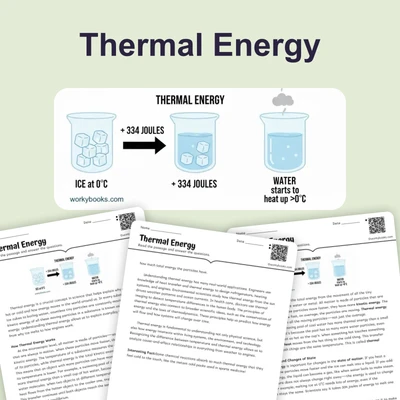
Thermal Energy
This comprehensive passage explores the concept of thermal energy, aligning with NGSS standards MS-PS3-3 and MS-PS3-4. S...
MS-PS3-3MS-PS3-4
Beach Day Science
This passage addresses NGSS K-PS3-1 by comparing temperature differences in materials exposed to sunlight versus shade. ...
K-PS3-1RL.1.1
How Circuits Convert Energy
This 250-word reading passage introduces Grade 4 students to the concept of energy conversion in electric circuits, alig...
NGSS 4-PS3-2
Sound Energy
This engaging science passage, titled "What is Sound Energy?", is designed for 4th-grade students and aligns with the NG...
What Happens When Cars Collide
This 250-word reading passage introduces fourth-grade students to the concept of energy transfer and transformation duri...
NGSS 4-PS3-3
Pool Table Physics
The Pool Table Physics reading passage is a highly engaging educational resource designed for fourth-grade science stude...
Energy Transformations
This engaging middle school science passage explores the concept of energy transformations, aligning with NGSS standards...
MS-PS3-1MS-PS3-2MS-PS3-5
Energy Transfer
This NGSS-aligned science passage introduces middle school students to the concept of energy transfer, aligned to standa...
MS-PS3-5
Where Does Our Energy Come From
This 250-word reading passage aligns with NGSS standard ESS3.A and introduces fourth-grade students to the fundamental c...
NGSS 4-ESS3-1
The Future of Energy
This engaging science passage for grades 6-8, aligned with NGSS standards MS-PS3-4, MS-ESS3-3, and MS-ESS3-4, introduces...