This learning resource is available in interactive and printable formats. The interactive worksheet can be played online and assigned to students. The Printable PDF version can be downloaded and printed for completion by hand.
This comprehensive passage for grades 6-8 explores the respiratory system, examining the pathway of air from the nose and mouth through the lungs, and explaining the detailed process of gas exchange in the alveoli. Students will learn how oxygen is absorbed into the bloodstream and carbon dioxide is removed, the roles of the diaphragm and rib muscles in controlling breathing, and how respiratory rate is regulated. The passage also highlights the connection between the respiratory and circulatory systems and discusses factors that impact respiratory health, such as smoking, air pollution, and asthma. The content is aligned with NGSS standards MS-LS1-3 and MS-LS1-7, and includes audio integration for accessibility. Activities reinforce understanding through quizzes, writing prompts, and graphic organizers, making it ideal for middle school science classrooms.
CONTENT PREVIEW
Expand content preview
Respiratory System
Breathing is a vital process that happens all day and night, allowing the body to take in oxygen and remove carbon dioxide. Every time a person inhales, air travels through a precise pathway before reaching the lungs. The efficiency of this pathway is essential for survival, as oxygen is required for every cell to produce energy. Scientists have studied how this system works by measuring the rate of gas exchange and observing how the body responds to changes in oxygen supply.
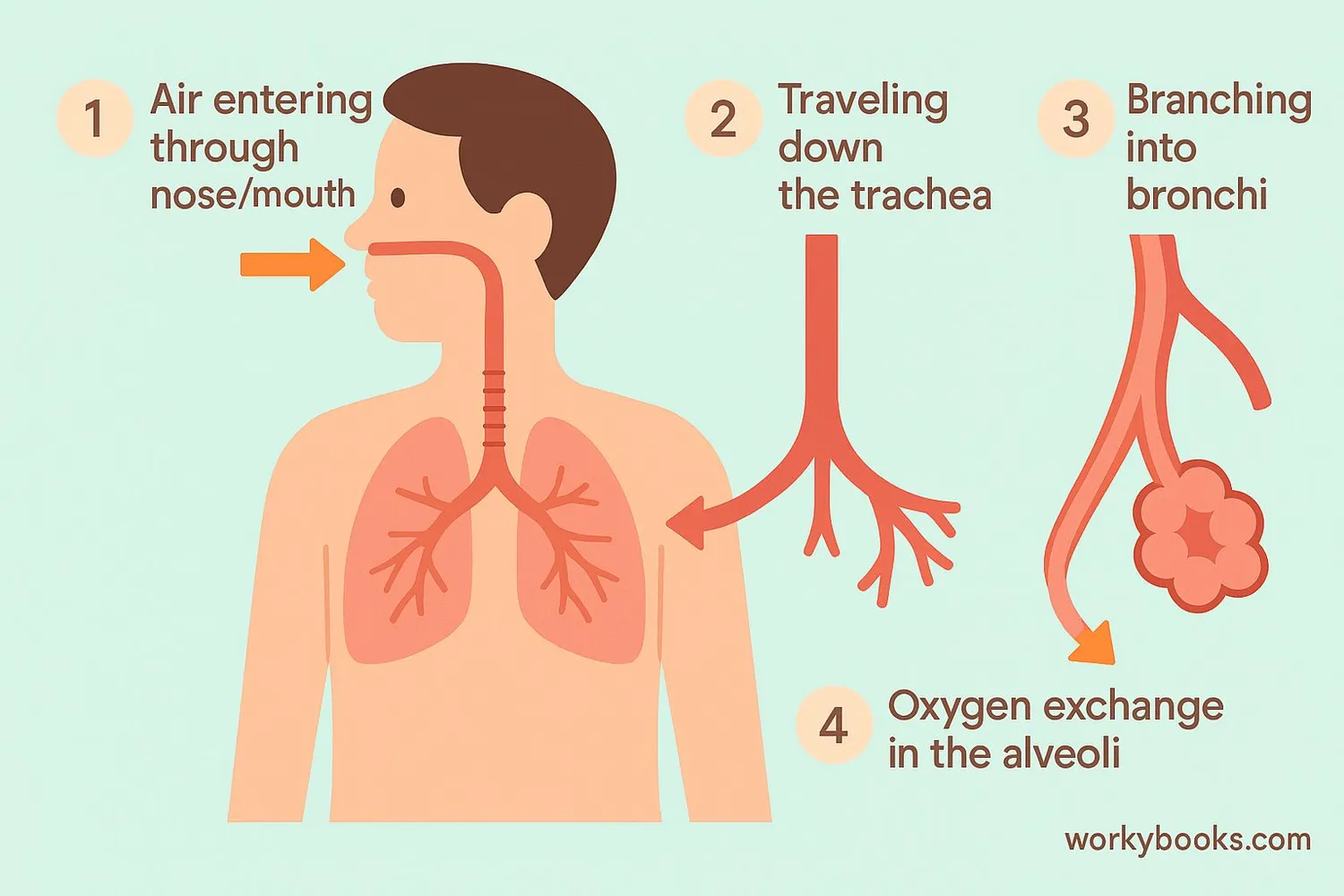
Pathway of Air and Gas Exchange Air enters the body through the nose or mouth, where it is filtered and moistened. Next, it passes through the pharynx, a muscular tube that directs air toward the larynx, or voice box. From there, air moves down the trachea, or windpipe, which divides into two bronchi leading to each lung. Within the lungs, the bronchi branch into smaller bronchioles, finally ending in clusters of tiny air sacs called alveoli. Here, gas exchange takes place. Oxygen from the air diffuses across the thin alveolar walls into the capillaries, while carbon dioxide moves from the blood into the alveoli to be exhaled. This process is highly efficient; in a single breath, millions of alveoli transfer oxygen to the blood, supporting the body's energy needs.
Mechanics of Breathing and Regulation The movement of air in and out of the lungs is controlled by the diaphragm and rib muscles. When the diaphragm contracts and moves downward, the chest cavity expands, causing air to rush in—this is inhalation. When the diaphragm relaxes and moves upward, the chest cavity gets smaller, and air is pushed out—this is exhalation. The respiratory rate, or number of breaths per minute, is regulated by the brain, which monitors levels of carbon dioxide in the blood. On average, a healthy teen breathes 12 to 20 times per minute at rest. The respiratory and circulatory systems work together closely; the blood transports oxygen from the lungs to the rest of the body and carries carbon dioxide back to the lungs for removal.
Respiratory Health and Cellular Respiration Maintaining healthy lungs is crucial for overall well-being. Factors such as smoking, air pollution, and diseases like asthma can damage the respiratory system, making it harder for oxygen to reach the blood. For example, smoking destroys alveoli, reducing the surface area for gas exchange. Asthma causes the airways to narrow and swell, making breathing difficult. Oxygen is not just important for breathing—it is also needed for cellular respiration, the process by which cells release energy from food. Without enough oxygen, cells cannot produce the energy required for growth, movement, and repair.
Understanding the respiratory system reveals how tightly connected our bodies are. The continuous exchange of gases supports life, and disruptions to this system can have immediate and serious effects. Advances in medicine and technology continue to improve our understanding of lung function and how to protect it in the modern world.
Interesting Fact: Humans have about 300 million alveoli in their lungs, providing a surface area roughly the size of a tennis court for gas exchange.
What is the main function of the alveoli in the respiratory system?
They exchange gases between air and blood.They produce sound for speaking.They filter dust from incoming air.They pump blood through the body.
Which muscles are mainly responsible for controlling inhalation and exhalation?
Diaphragm and rib musclesLeg and arm musclesStomach musclesNeck muscles
What happens to carbon dioxide during gas exchange in the alveoli?
It moves from blood into the alveoli to be exhaled.It is changed into oxygen.It is absorbed by the diaphragm.It remains in the blood forever.
What is the respiratory rate?
The number of breaths taken per minute.The amount of food eaten per day.The speed of blood flow in arteries.The amount of air the lungs can hold.
In the passage, what does the word 'diffuses' mean in the context of gas exchange?
Moves from an area of high concentration to low concentration.Is pumped by the heart.Is filtered by the nose.Is trapped in the trachea.
What is the best definition of 'cellular respiration' as used in the passage?
The process by which cells use oxygen to release energy from food.The movement of air into the lungs.The removal of waste from the body.The making of new blood cells.
Why are the respiratory and circulatory systems closely connected?
The circulatory system transports oxygen from the lungs to the body and brings back carbon dioxide.They are both controlled by the diaphragm.They both use the same muscles for movement.They both produce sound for speaking.
How might air pollution affect the respiratory system, based on the passage?
It can damage the lungs, making it harder for oxygen to reach the blood.It helps the diaphragm work better.It increases the number of alveoli.It makes breathing faster and easier.
True or False: The trachea branches into two bronchi, each leading to a lung.
TrueFalse
True or False: Cellular respiration does not need oxygen to release energy.
TrueFalse
Perfect For:
👩🏫 Teachers
• Reading comprehension practice
• Auto-graded assessments
• Literacy skill development
👨👩👧👦 Parents
• Reading practice at home
• Comprehension improvement
• Educational reading time
🏠 Homeschoolers
• Reading curriculum support
• Independent reading practice
• Progress monitoring
Reading Features:
📖
Reading Passage
Engaging fiction or nonfiction text
❓
Comprehension Quiz
Auto-graded questions
📊
Instant Feedback
Immediate results and scoring
📄
Printable Version
Download for offline reading
🔊
Read Aloud
Voice-over with word highlighting
Reviews & Ratings
No reviews yet. Be the first to share your experience!
Related Content
How Does Cryptobiosis work
This passage explains cryptobiosis, the process where organisms like tardigrades pause their metabolism to survive extre...
MS-LS1-3RI.6.3RI.7.3RI.8.8
What Characteristic Is Used to Divide Aquatic Biomes into Three Zones?
This NGSS-aligned reading passage explains how aquatic biomes such as oceans and lakes are divided into three zones base...
MS-LS1-3
Skeletal System
This comprehensive middle school science passage explores the human skeletal system, focusing on the 206 bones of the ad...
MS-LS1-3
Homeostasis
This engaging science passage introduces middle school students to the concept of homeostasis, focusing on how living or...
MS-LS1-3
Organization of the Human Body
This comprehensive passage for grades 6-8, aligned to NGSS MS-LS1-3, guides students through the intricate organization ...
MS-LS1-3
Levels of Organization
This middle school science passage, aligned with NGSS MS-LS1-3, introduces students to the concept of biological levels ...
MS-LS1-3
Muscular System
This comprehensive passage for grades 6-8 explores the human muscular system, covering structure, function, and health. ...
MS-LS1-3
Integumentary System
This comprehensive middle school science passage aligns with NGSS standard MS-LS1-3 and explores the integumentary syste...
MS-LS1-3
Digestive System
This comprehensive science passage for grades 6-8 explores the digestive system, tracing the step-by-step journey of foo...
MS-LS1-3MS-LS1-7
Excretory System
This comprehensive middle school science passage explores the excretory system and its importance in maintaining the bod...
MS-LS1-3
Circulatory System
This engaging middle school science passage explores the circulatory system, focusing on how the heart, blood, and blood...
MS-LS1-3
Nervous System
This comprehensive middle school science passage explores the structure, function, and significance of the human nervous...
MS-LS1-3MS-LS1-8
Endocrine System
This passage explores the middle school science topic of the endocrine system, aligned with NGSS standard MS-LS1-3. It d...
MS-LS1-3
Body Systems Working Together
This middle school science passage explores how the human body's systems work together to sustain life, aligned with NGS...
MS-LS1-3
Immune System
This comprehensive middle school science reading passage explores the immune system, focusing on its role as the body's ...
MS-LS1-3
Reproductive System
This passage provides a comprehensive overview of the human reproductive system for middle school students, aligning wit...
MS-LS1-3MS-LS1-4
Introduction to Cell Energy
This passage introduces middle school students to the essential topic of cell energy, aligning with NGSS standards MS-LS...
MS-LS1-6MS-LS1-7
Cellular Respiration: Releasing Energy
This middle school science reading passage introduces students to the process of cellular respiration, the mechanism by ...
MS-LS1-7
Photosynthesis and Respiration Connection
This science reading passage for grades 6-8 explores the connection between photosynthesis and cellular respiration, ali...