This learning resource is available in interactive and printable formats. The interactive worksheet can be played online and assigned to students. The Printable PDF version can be downloaded and printed for completion by hand.
This passage explores the profound legacy of Ancient Rome and how its beliefs, innovations, and systems continue to shape the modern world. Covering Roman law, government structure, engineering feats, and the spread of the Latin language, students will analyze how Rome’s influence can be seen in today’s legal systems, architecture, and vocabulary. The passage aligns with CA HSS 6.7, addressing Roman contributions and their global impact, and CCSS RH.6-8.2, supporting key ELA skills such as citing evidence and summarizing. Activities include a reading comprehension quiz, writing prompts that focus on causation and significance, graphic organizers, a timeline, a glossary, and Spanish translations of both the standard and differentiated texts. A public domain image enriches the content, and a coloring page prompt encourages creative engagement. This resource is ideal for classrooms seeking a rigorous, engaging, and accessible ancient history reading passage with read aloud audio and Spanish translation options.
CONTENT PREVIEW
Expand content preview
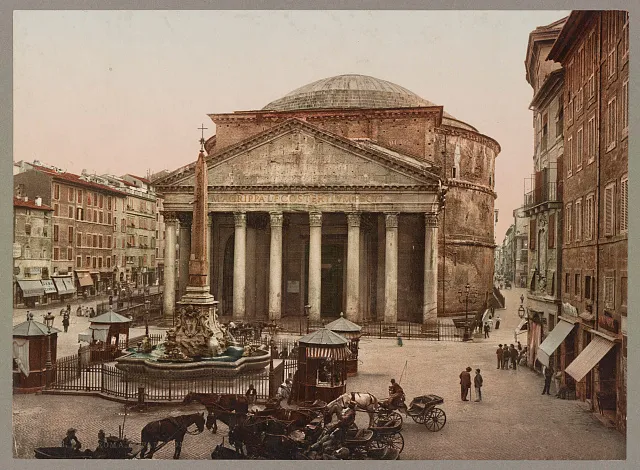
Roma. Il Panteon Source: Library of Congress - Photoglob Co.
The civilization of Ancient Rome has had an enduring impact on modern society. Rome, founded in 753 BCE along the banks of the Tiber River in present-day Italy, grew from a small city-state into a vast empire that covered much of Europe, North Africa, and parts of Asia. The legacy of Rome is visible in many aspects of daily life today, from laws and government structures to architecture and language.
One of Rome’s greatest contributions is its system of law. The Roman Republic developed the concept of a written code, called the Twelve Tables, around 450 BCE. These laws were publicly displayed so all citizens could know their rights and duties. The Roman legal system introduced key ideas, such as the principle that people are innocent until proven guilty and the right to a fair trial. Many modern legal systems, including those in the United States and Europe, are based on these Roman principles.
Roman government also influenced modern democracies. The Roman Republic used a system of representative government, where citizens elected leaders called senators to make decisions for them. This idea can be seen today in parliaments and congresses around the world. Furthermore, Romans created a complex network of cities connected by roads and aqueducts, demonstrating advanced engineering and infrastructure. The famous Roman roads, some of which still exist, allowed for trade, communication, and the swift movement of armies.
In architecture, the Romans borrowed ideas from the Greeks and improved them. They developed the arch, the dome, and concrete, allowing them to build large structures like the Colosseum and the Pantheon. The Colosseum, completed in 80 CE, could seat over 50,000 people and was used for public events, showing the importance of entertainment and civic life. Roman baths, forums, and amphitheaters became models for public spaces in later cities.
Another major legacy is the Latin language. Latin was the language of government, literature, and daily life in Rome. While Latin is no longer spoken as a native language, it is the basis for the Romance languages, including Spanish, French, and Italian. Many English words, especially in law, science, and government, come from Latin roots. Roman beliefs, such as respect for citizenship and civic duty, also continue to influence societies today.
The legacy of Rome endures through its contributions to law, government, architecture, and language. By studying Ancient Rome, we can better understand how past innovations and beliefs continue to shape our world.
The story of Rome connects to broader themes of cultural exchange, technological advancement, and the development of modern societies that students will explore throughout this course.
Interesting Fact: Roman concrete was so durable that some ancient harbors built by the Romans are still standing after more than 2,000 years.
What year was Rome founded?
753 BCE450 BCE80 CE100 CE
What was the Twelve Tables?
Roman written lawsA type of archA government leaderA Roman language
Which building could hold over 50,000 people?
PantheonColosseumSenate HouseForum
Why did Romans build roads?
For trade and armiesFor entertainmentFor farmingFor language
How did Roman law influence today?
It started modern legal systemsIt ended democracyIt built aqueductsIt created Latin
What is one Roman belief still important today?
Respect for citizenshipNo written lawsOnly spoken languageNo engineering
Rome invented the dome. True or false?
TrueFalse
What does 'infrastructure' mean?
Basic systems like roadsRoman lawsLeaders of RomeA type of language
Perfect For:
👩🏫 Teachers
• Reading comprehension practice
• Auto-graded assessments
• Literacy skill development
👨👩👧👦 Parents
• Reading practice at home
• Comprehension improvement
• Educational reading time
🏠 Homeschoolers
• Reading curriculum support
• Independent reading practice
• Progress monitoring
Reading Features:
📖
Reading Passage
Engaging fiction or nonfiction text
❓
Comprehension Quiz
Auto-graded questions
📊
Instant Feedback
Immediate results and scoring
📄
Printable Version
Download for offline reading
🔊
Read Aloud
Voice-over with word highlighting
Reviews & Ratings
No reviews yet. Be the first to share your experience!
Related Content
Ancient Law Codes: Hammurabi to Rome
This passage explores how ancient civilizations like Babylon and Rome used law codes to govern people, maintain social o...
Geography and Early Rome
This passage, aligned to HSS 6.7 and CCSS RH.6-8.2, explores the rise of Ancient Rome with a focus on its geographical s...
Evidence in Ancient History
This engaging history reading passage investigates how archaeologists and historians discover clues about how ancient pe...
Livy: Historian of Early Rome
This passage introduces students to Livy, one of Ancient Rome's most significant historians, whose writings help us unde...
Germanic Invasions of Rome
This engaging history reading passage explores the causes and effects of the Germanic tribes’ invasions of the Western R...
Slavery in Ancient Rome and in the Americas
This educational passage examines the history of slavery in two distinct regions and eras: Ancient Rome and Colonial Ame...
Ancient Theocracy
This engaging history reading passage explores the concept of theocracy in ancient civilizations, where priests and reli...
Slavery in Ancient World
This passage explores the complex history of slavery in the ancient world, examining its presence in societies such as M...
Life in the Roman Empire
This rigorous history reading passage explores Life in the Roman Empire, guiding students through the social hierarchy, ...
Ancient Canaan
This educational passage explores the land of Canaan, the historical homeland of the ancient Israelites. Students will l...
Ancient Literature
This passage explores the importance of ancient stories and poems from civilizations such as Greece, India, and Israel. ...
Geography of Ancient Israel
This passage explores the rich geography of Ancient Israel, focusing on how landforms, climate, and natural resources sh...
The Etruscans
This engaging history reading passage explores the vital role of the Etruscans in shaping Ancient Rome. Students will di...
Ancient Writing Systems
This engaging history reading passage explores the origins and evolution of ancient writing systems, including cuneiform...
Ancient Agriculture Farming
This passage explores the transformative impact of farming on ancient societies, examining how the Neolithic Revolution ...
Cincinnatus
This rigorous history reading passage explores the story of Cincinnatus, a Roman farmer who became a dictator in a time ...
Ancient Mathematics
This passage explores the essential role of mathematics in ancient civilizations, including Mesopotamia, Egypt, Greece, ...
Trade Across Ancient India
This history reading passage explores Ancient India's trade networks and their impact on global connections. Students wi...
The Roman Republic
This passage explores the structure and significance of government and law in the Roman Republic, focusing on how Roman ...