Ancient Law Codes: Hammurabi to Rome — Reading Comprehension
Rate this
Premium Resource
Present
Present in classroom. No work saved
Assign
Classroom with student accounts, Track progress
Quick Play
No student accounts, assign with a link
Grades
5
6
7
8
PRINT+DIGITAL RESOURCE
This learning resource is available in interactive and printable formats. The interactive worksheet can be played online and assigned to students. The Printable PDF version can be downloaded and printed for completion by hand.
This passage explores how ancient civilizations like Babylon and Rome used law codes to govern people, maintain social order, and solve problems. Students will learn about Hammurabi's Code, created in Mesopotamia around 1754 BCE, and the Roman Twelve Tables, established around 450 BCE. The text compares these systems, examines their influence on daily life, and highlights the importance of written laws in shaping societies. Students will use primary sources, analyze cause and effect, and connect the development of laws to geography and social structure. Activities include a reading quiz, writing exercises, graphic organizers, and a timeline. This passage is aligned with CA HSS 6.1.2, 6.1.3 and CCSS RH.6-8.1-4 and includes read aloud audio and a Spanish translation.
CONTENT PREVIEW
Expand content preview
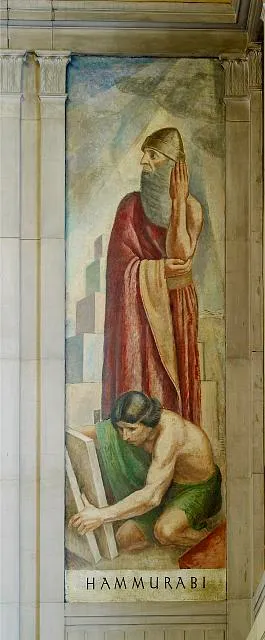
Oil painting "Hammurabi," stairway of Great Hall, Department of Justice, Washington, D.C. Source: Library of Congress - Highsmith, Carol M., 1946-
Throughout ancient history, civilizations developed law codes to organize society and establish order. Two of the most important ancient law codes were the Code of Hammurabi in Mesopotamia and the Twelve Tables in Rome. These systems shaped the way people lived, solved disputes, and set expectations for justice.
The Code of Hammurabi, created around 1754 BCE in Babylon (in modern-day Iraq), is one of the earliest known sets of written laws. King Hammurabi ordered these laws to be carved into a tall stone pillar, or stele, so everyone could see the rules. The code contained 282 laws, covering topics like trade, marriage, theft, and punishment. For example, one law stated, “If a builder constructs a house and it collapses, causing death, the builder shall be put to death.” This shows the seriousness of personal responsibility in Babylonian society. The code was based on the idea of “an eye for an eye,” meaning punishments were meant to fit the crime. However, these punishments were not equal for everyone. Social hierarchy played a big role; nobles, commoners, and slaves received different penalties for the same offense.
The Twelve Tables were created in Rome around 450 BCE after demands from Roman citizens for more transparent laws. Before the Twelve Tables, Roman law was mostly unwritten and controlled by the patrician class. The new written laws were displayed in the Roman Forum, so both nobles and plebeians (common citizens) could see them. The Twelve Tables covered property, crime, family, and civil rights. For instance, one table stated that anyone who broke another person’s bone must pay a fine, rather than face a brutal punishment. This shows a shift toward penalties based on compensation. The creation of the Twelve Tables was a key step toward citizenship rights and greater fairness in Roman society.
Comparing these two systems shows both change and continuity in history. Both Hammurabi’s Code and the Twelve Tables made laws public and tried to organize society, but their approaches differed. Hammurabi’s laws were strict and unequal, reflecting a rigid social hierarchy, while the Romans’ system slowly became more flexible and focused on property and civil rights. Geography influenced each system: the rivers and cities of Mesopotamia required strict rules for trade, while Rome’s expanding city-state structure led to more complex laws.
Law codes like Hammurabi’s and the Twelve Tables had a significant impact on daily life, government, and future legal systems. They provided examples for later societies, including modern legal traditions. By making laws visible and official, these ancient civilizations helped shape ideas about justice, order, and citizenship that still influence us today.
These developments connect to the broader study of how societies create systems to solve problems and promote fairness for their people.
Interesting Fact: The Code of Hammurabi was so important that copies of it were found far from Babylon, showing how its influence spread across the ancient world.
Who created the Code of Hammurabi?
King HammurabiJulius CaesarAlexander the GreatKing Tutankhamun
Where was the Code of Hammurabi made?
BabylonRomeAthensCarthage
What was the main purpose of law codes?
Organize societyGrow cropsBuild pyramidsCreate money
Why did Romans create the Twelve Tables?
Citizens wanted fair lawsTo worship godsFor war trainingTo collect taxes
How were punishments decided in Hammurabi's Code?
Matched the crimeAlways paid moneyNo punishmentBased on voting