This learning resource is available in interactive and printable formats. The interactive worksheet can be played online and assigned to students. The Printable PDF version can be downloaded and printed for completion by hand.
This passage explores the complex history of slavery in the ancient world, examining its presence in societies such as Mesopotamia, Egypt, Greece, and Rome. Students will learn about the origins, roles, and treatment of enslaved people, and how slavery shaped social hierarchies and daily life. The passage includes references to primary sources and archaeological evidence, highlighting the impact and continuity of slavery across time and cultures. Aligned to CA HSS 6.2.4 and CCSS RH.6-8.1, RH.6-8.2, this resource provides a rigorous reading passage, glossary, comprehension quiz, writing prompts, graphic organizers, and both English and Spanish versions with read aloud audio. This lesson supports critical historical thinking about human rights, social systems, and the development of ancient civilizations.
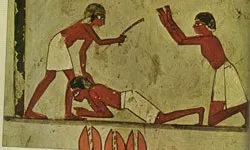
CONTENT PREVIEW
Expand content preview
Slavebeating / Wikimedia Commons
Slavery was a major part of many ancient civilizations, including Mesopotamia, Egypt, Greece, and Rome. In these societies, enslaved people formed the lowest level of the social hierarchy. Their lives and treatment depended on the customs, laws, and economic needs of their time and place.
In ancient Mesopotamia, records from as early as 3000 BCE show that people were enslaved for many reasons. Some became slaves because of debt, while others were captured during wars. The Code of Hammurabi, written around 1750 BCE, includes rules about how slaves could be treated and even allowed some to eventually buy their freedom. Archaeological evidence, such as clay tablets, shows that slaves worked in households, on farms, and in temples. Slavery provided labor for agriculture and construction, helping Mesopotamian city-states grow and prosper.
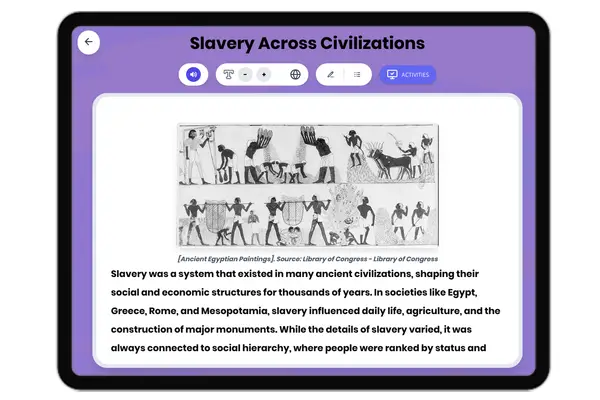
Ancient Egypt also relied on enslaved people for building projects, farming, and even serving in wealthy households. Wall paintings from tombs near Thebes show large groups of enslaved workers hauling stones and constructing monuments like the pyramids. Most slaves in Egypt were prisoners of war or people forced into slavery because of poverty. Egyptian laws sometimes protected slaves from harsh treatment, but their lives were still controlled by their owners. The economic importance of slavery in Egypt was clear in the way it supported the power of pharaohs and enabled massive construction projects.
In Greece and Rome, slavery became even more central to society. In Athens, as many as one-third of the population was enslaved. Slaves performed many jobs, from working in silver mines to tutoring wealthy children. Ancient Greek philosopher Aristotle argued that some people were “natural slaves,” a belief that justified keeping people in bondage. In Rome, slavery expanded as the empire conquered new lands. Roman slaves came from many places, including Gaul, North Africa, and the Middle East. Some were forced to fight as gladiators, while others worked on large farms called latifundia. Occasionally, enslaved people rebelled, as in the famous revolt led by Spartacus in 73 BCE, which showed both the cruelty and danger of a society dependent on slavery.
The practice of slavery in the ancient world shaped economies, cultures, and ideas about power and freedom. While some enslaved people could earn their freedom, most lived hard lives with little control over their future. Over time, the systems of slavery changed, but the presence of enslaved people remained a constant part of ancient societies.
Understanding slavery in the ancient world helps historians study social structures, human rights, and the ways geography and conflict shaped civilizations.
Interesting Fact: In ancient Athens, some skilled slaves could save money and eventually buy their freedom, but this was rare and often depended on the goodwill of their owners.
What was the lowest class in ancient societies?
Enslaved peopleFarmersPharaohsMerchants
Where were early slavery laws recorded?
Code of HammurabiGreek playsRoman lettersPyramid walls
Who led a famous slave revolt in Rome?
SpartacusAristotleHammurabiThebes
Why did ancient Egypt use slaves?
To build monumentsTo write lawsTo lead armiesTo be pharaohs
What was a latifundia?
Roman farm estateGreek city-stateEgyptian monumentMesopotamian temple
How did slavery shape ancient societies?
Economies and cultureReligion onlyDid not matterOnly helped pharaohs
Some slaves could buy freedom. True or False?
TrueFalse
What does 'bondage' mean?
Being controlled by anotherOwning landMaking lawsBuilding monuments
Perfect For:
👩🏫 Teachers
• Reading comprehension practice
• Auto-graded assessments
• Literacy skill development
👨👩👧👦 Parents
• Reading practice at home
• Comprehension improvement
• Educational reading time
🏠 Homeschoolers
• Reading curriculum support
• Independent reading practice
• Progress monitoring
Reading Features:
📖
Reading Passage
Engaging fiction or nonfiction text
❓
Comprehension Quiz
Auto-graded questions
📊
Instant Feedback
Immediate results and scoring
📄
Printable Version
Download for offline reading
🔊
Read Aloud
Voice-over with word highlighting
Reviews & Ratings
No reviews yet. Be the first to share your experience!
Related Content
Ancient Civilizations and the Environment
This engaging history reading passage explores how ancient civilizations such as Mesopotamia, Egypt, and the Maya adapte...
Gender Roles in Ancient Civilizations
This engaging history reading passage explores the roles of men and women in various ancient civilizations, including Me...
Writing Prompts Ancient Civilizations
Step into the shoes of an archaeologist with this engaging worksheet focused on ancient civilizations. Students will be ...
W.5.2.A-2W.5.1.CW.5.1.D
Power and Authority in Ancient Civilizations
This passage explores the roles of men in positions of power within ancient civilizations, focusing on their authority i...
Ancient Monarchy
This reading passage explores the concept of monarchy in ancient civilizations, focusing on the origins, structure, and ...
Evidence in Ancient History
This engaging history reading passage investigates how archaeologists and historians discover clues about how ancient pe...
Ancient Theocracy
This engaging history reading passage explores the concept of theocracy in ancient civilizations, where priests and reli...
Ancient Mathematics
This passage explores the essential role of mathematics in ancient civilizations, including Mesopotamia, Egypt, Greece, ...
Ancient Canaan
This educational passage explores the land of Canaan, the historical homeland of the ancient Israelites. Students will l...
Ancient Money Barter
This passage explores the fascinating evolution from barter to the earliest coins in ancient civilizations, focusing on ...
Ancient Science and Medicine
This comprehensive reading passage explores the development of science and medicine in ancient civilizations, including ...
Ancient Literature
This passage explores the importance of ancient stories and poems from civilizations such as Greece, India, and Israel. ...
Ancient Agriculture Farming
This passage explores the transformative impact of farming on ancient societies, examining how the Neolithic Revolution ...
Ancient Writing Systems
This engaging history reading passage explores the origins and evolution of ancient writing systems, including cuneiform...
Geography of Ancient Israel
This passage explores the rich geography of Ancient Israel, focusing on how landforms, climate, and natural resources sh...
Slavery Across Civilizations
This detailed history reading passage explores the role and impact of slavery across several ancient civilizations, incl...
Social Classes in Ancient Societies
This passage explores the concept of social hierarchies in ancient civilizations, focusing on why societies such as Meso...
Social structures in Ancient World
This passage explores the organization and significance of family life in ancient societies, focusing on how extended fa...
Polytheism and Monotheism in Ancient Times
This passage explores the religious beliefs of ancient civilizations, focusing on the differences and similarities betwe...
Women in Ancient Societies
This reading passage explores the complex roles of women in the ancient world, focusing on civilizations such as Mesopot...